

Leadership Communication in the Attention Economy: Command the Room in 3 Seconds
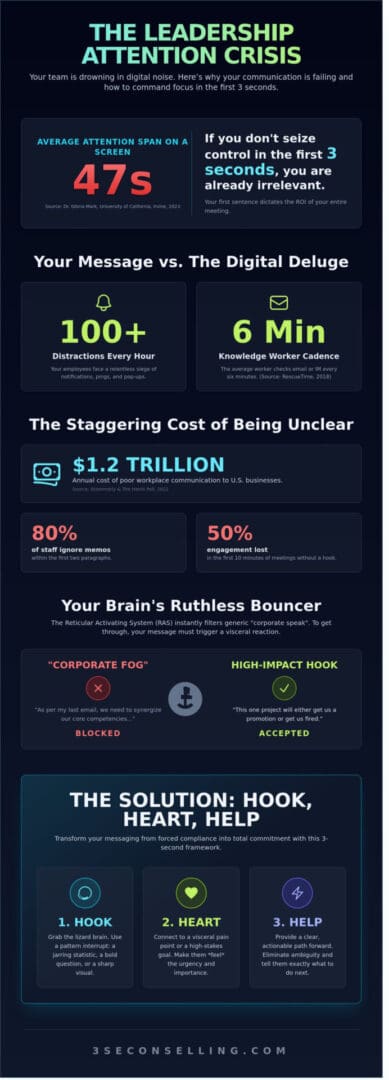
Your team isn’t listening to you. A 2023 study by Dr. Gloria Mark at the University of California, Irvine, reveals that the average attention span on a digital screen has plummeted to a mere 47 seconds. If you don’t seize control in the first 3 seconds, you’re already irrelevant. You’ve felt that agonizing silence on Zoom. You’ve seen the glazed eyes while you’re explaining the new strategy. This isn’t just a minor communication gap. It’s a total failure of your leadership communication that’s actively eroding your authority and slowing down your growth.
You’re tired of being treated like background noise. You know your initiatives deserve better than a “read” receipt and zero action from your staff. You want a team that’s aligned, focused, and ready to execute. I’m going to show you how to hijack their attention and transform your messaging into a high-conversion engine. This guide breaks down the psychological triggers you need to command every room and ensure your internal projects actually cross the finish line without the usual friction.
Key Takeaways
- Stop drowning your team in digital noise and learn why “relentless communication” is actually the fastest path to team burnout.
- Command any room instantly by mastering the 3-second window through the “Hook, Heart, and Help” messaging framework.
- Transform your leadership communication from forced compliance into total commitment by replacing dry facts with high-impact “victory narratives.”
- Execute “No-Snooze” meetings and write emails that demand immediate action and get read in under three seconds.
- Upgrade your influence with a visceral approach to messaging that succeeds where standard, sterile leadership training fails.
The Attention Deficit: Why Traditional Leadership Communication is Failing
Your team isn’t ignoring you because they’re lazy. They’re ignoring you because you’re boring. In the current attention economy, your employees face a relentless siege of 100+ distractions every single hour. Data from RescueTime in 2018 confirms the average knowledge worker checks email or instant messaging tools every 6 minutes. When you broadcast generic updates into this chaos, you aren’t leading; you’re just adding to the noise.
Most executives fall into the trap of relentless communication. They believe volume equals clarity. It doesn’t. Constant pings and “just checking in” emails trigger message fatigue and employee burnout. When every message is marked urgent, nothing is urgent. This flood of data forces the brain to shut down. To succeed, you must stop viewing leadership communication as a speech or a top-down broadcast. It’s a conversion event. You are selling a vision, a deadline, or a shift in strategy. If your team doesn’t “buy” within the first few seconds, your message is dead on arrival.
The financial impact of these failures is staggering. A 2022 study conducted by Grammarly and The Harris Poll found that poor workplace communication costs U.S. businesses up to $1.2 trillion annually. This isn’t just a soft skill issue. It’s a direct hit to your bottom line. Lost revenue, missed project goals, and plummeting morale are the price you pay for being unclear. You cannot afford to be misunderstood.
The Biological Reality of Distraction
The human brain is a ruthless filter. The Reticular Activating System (RAS) acts as a cognitive bouncer, instantly blocking “corporate speak” as background noise. If your opening sentence sounds like a generic template, the amygdala decides it’s not a priority for survival or success. You have exactly three seconds to hook their focus. If you don’t trigger a visceral reaction immediately, their minds will drift to lunch or unread Slack notifications. Your first sentence dictates the ROI of your entire meeting.
The High Cost of “Corporate Fog”
Vague messaging creates “decision paralysis” in your direct reports. When instructions are fuzzy, people hesitate. They second-guess. They wait for clarification that never comes. SIS International Research found that companies with 100 employees lose an average of 528 hours per year just clarifying poorly communicated instructions. This “corporate fog” erodes your executive presence. True authority comes from punchy, high-impact effective leadership communication that leaves no room for interpretation. Clear leaders move fast. Foggy leaders go broke.
- Traditional memos are ignored by 80% of staff within the first two paragraphs.
- Meetings without a “hook” lose 50% of participant engagement in the first 10 minutes.
- Clarity is a competitive advantage that directly scales with your profit margins.
Stop talking and start converting. If your leadership communication doesn’t demand immediate attention, it’s a waste of company resources. You aren’t there to be heard. You’re there to drive action. Every word must serve the objective. Every second must earn its place in your team’s crowded mental space. The era of the long-winded executive is over. The era of the high-conversion leader has begun.
The 3-Second Rule: Commanding the Room from the First Breath
You have three seconds. That is 180 ticks of the clock to prove you are worth the oxygen you are consuming. In a world where attention spans have collapsed to less than eight seconds, your first breath is your only weapon. If you fail to command the room instantly, you are already invisible. Most managers spend their first 30 seconds on throat-clearing garbage. They ask if the mic works. They thank people for coming. They apologize for the technical issues. This is a death sentence for your authority. Every second spent on pleasantries is a second your audience spends checking their email.
Effective leadership communication demands a “Hook, Heart, and Help” framework. You start with a Hook that grabs the lizard brain. You follow with the Heart to connect the message to a visceral pain or a high-stakes goal. You finish with the Help by providing a clear, actionable path forward. This isn’t just a speaking tip; it is a survival strategy for the digital age. You must use pattern interrupts to stop the mental scroll. A sudden shift in volume, a sharp visual, or a jarring statistic can reset the room’s focus. If you don’t dominate the first three seconds, you won’t own the next thirty minutes.
Mastering this level of tactical execution requires more than just a loud voice. It requires a structured approach to every interaction. High-stakes communicating with leadership involves a precise sequence that prioritizes impact over ego. You are not there to be liked; you are there to be heard and followed. If you want to transform your presence into a tool for market dominance, you need to audit your opening pitch for maximum impact.
Crafting the Perfect Hook
Kill the “Can everyone hear me?” opening immediately. It signals weakness. Replace it with a data-driven provocation. Tell them that 22% of your leads are rotting in the CRM or that the competition just cut their delivery time by half. Use the power of the unanswered question to create a mental loop. When you pose a problem that affects their bottom line and wait three beats before answering, you force their brains to engage. You aren’t just talking; you are seizing their attention monopoly.
The News Anchor Secret: Vocal Authority
Communication expert David Gee teaches broadcast pacing to ensure every syllable carries weight. This isn’t about talking fast. It is about deliberate speed. Most leaders rush because they are afraid of losing the floor. The opposite is true. The “Power of the Pause” is your greatest asset. A strategic three-second silence after a bold claim forces the audience to process the gravity of your words. It signals that you are in total control of the environment. Match this with open, dominant body language. If your words say “growth” but your shoulders say “defeat,” the room will believe your posture every time. Control your breath; control the room.
Internal StorySelling™: Moving Teams from Compliance to Commitment
Stop boring your employees to death with data dumps. If you want your team to move, you have to stop lecturing and start selling. Your spreadsheet is not a strategy; it’s a sleep aid. Research from Stanford University proves that while people remember only 5% of statistics, a staggering 63% remember stories. This is not “fluff” or “soft skills.” It’s biology. A 2010 study by Uri Hasson at Princeton University revealed a phenomenon called neural coupling. When you tell a story, the listener’s brain activity mirrors your own. You are literally hard-wiring your vision into their minds. High-impact leadership communication requires you to ditch the dry case studies and build “victory narratives” where your team is the protagonist.
Most managers position themselves as the hero. That’s a fatal mistake. In the StorySelling™ framework, you are the mentor; your project managers and frontline staff are the heroes. They are the ones facing the “villain” of market volatility or technical debt. When you frame a project as a Hero’s Journey, you transform a mundane task into a mission. Compliance means they do it because you said so. Commitment means they do it because they believe they are part of something legendary. If you don’t give them a story, they’ll invent their own, and usually, it’s a story about why your new initiative will fail.
The Architecture of a Leadership Story
Every effective narrative needs a villain and a treasure. The villain is the specific problem, like the 22% drop in customer retention recorded last June. The treasure is the goal, such as hitting a 95% satisfaction rate by December. You must keep these stories under 60 seconds. Attention is the most expensive currency in your building; don’t waste it. Use your leadership communication to bridge the gap between a developer’s daily coding and the company’s mission to disrupt the industry. If they don’t see the link, they won’t give you their best work.
- Identify the Villain: Be specific. Is it “inefficiency” or is it “the 40 hours a week we waste on manual data entry”?
- Define the Treasure: What does winning look like for them, not just the board of directors?
- The 60-Second Rule: If you can’t explain the “why” before the elevator hits the lobby, your story is too bloated.
Winning the “Internal Sale”
Treat your next internal initiative like a high-stakes product launch. You are selling a change in behavior, and your employees are the buyers. Why should they “buy” your new workflow? You must identify their Buying Motives. Some employees crave the safety of a proven system, while others want the status of being an early adopter. Use social proof within your organization to build momentum. According to the Law of Diffusion of Innovation, once you win over the first 15% of your team, the rest of the organization will follow to avoid being left behind.
Don’t ask for permission to lead; create a movement. Use the “if-then” logic to show the consequences of inaction. If we stay on this legacy platform, then we lose 10% of our market share to the competition by Q4. If we migrate now, then we dominate. Use short, punchy directives. Make the choice inevitable. Results don’t come from polite suggestions. They come from stories that demand action and a leader who refuses to be ignored.
Tactical Execution: Communication Across Every Platform
Stop pretending your team is hanging on your every word. They aren’t. In a world where the average human attention span has plummeted to eight seconds, your leadership communication is either a sharp blade or a blunt instrument. You have exactly three seconds to hijack their focus before they drift back to their notifications. If you can’t dominate the room or the inbox instantly, you’ve already lost the war for productivity. High-stakes leadership requires a tactical shift from “sharing information” to “commanding action.”
The 10-Minute Meeting Manifesto
The 60-minute meeting is a corporate relic that kills momentum. Microsoft’s 2023 Work Trend Index reveals a 252% increase in weekly time spent in meetings since 2020; most of it is wasted. Stop the bleeding. Cut your meetings to 10 minutes. Use the “Bottom Line Up Front” (BLUF) method. Don’t build up to the point; start with the conclusion. If you can’t state the desired outcome in the first 60 seconds, cancel the call. Assign “Attention Roles” to keep the energy high. One person acts as the “Timekeeper” to cut off ramblers; another serves as the “Devil’s Advocate” to challenge every assumption. This creates a high-pressure environment where only results survive.
Digital Messaging for Leaders
The Radicati Group reports that the average professional receives 121 emails every day. To get read, your subject line must be a trigger. Forget “Weekly Update” or “Checking In.” Use “ACTION REQUIRED: [Project] – Deadline 4 PM.” It’s aggressive, clear, and impossible to ignore. Follow the “One Screen Rule.” If your message requires the recipient to scroll on their mobile device, it’s too long. Short sentences. Punchy directives. Use Slack and Teams for speed, but don’t become part of the 43% of employees who feel overwhelmed by digital pings. If a thread goes past three replies, pick up the phone. Real leadership communication happens when you stop the “typing” bubbles and start making decisions.
Master the art of virtual dominance. Your executive presence on video isn’t about your suit; it’s about your setup. 67% of employees judge a leader’s authority based on their video quality and lighting within five seconds. Look at the camera lens, not the faces on the screen. This creates a visceral, “eye-to-eye” connection that commands respect. Fix your audio. If you sound like you’re speaking from a basement, your message will carry the same weight. Invest in a dedicated microphone and a key light. You’re broadcasting a brand, not just hosting a chat.
When the stakes are high, use the “Level Up Your Listening” technique. Most leaders talk to fill the void. Don’t. In negotiations, apply the “4-Second Pause” after the other party finishes their sentence. Silence is a psychological weapon. It forces the other person to fill the gap, often revealing their true position or offering a concession they hadn’t planned. Listen 70% of the time. Speak 30% of the time. When you finally do speak, make it a command, not a suggestion. This is how you maintain the “Attention Monopoly” in any environment.
Ready to turn your words into a high-conversion engine? Apply these 3-second rules to your next campaign and watch your influence explode.
Level Up Your Leadership with David Gee and 3 Second Selling™
Traditional leadership training is dead. It is a slow, polite relic of an era that no longer exists. Most programs focus on “active listening” or “empathy circles” while your market share evaporates in real-time. In the 2024 Attention Economy, you don’t have the luxury of a slow build-up. You have exactly three seconds to command authority. If your leadership communication doesn’t grab the audience by the throat in that window, you have already lost the room. David Gee doesn’t teach you how to manage; he teaches you how to dominate the mental space of your team and your clients.
Standard corporate workshops fail because they ignore the visceral reality of human biology. Your team is distracted. Their phones are buzzing. Their attention spans have shrunk to 8.25 seconds, according to data from the Spruce Health Group. You are competing with TikTok, urgent emails, and internal anxiety. 3 Second Selling™ isn’t a theory. It is a survival mechanism for the modern executive. We replace polite, ignored speeches with high-impact “Pattern Interrupts” that force immediate engagement. David Gee brings the intensity of a live newsroom to the boardroom, ensuring your message isn’t just heard, it’s obeyed.
- StorySelling™ Workshops: We stop the “death by PowerPoint” culture. Your team will rebuild their messaging in real-time, moving from boring data-dumps to narrative-driven persuasion that triggers a gut-level response.
- Executive Coaching: Master your presence with a former TV news anchor. David Gee uses his decades of broadcast experience to strip away your “umms,” “ahhs,” and weak posture. You will learn to project the “alpha-mentor” persona that commands respect before you even finish your first sentence.
The Keynote Experience
A keynote with David Gee is a high-stakes demonstration of power. You will see exactly how a former news anchor controls the narrative under extreme pressure. We customize every session to your industry’s specific blood-points. Whether you’re in fintech or heavy manufacturing, the rules of attention remain the same. We are currently accepting booking logistics for 2026 events. Don’t wait until your competitors have already captured the market’s focus. Secure your slot before the calendar closes and the opportunity vanishes.
Measuring the ROI of Communication
Stop treating leadership communication as a “soft skill.” It is a hard financial lever. Clearer internal instructions reduce project rework by 25%, saving hundreds of man-hours every quarter. “Attention-Based Selling” techniques applied to external pitches have shown a 14% increase in conversion rates for B2B firms. When your leaders speak with surgical precision, decisions happen faster. Speed is profit. If you’re ready to stop the bleeding and start leading with absolute authority, schedule a strategy audit for your leadership team today. Every second you delay is a second your audience spends looking at someone else.
Own the Room or Get Out of the Way
Your team’s focus isn’t a gift. It’s a prize you must seize. Traditional leadership communication fails because it ignores the 3-second biological trigger. David Gee, a former network TV news anchor, developed a framework rooted in behavioral science to solve this. You don’t have minutes to warm up. You have three seconds to prove you’re worth the mental energy. If you miss that window, you’re just background noise. National sales teams use these conversion-driven tactics to move beyond mere compliance. They demand commitment.
Stop hoping your message lands. Start engineering the visceral reaction that drives growth. Every second you waste is a lead lost to the attention deficit. It’s time to stop talking and start commanding. Your next presentation shouldn’t just be heard; it should be felt. You have the tools to own the room from the first breath. The market doesn’t wait for the slow. Neither should you.
Ready to transform your organization’s impact? Bring the 3 Second Selling™ Keynote to your next event and watch your results skyrocket. Success belongs to those who act now.
Frequently Asked Questions
What is the most important skill in leadership communication?
The most critical skill is the ability to grab and hold attention in under 3 seconds. Research from Microsoft shows the human attention span dropped to 8 seconds in 2015; if you don’t hook your audience immediately, you’ve already lost. Forget long preambles. Start with a result, a provocation, or a high-stakes question. It’s about dominance over the noise, not just delivering information.
How can I improve my executive presence in virtual meetings?
You improve virtual presence by looking directly at the camera lens, not the faces on your screen. A 2021 study by Quantified Communications found that eye contact 60% to 70% of the time creates a sense of connection and authority. Position your camera at eye level and use a dedicated light source. If you look like a hostage in a dark basement, your team won’t respect your lead.
What is the 3-second rule in communication?
The 3-second rule states you have exactly 3 seconds to prove your value before someone tunes out. This isn’t a theory; it’s a survival mechanism in a world where users see 5,000 ads daily. Your first sentence must promise a specific benefit or highlight a critical pain point. Fail this, and your leadership communication becomes invisible noise. Speed is your only leverage in a distracted market.
How do I handle a distracted or disengaged team?
Stop talking at them and start forcing them to act immediately. Gallup reports that 70% of team engagement depends on the manager’s style. Cut your meeting times by 50% and double the stakes for participation. Use rhetorical questions that demand an instant response. If they’re distracted, it’s because your message is boring. Make it hurt for them to look away from the mission.
Why is storytelling important for leaders and managers?
Storytelling is vital because people remember stories 22 times more than facts alone, according to Stanford professor Jennifer Aaker. Leaders use stories to bypass logical resistance and trigger visceral reactions in their teams. Don’t just show a spreadsheet; tell the story of the 15% revenue drop that almost killed the project. Data informs, but stories drive the execution machine.
How much does a leadership communication workshop cost?
High-end leadership communication workshops typically range from $2,500 for individual intensives to $15,000 for corporate team sessions. You aren’t paying for training; you’re paying for the ROI of a team that actually executes under pressure. Cheap workshops are a waste of time and capital. If a program doesn’t promise a 10x return on your time, keep your money and stay home.
What is the difference between leadership and management communication?
Leadership style focuses on the “why” and “where,” while management communication handles the “how” and “when.” Management is about 100% task completion and efficiency. Leadership is about 100% buy-in and emotional alignment. Leaders use provocative vision to move people; managers use systems to track them. Both are necessary, but only one creates a monopoly on the team’s attention.
How can I become a better listener as an executive?
You become a better listener by shutting up and using a 2-second pause after someone finishes speaking. 80% of executives interrupt their subordinates within 11 seconds. Don’t be that guy. Ask “What else?” or “Why does that matter?” then wait for the answer. Listening isn’t being passive; it’s an aggressive search for the truth. It’s the only way to get the data you need to win.