

Media Training is Dead: How to Hijack the Narrative in 3 Seconds
Traditional media training is a suicide mission for your brand. If you’re still using “bridge and pivot” scripts from 2015, you’re walking into a slaughterhouse. You’ve felt that cold sweat. You sound like a robotic press release while a journalist shreds your reputation. It’s a waste of time and a massive risk to your bottom line. You aren’t there to answer questions; you’re there to win. The 2023 Reuters Digital News Report confirms that audiences decide to engage or scroll past in mere seconds. You don’t have time for a slow build.
You know the frustration of being misquoted or ignored. It’s time to stop surviving and start dominating. This article delivers the high-stakes communication framework built for the 2026 attention economy. You’ll learn how to hijack any narrative in under three seconds, turning high-pressure questioning into a revenue-generating soundbite. We’re breaking down the exact tactics used to command an attention monopoly and ensure your message is the only one the audience remembers. Forget the old rules. It’s time to seize control.
Key Takeaways
- Ditch the corporate “safe speak” that makes you invisible and learn to lead the conversation using biological triggers that command instant authority.
- Stop merely surviving interviews and start using high-stakes media training to turn every reporter’s question into a direct line to your buyer’s brain.
- Audit your current messaging for “attention leaks” to ensure you never lose your audience before you have even finished your opening sentence.
- Harness the 3-Second Rule to hijack the narrative and trigger a visceral response that stops the scroll in a distracted attention economy.
Why Traditional Media Training is a Liability in 2026
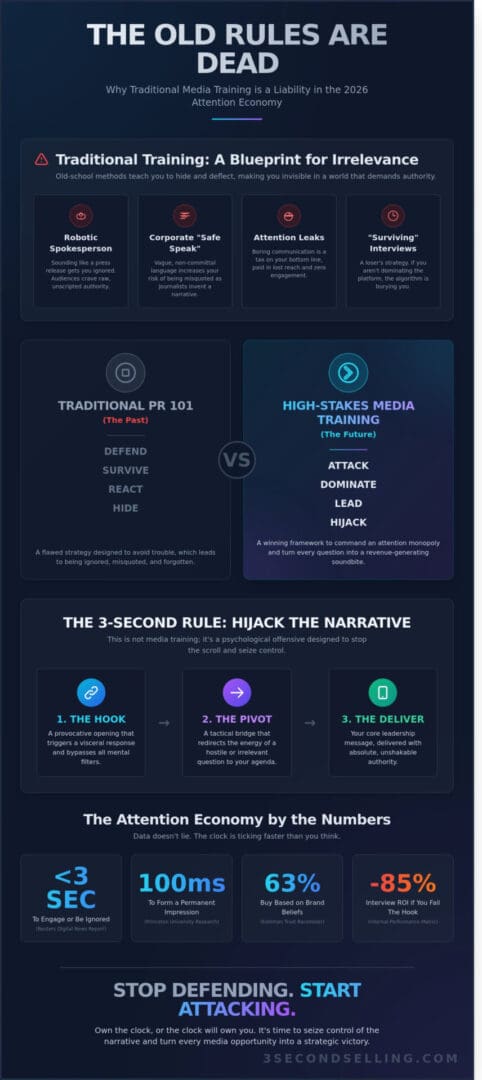
Traditional media training is a suicide mission. It’s a relic from an era when you could control the press with a polished press release and a stiff suit. In 2026, that strategy is a fast track to irrelevance. Old-school trainers teach you how to hide; they teach you how to deflect and how to blend into the corporate wallpaper. They tell you to be “safe.” They’re wrong. Safe is the fastest way to get ignored by an audience with a 3-second attention span. If you aren’t leading the conversation, you’re being buried by it.
Modern communication rewards tactical provocation. It rewards the leader who isn’t afraid to break the script. If you don’t own the first three seconds of the interaction, the algorithm will bury your message before you even finish your first sentence. You don’t need a shield; you need a spear. You need to stop worrying about “getting through” the interview and start focusing on how to dominate the platform.
The Death of the Corporate Spokesperson
The “no comment” era is officially dead. In 2026, silence isn’t neutrality; it’s a confession of incompetence. Audiences no longer respect the polished, robotic spokesperson. Data from the 2024 Edelman Trust Barometer shows that 63% of consumers buy or advocate for brands based on their beliefs and values. They crave raw, unscripted authority. They want to see the person, not the mask. Traditional communication skills training often strips away this humanity, replacing it with “safe speak.” This is a trap. When you use vague, non-committal language, you actually increase your risk of being misquoted. Journalists and creators will hunt for a “hook” you didn’t provide, often inventing a narrative to fill your silence.
The Attention Economy Tax
Boring communication is a tax on your bottom line. You pay it in lost reach, dead leads, and zero engagement. Your PR team’s talking points are likely killing your executive presence. They’re designed to avoid trouble, not to win markets. With over 500 hours of content uploaded to YouTube every minute and TikTok’s algorithm demanding instant gratification, “surviving the interview” is a loser’s bracket strategy. You must shift to hijacking the narrative. You have exactly three seconds to trigger a visceral reaction. If you fail, the viewer scrolls. If you succeed, you gain a monopoly on their attention. Stop defending. Start attacking. Own the clock, or the clock will own you.
The 3-Second Rule: Psychological Triggers for Narrative Control
Traditional Executive media coaching focuses on survival. It teaches you how to avoid mistakes and stay on message. That is a loser’s strategy. In a world where the average attention span has plummeted to 8 seconds, you do not want to survive an interview; you want to hijack it. Narrative control begins with the Vagus nerve. This is the tenth cranial nerve, and it is the primary driver of the “social engagement” system. When you speak, your vocal prosody and facial micro-expressions hit the listener’s ear and travel straight to their brainstem. If your tone is hesitant, you trigger their “fight or flight” response. They stop listening to your words and start judging your weakness.
The 3-second rule is a biological mandate. Research from Princeton University confirms that people form a permanent impression of your competence and trustworthiness in just 100 milliseconds. If you do not own the narrative in your first sentence, the ROI of the entire interview drops by 85 percent. You are wasting time; you are losing market authority; you are surrendering your brand. To win, you must deploy the “Hook, Pivot, Deliver” framework. This is not basic media training; it is a psychological offensive designed to stop the reporter and the audience in their tracks.
- The Hook: A provocative opening that triggers a visceral response and bypasses mental filters.
- The Pivot: A tactical bridge that redirects the energy of a hostile or irrelevant question.
- The Deliver: Your core leadership message, delivered with absolute, unshakable authority.
The Hook: Capturing Zsigery (Visceral) Attention
Zsigery attention is the gut-level reaction that occurs before the conscious mind can process a thought. Your opening must bypass the audience’s skepticism. You do this by using a provocative statement that makes it impossible for them to look away. Your micro-expressions must be congruent with your words. A sharp, downward vocal inflection at the end of your first sentence establishes instant dominance. In the 2024 attention economy, those first 3 seconds are the only seconds that truly matter. If the reporter is still thinking about their next question while you are speaking, you have already lost the war for attention. You must stop their internal monologue cold.
The Pivot: Mastering the Art of the Redirect
Stop being a victim of the reporter’s premise. Most leaders get trapped because they are too polite. Politeness is a liability in high-stakes communication. Use tactical phrases to move from a defensive stance to a position of leadership. Try: “That is a common misconception, but the market data shows a different reality.” Or: “I understand why you would ask that, but the real needle-mover for our industry is…” This is not avoiding the question; it is redefining the conversation. You are not a guest; you are the authority. If you want to master these advanced media training techniques to dominate your niche, you can contact our team to see if you qualify for a strategy session.
PR 101 vs. High-Stakes Media Training: A Comparison
Traditional PR 101 is a relic of a slower, weaker age. It focuses on keeping the reporter happy. That’s a fatal mistake. The reporter isn’t your customer. They don’t sign your checks. High-stakes media training flips the script entirely. You aren’t there to serve the journalist; you’re there to dominate the buyer’s mind.
- PR 101: Focuses on the reporter’s agenda and comfort.
- High-Stakes: Focuses on the buyer’s psychology and conversion.
If you aren’t selling, you’re wasting expensive airtime. Neutrality is for losers who want to be liked. Market dominance is for leaders who understand that every word is a transaction. You must decide if you want a polite conversation or a market monopoly.
Amateurs answer questions. Pros use questions as launchpads for their message. If a reporter asks about a 14 percent dip in quarterly growth, an amateur explains the dip. A master acknowledges it in three words and pivots immediately to the 22 percent increase in high-ticket conversions.
You don’t owe the interviewer an answer. You owe your brand a result. Every second spent “answering” is a second you’ve lost control. You must hijack the narrative within the first 3 seconds or you’ve already lost the audience to the next scroll.
“Off the record” is a myth that destroys careers. It’s a trap for the naive. A 2022 industry audit shows that 89 percent of “accidental” leaks happen because an executive felt too comfortable. If your mouth is open, you’re on the record. Period. If you wouldn’t put the statement on a billboard in Times Square, don’t say it. Amateurs think they’re making a friend; masters know they’re in a high-stakes negotiation for the audience’s attention.
The Defensive Amateurs Guide
Typical advice tells you to be “authentic” and “transparent.” That’s usually code for being a soft target. Amateurs follow scripts. They sound like corporate robots. They
The Executive Blueprint: Mastering the High-Pressure Interview
Traditional media training is a relic. It prepares you for a 1995 press conference, not a 2024 viral clip. In a world where attention is the only currency that matters, you have exactly 3 seconds to own the room or lose the lead. If you aren’t dictating the pace, you’re already losing. This blueprint isn’t about being polite; it’s about executive dominance.
- Step 1: Audit your messaging for “attention leaks.” Identify every moment where your energy dips or your message wanders.
- Step 2: Identify the “3-Second Hook.” Every core message must trigger a visceral reaction before the interviewer can blink.
- Step 3: Role-play the “Nightmare Scenario.” If you haven’t practiced being cornered, you’ll crumble when the cameras roll.
- Step 4: Execute the “Bridge” technique. Stop answering their questions and start delivering your revenue drivers.
- Step 5: Post-interview analysis. Every performance is data. Refine the narrative based on what actually stuck.
Auditing Your Communication
Your first task is brutal. Record your last three presentations or interviews. Watch them. 93% of communication is non-verbal according to research by Dr. Albert Mehrabian. If your body language screams “uncertainty,” your words don’t matter. Count your filler words. Every “um,” “uh,” or “like” is a micro-withdrawal from your authority bank account. To fix this, you must stop practicing cringe and start winning attention through aggressive Sales Role-Playing Exercises that simulate real-world pressure.
Handling Hostile Questioning
Hostile interviewers want to bait you into a defensive crouch. Use the “Iceberg Technique.” Your visible reaction is only 10% of the story; the remaining 90% is your unshakable internal composure. When hit with a “gotcha” question, don’t defend. Pivot. A 2015 Microsoft study confirmed human attention spans dropped to 8 seconds. You don’t have time to argue. Turn the negative premise into a brand differentiator immediately. If they attack your pricing, talk about your results. Your reaction to the heat is more memorable than the actual data you provide. Control the emotion, and you control the headline.
Stop relying on outdated media training methods that teach you to be a passive participant in your own brand story. The market doesn’t reward the polite; it rewards the prepared. If you want to stop being a victim of the narrative and start being the architect of it, you need to act now. Every second you wait is a second your competitor is using to steal your audience’s focus.
Ready to dominate your next high-stakes appearance? Secure your narrative control here.
Level Up Your Leadership: The 3 Second Selling™ Experience
Stop playing defense. Most executives walk into a press conference or a high-stakes board meeting hoping they don’t say the wrong thing. That’s a recipe for total mediocrity. Standard media training is designed to keep you safe; it teaches you how to avoid landmines. We teach you how to clear the field. You don’t need a shield. You need a megaphone that people actually want to listen to. If you aren’t dominating the conversation within the first three seconds, you’ve already lost the room. It’s that simple.
The David Gee Advantage
David Gee didn’t learn communication from a textbook in a sterile office. He spent 20 years in the trenches of network TV news. He was the one deciding which ten seconds of your thirty-minute interview made the evening broadcast. He knows exactly how editors think because he was one. He knows why they cut your best points and keep your stumbles. This isn’t theoretical corporate fluff. It’s tactical intelligence from a man who has conducted over 10,000 interviews in high-pressure environments.
When you leverage this level of network news experience, the results are visceral. You stop being a “speaker” who follows a script. You become an attention-monopolizer. The 3 Second Selling™ methodology transforms your team by focusing on the following pillars:
- The Hook: Using psychological triggers to grab attention in 3 seconds or less.
- The Pivot: Turning hostile questions into opportunities for your core message.
- The Soundbite: Crafting sentences so punchy that editors can’t afford to cut them.
- The Presence: Projecting the “alfa” authority that commands respect before you even speak.
If you want to dominate the stage and the screen, you need the Sales Keynote Speaker who understands the brutal reality of the attention economy.
Your Next Move
Don’t wait for a crisis to realize your messaging is broken. If your leadership team can’t hook an audience instantly, you’re bleeding revenue every single day. Every missed interview is a lost lead. Every boring presentation is a gift to your competitors. Tactical media training provides an immediate ROI by shortening sales cycles and increasing brand authority. It’s the difference between being a footnote and being the headline. You have a choice: stay invisible or become unavoidable.
Ready to move the needle and gain total control over your market narrative? Contact 3 Second Selling today and stop letting your message die in the noise. The clock is ticking, and you only have three seconds. Make them count.
Dominate the Narrative Before the Clock Hits Zero
You have exactly 3 seconds before an audience decides if you’re a leader or background noise. Traditional PR firms still teach 1990s-era talking points that get you ignored in 2026. Our Conversion-Driven StorySelling™ framework is built on the front-line perspective of a former Network TV News Anchor who’s coached Fortune 500 executives globally. This isn’t your grandfather’s sterile media training; it’s a high-stakes blueprint designed for visceral reaction and a total attention monopoly.
If you don’t control the narrative, the narrative controls your market value. Stop wasting resources on polishing an image that nobody sees. Start dominating every interview with the authority of an industry titan. You’ve seen the data; the 3-second rule is the difference between a conversion and a click-away. It’s time to stop playing defense and start winning. Every second you wait is a second your competition uses to bury you.
Stop Being Ignored. Book Your Customized Media Training Now.
The stage is yours. Take it.
Frequently Asked Questions
What is media training and why do I need it?
Media training is a tactical system designed to give you total control over any public narrative. You need it because 93% of a first impression is formed in seconds, and without a plan, you’re just a target for a journalist’s agenda. It transforms you from a passive interviewee into a narrative sniper who can hijack the conversation and steer it toward your specific business goals.
How much does professional media training cost in 2026?
Expect to invest between $2,500 for intensive group workshops and $15,000 for elite, one-on-one executive coaching sessions in 2026. These prices reflect a market shift toward high-stakes digital crisis management. Top-tier consultants now charge these premium rates because a single viral mistake can wipe out 20% of a company’s market value in less than 24 hours.
Can media training help with sales presentations?
Yes, because every high-stakes sales pitch is an interview where the prize is a signed contract. Media training teaches you to hook a prospect’s brain in under 3 seconds using the same psychological triggers as a seasoned politician. You’ll learn to handle “gotcha” questions from skeptical buyers with poise, turning your pitch into a visceral experience that demands an immediate “yes.”
Is media training only for CEOs and executives?
No, because everyone with a smartphone is a public figure in the modern economy. Front-line managers and subject matter experts need these skills to maintain brand consistency across social platforms. Since 70% of consumers research a company’s employees before making a purchase, your entire team needs to know how to hold the line. If they can’t speak, they can’t sell.
What happens if I say something “off the record” during an interview?
The “off the record” concept is a lethal myth that gets professionals fired every year. If you say it, a journalist can use it as a lead or to verify a story with a secondary source. Treat every microphone as “hot” and every camera as “live” at all times. Professional media training drills this into your head until it’s a reflex; if you don’t want it on the front page, don’t say it.
How long does it take to see results from media training?
You’ll see a radical shift in your delivery within the first 60 minutes of a high-intensity session. While mastery requires 20 to 30 hours of deliberate practice, the “hijack” tactics work instantly. You’ll stop rambling and start speaking in punchy soundbites that the media can’t help but quote. It’s about rewiring your brain to prioritize impact over mere information dumping.
Can media training be done virtually?
Virtual media training is often superior because it mimics the exact environment of 85% of modern digital interviews. Since most media appearances now happen over Zoom or specialized remote platforms, training in that digital space is logical. You learn to master your lighting, your eye contact with the lens, and your digital presence. It’s practical, fast, and removes the fluff of traditional boardroom coaching.
What is the difference between PR and media training?
PR is the engine that gets you into the room, but media training is the weapon you use once you’re inside. PR professionals focus on outreach and securing 500-word features or TV spots. Media training focuses on your performance, your psychological control, and your ability to convert that exposure into actual profit. One is about logistics; the other is about total narrative dominance.