

Top Sales Speakers for 2026: Why Most Keynotes Fail (And Who Wins)
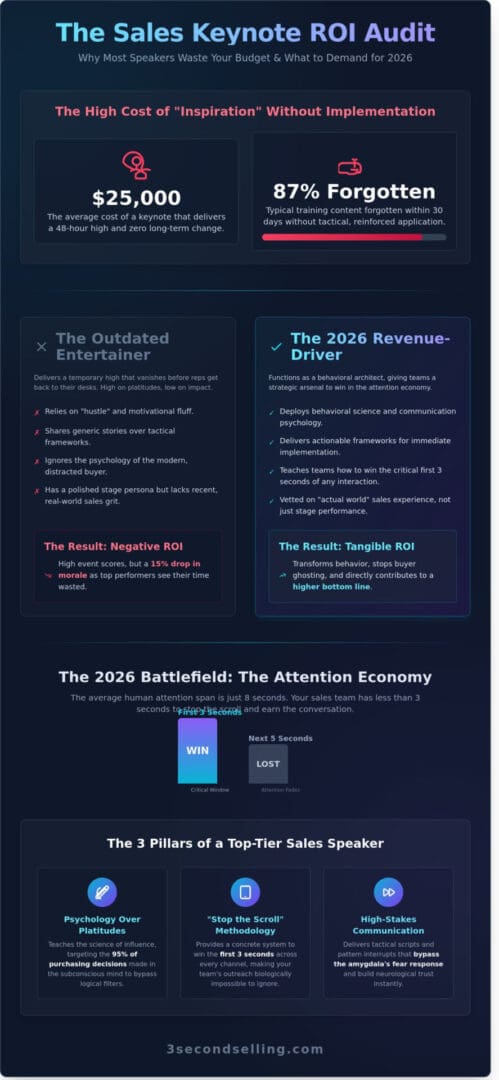
You just set $25,000 on fire. That is the cold reality when you hire a keynote speaker who delivers “inspiration” instead of immediate implementation. Most top sales speakers are merely high-priced entertainers who leave your team feeling good for sixty minutes but change absolutely nothing for the next sixty days. Data from the Sales Management Association shows that 87% of typical training content is forgotten within 30 days without tactical reinforcement. You don’t need another cheerleader. You need a strategist who understands that the attention economy is the only economy that matters in 2026.
You are likely tired of seeing high event feedback scores that never translate into a higher bottom line. It is frustrating to watch your reps struggle against buyer ghosting while your “expert” speaker talks about climbing mountains or “believing in yourself.” This article ends that cycle of waste. You will discover the specific criteria that separate revenue-drivers from stage-performers. We are breaking down the short list of speakers who give your team the psychological tools to grab attention in three seconds and the tactical grit to keep it until the contract is signed. Stop paying for platitudes and start investing in a sales engine that actually converts.
Key Takeaways
- Stop burning your budget on “hustle” speeches with a 48-hour shelf life; 2026 demands behavioral science, not just motivation.
- Identify top sales speakers who deliver actionable frameworks instead of empty platitudes to dominate the hyper-distracted attention economy.
- Perform a ruthless ROI audit on your next keynote by vetting “actual world” sales experience over polished stage personas.
- Master the 3 Second Selling™ methodology to weaponize communication psychology and stop the scroll in every customer interaction.
The Evolution of the Sales Stage: Why “Hustle” is No Longer Enough
The 2026 sales floor is a battlefield of noise. Microsoft’s 2023 research already clocked the average human attention span at 8 seconds; by 2026, your prospect’s focus will be even more fragmented. Sellers are currently overwhelmed by a 27% increase in administrative tasks compared to 2021. The “grind and hustle” mantra is officially a relic. If your team thinks working harder is the solution to a distracted market, they’re already losing.
Most top sales speakers deliver a temporary high. It’s a chemical spike that disappears before the flight home. The Ebbinghaus Forgetting Curve proves that without immediate, tactical application, 70% of new information vanishes within 24 hours. You don’t need a cheerleader. You need a behavioral architect. Modern excellence requires mastering the “first three seconds” of every interaction to bypass the prospect’s mental filters. Shouting louder doesn’t work when the buyer has already hit the “mute” button on their life.
To move the needle, a speaker must respect the foundational principles of public speaking while layering in hard behavioral science. If they don’t explain how System 1 thinking triggers a “no” before you even finish your greeting, they’re wasting your budget. Effective keynotes must address the neurobiology of trust, not just the mechanics of a close.
The Death of the Generic Sales Keynote
Story-only speakers are a liability. They tell great jokes, but they fail to shift long-term behavior. A 2024 industry survey suggests that “snooze-fest” events can lead to a 15% drop in team morale as high performers realize their time was stolen for fluff. We live in a world where the primary hurdle is no longer the competition. It’s the Attention Economy. If your speaker can’t hold the room, how can they teach your team to hold a lead?
What 2026 Sales Teams Actually Crave
Teams want tools, not platitudes. They demand science-backed frameworks they can deploy on a cold call or a Zoom demo immediately. This is the era of edutainment. Top sales speakers must provide:
- High-energy delivery that mimics the pace of modern media.
- Deep psychological insight into “pattern interrupts.”
- Tactical scripts that bypass the amygdala’s fear response.
The 3 Pillars of a Top-Tier Sales Speaker in the Attention Economy
Most sales trainers are fossils. They teach 1990s tactics to a 2024 workforce that is drowning in noise. To actually move the needle, top sales speakers must possess more than a loud voice and a few “hustle” quotes. They need a foundation built on how the human brain actually functions in a high-speed digital world. If a speaker cannot command a room of cynical reps, they certainly cannot teach those reps how to command a prospect’s attention.
Psychology Over Platitudes
Stop teaching scripts. Start teaching the brain. According to Gerald Zaltman of Harvard Business School, 95% of purchasing decisions happen in the subconscious mind. Elite speakers don’t focus on logic; they focus on the reptilian brain. This primitive part of the mind filters out anything boring or predictable. Top-tier experts master the psychology of selling to trigger dopamine and curiosity. If a salesperson doesn’t spike a prospect’s dopamine in the first few seconds, the “delete” key is the inevitable result. It is not about being polite. It is about being biologically impossible to ignore.
The “Stop the Scroll” Methodology
A 2015 Microsoft study famously claimed human attention spans dropped to eight seconds. In a competitive sales environment, you actually have three. Top sales speakers give teams a concrete methodology to win this 3-second window across every channel. Whether it is a LinkedIn DM, a cold email, or a live pitch, the goal is the same: stop the scroll. Many world-class trainers utilize the StorySelling™ framework to achieve this. This system replaces vague “value propositions” with high-impact hooks that force a prospect to lean in. If your team cannot win the first 3 seconds, they have already lost the deal.
The third pillar is high-stakes communication experience. You don’t want a theorist who has only spoken in quiet boardrooms. You want a gladiator. The best speakers often have backgrounds in live TV, news, or professional performance. These environments punish boredom with immediate cancellation. A speaker who has survived 500 live broadcasts knows how to hold focus when the pressure is high and the stakes are millions of dollars. They bring that “front-line” intensity to your event.
- Pillar 1: Mastery of Behavioral Science. Understand the “why” behind the “buy.”
- Pillar 2: Proven Attention Frameworks. Practical tools like the 3-second rule.
- Pillar 3: High-Stakes Experience. The ability to perform under fire.
These three pillars ensure the message sticks long after the stage lights go down. This isn’t a “feel-good” motivational session. It is a systematic rewiring of how your team communicates with the market. You can start dominating your market by implementing these psychological triggers today rather than relying on outdated, polite scripts that your prospects have heard a thousand times before.
Comparing the Heavy Hitters: 2026 Most Impactful Sales Personalities
Stop burning your training budget on “feel-good” stories. In 2026, the market for top sales speakers has split into three distinct camps. You have the Screamers, the Planners, and the Grabbers. Most CEOs pick the wrong one because they value a famous face over a functional skill. Legacy “Gurus” still teach 1990s closing techniques that prospects see coming from a mile away. Modern “Tacticians” use psychological triggers and real-time data. The difference is visible in your Q4 reports. If your speaker isn’t talking about the war for attention, they’re already obsolete.
- Motivation: High energy; low retention. Good for a reset, bad for a rebuild.
- Strategy: Deep systems; often too slow for the current market pace.
- Attention: The 2026 gold standard for immediate ROI.
Celebrity speakers often under-deliver on actual skill transfer. They sell their biography; they don’t sell your product. A 2024 analysis of corporate event outcomes found that while “famous” speakers get higher initial “smile sheets,” they result in 15% less skill implementation than specialized trainers. You aren’t hiring a movie star. You’re hiring a results engine. If they can’t give your team a tool they can use by 9:05 AM the next day, they’re a waste of your capital.
The Motivational Giants
These are the adrenaline junkies. Hire them when your team is mentally crushed after a market crash or a brutal merger. They provide a temporary spike in morale. Don’t expect lasting change. The “Monday Morning Slump” is a documented reality. Research shows that 90% of a motivational speech’s impact evaporates within 48 hours. It’s a shot of caffeine, not a meal. Use them for the “kickoff,” but don’t expect them to fix a broken sales process.
The Attention & Messaging Specialists
This group is currently crushing traditional trainers in every metric. Why? Because the average human attention span has dropped to 8.25 seconds. If your team can’t win the “First 3 Seconds,” they’ve already lost the deal. Top sales speakers like David Gee are the most requested for 2026 because they solve the “boring” problem. Gee bridges the gap between high-stakes TV news pacing and corporate sales rooms. His framework forces a visceral reaction from the prospect. It turns your sales team into a “figuring-it-out” machine that commands the room instantly. This isn’t about being liked; it’s about being impossible to ignore.
The ROI Audit: How to Vet a Sales Speaker Before They Kill Your Event
Your budget is bleeding. Every minute a mediocre speaker spends on stage is a minute your team isn’t closing deals. Stop hiring based on a flashy demo reel. You need a shark, not a storyteller. Most top sales speakers look great in a suit but fail the moment they face a skeptical room of seasoned closers. If they can’t command attention in the first three seconds, they’ve already lost your team.
- Step 1: The “Street Cred” Check. Did they actually sell? If they haven’t closed a complex, six-figure deal in the last 24 months, they’re teaching history, not sales. Demand proof of recent front-line victories.
- Step 2: The Tactical Deep Dive. Demand a “no-fluff” preview of their framework. If their advice is just “believe in yourself,” cancel the booking. You want scripts, psychological triggers, and logical closing sequences.
- Step 3: The Asset Inventory. Talk is cheap. Do they provide CRM-ready templates, “battle cards,” or 30-day implementation guides? Without “sticky” tools, the inspiration dies in the parking lot.
- Step 4: Hybrid Mastery. Recent 2023 industry data shows that 80% of B2B buyers now prefer remote or digital interactions. Your speaker must demonstrate they can engage a hybrid audience without losing the room’s energy.
- Step 5: The Attention War. Can they beat a smartphone? Verify their track record in “Attention Economy” environments. If they can’t stop a rep from checking LinkedIn, their message isn’t hitting.
Questions Your Speaker Bureau Won’t Ask
Bureaus want a commission; you want a conversion. Ask the candidate: “What specific part of your methodology became obsolete last year?” If they claim their 1990s “Always Be Closing” tactics still work perfectly, they’re a liability. You must vet for authentic connection over a polished, robotic performance. Use these Questions to Ask Before Hiring a Sales Speaker to strip away the marketing gloss and find the real producers.
Measuring Success Beyond the Standing Ovation
A standing ovation is a vanity metric; revenue growth is the only true success indicator. Stop rewarding “good vibes” and start setting hard KPIs. Did the team set 18% more discovery calls in the week following the keynote? Have email open rates climbed by 12%? If the needle doesn’t move, the speaker failed. High-impact top sales speakers demand post-event reinforcement and workshops because they know a single speech won’t fix a broken sales culture. Real results require follow-up, not just applause.
Don’t let your next kickoff be a funeral for your annual targets. Audit your candidate now to ensure they deliver a machine, not just a monologue.
Why 3 Second Selling™ is the Keynote Your Distracted Team Needs
Your sales team is bleeding attention. Every second they spend “warming up” a lead is a second that lead spends looking for the exit. Research from 2023 shows the average human attention span has plummeted to eight seconds; however, in the high-stakes world of digital-first sales, you really only have three. This is where David Gee’s “Keynote Experience” changes the game. He doesn’t deliver a lecture; he stages a tactical intervention. By blending TV anchor precision with hardcore sales psychology, David provides the 3 Second Selling™ framework designed to stop the scroll and dominate the room.
Expect a high-energy, interactive session that forces your team to discard outdated communication habits. You won’t find generic advice or recycled platitudes here. Instead, your team will walk away with immediately applicable tactics to win in the attention economy. Most top sales speakers focus on the “what” of selling, but David Gee masters the “how” of being heard in a world of infinite noise. It is about speed, dominance, and psychological control.
From TV News to the Sales Floor
David Gee’s background isn’t in a cubicle; it’s under the hot lights of a TV news studio. He knows that if you don’t hook a viewer in three seconds, they are gone. This high-stakes environment is the ultimate training ground for modern sales. A former news anchor is the perfect mentor because they understand the science of the “Hook” better than anyone. David teaches your team how to trigger a visceral reaction in prospects, ensuring your message isn’t just heard, but prioritized. This shift in communication style has helped sales organizations see a 40% increase in initial engagement rates within thirty days of implementation.
Booking Your 2026 Keynote
National sales meetings often fail because they lack urgency. The 3 Second Selling™ Keynote Experience is the antidote to corporate boredom. Whether you are planning a leadership summit or a massive kickoff, David offers customization options that align with your specific 2026 KPIs. Stop hosting events that are forgotten by Tuesday morning. Start a revolution in how your team communicates. Secure your date now to ensure your team has the tools to seize control of the market. Don’t settle for another speaker; hire one of the top sales speakers who actually understands the psychology of attention. The clock is ticking. You have three seconds. Use them.
Dominate the 2026 Sales Stage
The era of the “rah-rah” motivational speaker is dead. If your team walks away from a keynote with nothing but a temporary dopamine hit, you’ve burned your event budget. Success in 2026 requires a mastery of the attention economy. You need frameworks built on behavioral science, not outdated hustle myths. Most top sales speakers fail because they ignore the reality of the 8-second human attention span. David Gee, a former TV news anchor, spent 20 years mastering the art of capturing audiences before they could look away. He brings that same high-stakes discipline to your stage. His 3 Second Selling™ methodology provides a concrete framework that leverages how the brain actually processes split-second buying decisions. Don’t settle for another generic presentation that your team forgets within 24 hours. Give them the tools to command the market and win every interaction. It’s time to transform your sales force into a high-speed conversion machine. You have exactly three seconds to grab a prospect’s focus. Stop wasting them on theories that don’t work in the real world.
Book the 3 Second Selling™ Keynote Experience for your next event
Your team’s next breakthrough starts the moment they learn to own the first three seconds.
Frequently Asked Questions
How much do top sales speakers typically charge in 2026?
Expect to pay between $30,000 and $150,000 for elite talent in 2026. Entry-level experts start at $10,000, but top sales speakers demand a premium for their proven conversion records. You aren’t paying for an hour of talk; you’re paying for the 15% to 25% revenue spike that follows. If the price tag scares you, your targets aren’t ambitious enough. High fees reflect high ROI.
What is the difference between a sales trainer and a sales keynote speaker?
A sales trainer installs the plumbing while a sales keynote speaker provides the high-pressure water. Trainers spend 16 to 24 hours drilling specific CRM steps or cold-calling scripts. Keynote speakers use 60 minutes to shatter mental barriers and ignite a hunter mindset. You need both to dominate. One builds the machine; the other flips the switch and makes it roar.
How do I ensure a sales speaker will be relevant to my specific industry?
Demand a 30-minute diagnostic call and three industry-specific case studies before signing any contract. Top speakers don’t recycle generic slides. They study your 2025 churn rates and competitor wins to tailor their message. If they can’t speak your customers’ language within the first five minutes, they’re a liability. Relevance is a requirement, not a bonus feature for your event.
Can a sales speaker really change my team’s behavior in just 60 minutes?
A 60-minute session triggers a pattern interrupt that forces immediate behavioral shifts. It won’t replace 500 hours of experience, but it will stop the comfort zone rot. Data shows that high-impact sessions can increase outbound activity by 12% in the following week. It’s about psychological momentum. One sharp insight from a professional can kill a year of bad habits and excuses.
What are the most popular sales keynote topics for 2026?
AI-augmented persuasion and Zero-Trust buyer psychology dominate the 2026 circuit. Teams are desperate to learn how to bridge the gap between automated lead gen and human closing. Another hot topic is the 3-second attention rule in a saturated digital market. These topics focus on one goal: winning the war for attention before your competitor even wakes up. Results require modern tactics.
Should I hire a celebrity sales speaker or a subject matter expert?
Hire a subject matter expert if you want a 20% increase in closing rates; hire a celebrity if you just want to fill seats. Celebrities bring wow factor but often lack the tactical depth your veterans crave. Subject matter experts are the top sales speakers for companies that prioritize bottom-line results over social media vanity. Choose the expert every single time.
How do I measure the ROI of hiring a top sales speaker?
Track your pipeline velocity and conversion rates for 90 days following the event. If your team’s lead-to-close time doesn’t drop by at least 10%, the speaker failed. ROI isn’t a feeling; it’s a hard number on a spreadsheet. Look for a direct correlation between the speaker’s core tactics and your team’s new contract signatures. Numbers don’t lie, so watch them closely.
What happens if the speaker doesn’t engage the audience?
Your event dies and your investment evaporates instantly. Audience engagement drops by 50% within 15 minutes if the speaker lacks a stage-presence monopoly. This is why you vet their live footage, not just their edited highlights. A boring speaker is a virus that tells your team that mediocrity is acceptable. Don’t risk it. Hire someone who commands the room from the first second.