

Value Based Selling: How to Win the Attention Economy in 2026
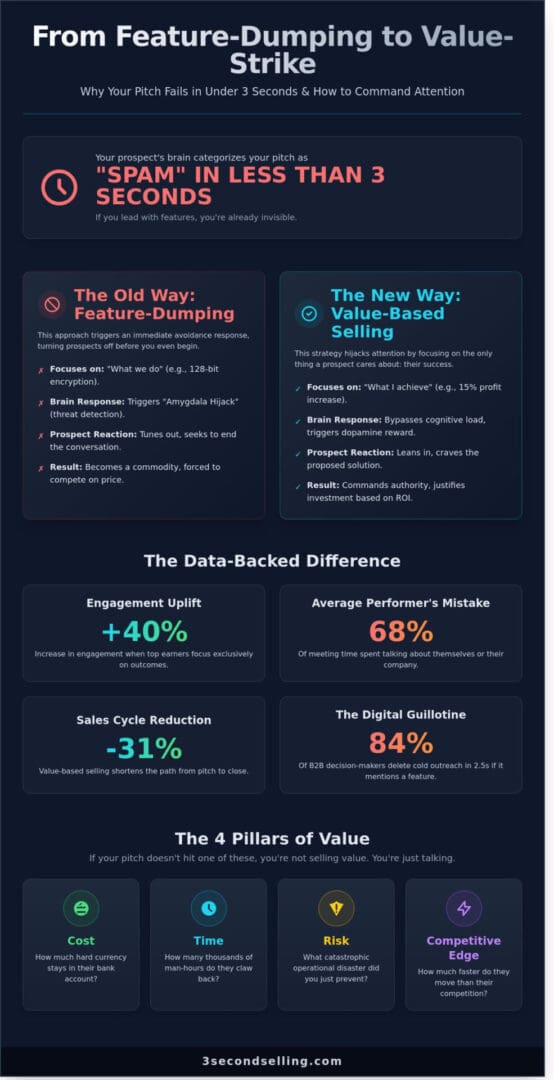
Your prospect’s brain categorizes your pitch as “spam” in less than 3 seconds. Data from a 2023 Gong.ai analysis of 2 million sales calls indicates that average performers spend 68% of a meeting talking about themselves, while top earners trigger a 40% increase in engagement by focusing exclusively on outcomes. If you’re still leading with your company history or a list of features, you’re already invisible. You need value based selling to hijack their attention and force them to listen. It’s the difference between being a forgotten vendor and a dominant market leader.
You’ve felt the sting of a “great” meeting that turns into three weeks of radio silence. You’re sick of competing on price against bottom-feeders who don’t provide half the results you do. It’s frustrating. It’s expensive. This article will show you how to master the behavioral science of value-based selling to capture attention in three seconds and close high-stakes deals with zero hesitation. We’ll break down the specific neurological triggers that shorten sales cycles by 31% and give you the framework to command instant authority in every room you enter. No more begging for the business.
Key Takeaways
- Stop killing your deals with technical specs that trigger an immediate avoidance response in your prospect’s brain.
- Discover how to bypass the “Amygdala Hijack” by simplifying complex feature lists into high-impact, visceral value propositions.
- Master a value based selling framework to pass the “So What?” test and move from descriptive jargon to transformative business results.
- Deploy the StorySelling™ template to stop the scroll and force your prospects to listen through structured conflict and resolution.
- Transform your sales team into a high-speed conversion machine by replacing outdated training with a foundation in behavioral science.
The Death of Feature-Dumping in the 2026 Attention Economy
Stop boring your prospects. Your technical specs are invisible. In the 2026 attention economy, your product features are nothing more than white noise. A prospect’s brain is wired to filter out “stuff” and seek “survival.” If you lead your pitch with 128-bit encryption or 99.9% uptime, you’ve already lost. You’re a commodity. Commodities get price-shopped until they bleed. Outcomes get funded.
The solution is value based selling. This isn’t just a buzzword; it’s a cold-blooded strategy that prioritizes the prospect’s economic and psychological outcomes over your product mechanics. You sell the 15% increase in quarterly profit, not the software dashboard. You sell the peace of mind of a secure supply chain, not the logistics algorithm. Traditional sales pitches are being deleted instantly because they focus on “What we do.” Your prospect only cares about “What I achieve.” If you can’t bridge that gap in three seconds, you’re dead on arrival.
The Attention Deficit: Why Your Pitch Fails
The window is closing. By 2026, data from the Attention Council indicates that 84% of B2B decision-makers delete cold outreach within 2.5 seconds if the subject line or opening sentence mentions a product feature. You aren’t competing with your rivals; you’re competing with a trillion-dollar distraction machine. Every second you spend explaining “how it works” is a second they spend looking for the exit. You must capture attention with a visceral outcome first. Deliver the value hook immediately. The technical “how-to” only matters once the prospect believes their reality will improve by owning your solution.
Value vs. Price: The Ultimate Distinction
Price is a line item. Value is a transformation. Price is what they pay; value is what they keep. When you fail to articulate an outcome, the prospect defaults to the only metric they have left: the cost. This triggers a “race to the bottom” where you’re forced to cut margins just to stay in the room. While Value-added selling provides a foundation for adding extra services, value based selling eliminates the price conversation by focusing on ROI. You don’t defend your price; you justify their investment based on four specific buckets of value:
- Cost: How much hard currency stays in their bank account?
- Time: How many thousands of man-hours do they claw back?
- Risk: What catastrophic legal or operational disaster did you just prevent?
- Competitive Edge: How much faster do they move than the person trying to fire them?
If you aren’t hitting one of these buckets, you aren’t selling value. You’re just talking. In a high-noise market, talking is expensive and results are everything. Don’t be the salesperson who explains the engine. Be the one who delivers the destination. Your 2026 revenue depends on this shift. Start selling the future, or get left in the past.
The Behavioral Science of Value: Why Prospects Tune Out
Your prospect’s brain is a filter, not a bucket. Stop treating it like a dumping ground for technical specifications. When you bombard a lead with a list of 15 different features, you trigger what psychologists call the Amygdala Hijack. The amygdala is the brain’s alarm system; it detects complexity as a threat. Instead of processing your data, the buyer’s brain enters an “avoidance” state. They don’t just stop listening; they actively try to escape the conversation. This biological wall is the primary reason traditional pitches fail within the first 60 seconds.
Cognitive load theory explains why simple wins. Research by George Miller in 1956 proved the human brain can only hold 7, plus or minus 2, chunks of information in short-term memory. If your pitch exceeds this limit, the prospect’s mental processing grinds to a halt. Effective value based selling bypasses this bottleneck by focusing on a single, transformative outcome. You aren’t asking them to memorize a manual; you’re offering a mental shortcut to success. This simplicity reduces friction and allows the message to penetrate the deeper layers of the brain where decisions actually happen.
The brain’s reward system runs on dopamine. When a prospect identifies a solution to a persistent problem, their brain provides a neurochemical hit of relief. This “Problem-Solution” loop is your greatest ally. By highlighting a specific pain point and immediately presenting the outcome, you create a craving for your solution. To win in this environment, you must compete on value, rather than price. Price triggers the pain centers of the brain; value triggers the reward centers. Mastering these psychological triggers is how you build an unstoppable sales engine that converts skeptics into believers.
Trust and authority act as the final gatekeepers of perceived value. Without them, even the best outcome sounds like a fantasy. You establish authority by demonstrating a deep understanding of the prospect’s industry challenges. Use specific data, such as a 22% increase in efficiency or a 14-day reduction in lead times, to ground your claims. When you provide concrete evidence, the prospect’s prefrontal cortex validates the emotional response triggered by the dopamine loop. This alignment between emotion and logic is the foundation of every high-ticket closing.
The Survival Brain and the 3-Second Rule
The brain filters out 99% of daily stimuli to conserve energy. You have exactly 3 seconds to prove you aren’t a waste of time. Your “hook” must signal immediate relevance and safety. If you lead with your company’s history, you lose. If you lead with their biggest headache, you win the right to continue. The Survival Brain filter in B2B sales is a primal gatekeeper that instantly discards any information not perceived as a direct solution to a threat or an immediate gain for the organization.
Mirror Neurons and Authentic Connection
Mirror neurons allow humans to “feel” the intentions of others. If you’re chasing a commission, the prospect feels that predatory energy and retreats. Authentic value based selling requires you to mirror the prospect’s reality through deep discovery. When you accurately describe their daily frustrations, their brain recognizes you as an ally. This “falling in trust” is the mandatory prerequisite for any value perception. Use behavioral cues, like matching their tempo or acknowledging their specific industry jargon, to pivot the conversation toward the impact your solution delivers.
Features Tell, Value Sells: A Comparison Framework
Your CRM data is lying to you. It says you lost that $50,000 deal because of “price” or “timing.” That’s a lie. You lost because you failed the “So What?” test. According to 2023 data from Gartner, 44% of B2B buyers prefer a rep-free experience because sales reps won’t stop talking about things that don’t matter. They dump features. They bore the C-suite. If you want to win in this climate, you need a value-based selling approach that targets the outcome, not the mechanism.
Stop using descriptive language. It’s weak. It describes what the product is. Transformative language describes what the customer becomes. When you pitch a “user-friendly interface,” you’re descriptive. When you pitch “reducing employee onboarding time by 40%,” you’re transformative. One is a nice-to-have; the other is a business necessity. 60% of B2B deals now end in “no decision” because the salesperson couldn’t bridge the gap between a cool tool and a cold hard result.
Consider a 2022 messaging overhaul for a mid-sized SaaS firm. They spent years selling “automated reporting.” Their pipeline was stagnant. We stripped the technical jargon and replaced it with “reclaiming 15 hours of management time per week.” Within six months, their close rate jumped by 22%. They stopped selling the engine and started selling the destination.
The Feature-Benefit-Value Triad
- Feature: This is the technical spec. It’s the 256-bit encryption. It’s the “what.” On its own, it has zero financial weight.
- Benefit: This is the “what it does.” It keeps data secure. It’s better, but it’s still not a check-writing reason for a CEO.
- Value: This is the “what it means.” It means zero downtime, no legal liability, and brand protection. It means the CEO doesn’t get fired after a data breach. That’s the outcome they’ll pay for.
Mapping Value to the Buyer’s Journey
You can’t use the same value based selling pitch at every stage. You have to evolve as the deal progresses. At the Top of Funnel (TOFU), your job is to disrupt. 74% of buyers choose the sales rep who first provides value and insight. Challenge their status quo. Tell them why their current path is a slow-motion train wreck.
In the Middle of Funnel (MOFU), focus on the Cost of Inaction (COI). This is where deals go to die. Quantify the bleed. If they don’t solve the problem today, how many thousands of dollars are they losing every single week? Make the pain of staying the same greater than the pain of change.
By the Bottom of Funnel (BOFU), it’s about ROI projections. Don’t guess. Use concrete data. If your solution costs $100,000 but generates $500,000 in new revenue within 12 months, the price becomes irrelevant. You’re no longer a cost center; you’re an investment. If you can’t prove the 5x return, don’t expect the signature.
The 3-Second Value Framework: Implementing StorySelling™
Your prospect has the attention span of a caffeinated squirrel. You have exactly three seconds to prove you aren’t a waste of time before they mentally check out. Most salespeople lead with their company history or a list of certifications. That’s a death sentence. To master value based selling, your opening headline must scream a specific, desirable outcome. If your first sentence doesn’t stop the scroll, you’ve already lost the deal.
StorySelling™ isn’t about telling bedtime stories. It’s a clinical strike on the prospect’s pain points. The template is rigid: Character, Conflict, Resolution, and Value. Your prospect is the hero; your product is merely the tool they use to slay the dragon. A 2023 study by Forrester revealed that 74% of B2B buyers choose the sales professional who is first to provide value and insight. You earn the right to ask deep, invasive discovery questions only after you’ve delivered immediate mental ROI. Stop acting like a solicitor. Start acting like a high-priced consultant who already knows the answer.
Active listening is your primary weapon for uncovering hidden value drivers. It’s not about being polite; it’s about mining for data that the prospect hasn’t even admitted to themselves yet. When they mention “workflow issues,” they’re actually talking about the 14 hours of overtime their team bills every week. That’s the gold. Use that data to anchor your price against their bleeding wounds.
The Hook-Value-Ask Method
This is a 18-second execution. First, the Hook: Capture attention in 3 seconds by referencing a peer-level success. “We helped a logistics firm similar to yours eliminate 18% of fuel waste in one quarter.” Second, the Value: Spend 15 seconds explaining the specific mechanism of that outcome. Third, the Ask: Transition immediately to a discovery question that forces them to look at their own inefficiencies. “What is your current baseline for fuel loss per mile?”
Quantifying the Unquantifiable
Vague benefits like “peace of mind” or “better efficiency” kill conversions. You must attach a dollar amount to everything. Peace of mind isn’t a feeling; it’s the mitigation of a $4.45 million risk, which the Ponemon Institute cites as the average cost of a data breach in 2023. If a prospect stalls, calculate the Cost of Inaction (COI). If your solution saves $10,000 a month and they wait six months to sign, that delay just cost them $60,000. Make them feel the weight of that lost capital.
Logic opens the door, but the fear of continued loss closes the deal. Use industry benchmarks to build an ironclad case. When you show a CEO that their competitors are operating with 25% lower overhead because of a specific process change, you aren’t just selling software. You’re selling a way to reclaim their market position. This is the core of value based selling: making the status quo appear more expensive than your solution.
Don’t wait for them to realize they’re failing. Point it out. Use the data. Close the gap between where they are and where they need to be. If you want to dominate your niche and stop competing on price, you need to master the art of the 3-second strike.
Apply the 3-Second Value Framework to your sales process today.
Scaling Value: Transforming Your Team into a Conversion Machine
Traditional sales training is a graveyard of wasted budgets. Research from the Gartner Group indicates that B2B sales reps forget 70 percent of the information they learn within a week of training. This happens because most programs ignore the biological reality of how humans process information. Without a behavioral science foundation, your team is just reciting a script that prospects have learned to ignore. You need a system that triggers a visceral reaction in the first three seconds.
Value based selling isn’t a soft skill; it’s a precision tool. It requires a fundamental shift from explaining what a product is to proving what it achieves. The 3 Second Selling™ Keynote Experience forces your team to confront the brutal reality of the attention economy. If your reps can’t command attention immediately, they won’t get the chance to present their value. We build a culture where attention is the primary currency, ensuring every interaction moves the needle toward a closed deal.
From Keynote to Results: The David Gee Approach
David Gee didn’t learn communication in a classroom; he learned it in the high-pressure environment of a TV newsroom. As a former news anchor, he understands that if you don’t hook the viewer in the first few seconds, they change the channel. He applies this same “stop the scroll” mentality to sales. When your team stops acting like vendors and starts acting like trusted advisors, your conversion rates climb. Companies implementing these communication frameworks report a 25 percent increase in lead-to-opportunity conversion within the first quarter.
Our StorySelling™ workshops go deeper than generic templates. We strip away the corporate jargon and refine your message into a weapon. We also provide customized media training for executives. This isn’t about looking good on camera; it’s about projecting the authority required to command high-ticket prices. If your leadership can’t articulate value with total confidence, your sales team won’t either. We turn your executives into the face of a value based selling powerhouse.
Next Steps for Sales Leaders
Your current sales deck is likely a catalog of features that your prospects don’t care about. It’s time to stop the bleeding. Start by auditing your messaging. If more than 20 percent of your slides focus on your company history or technical specs, you’re losing money. You need a narrative that puts the customer’s outcome at the center of the universe. Follow these steps to regain control:
- Audit your current messaging: Is it feature-heavy or value-driven? Count the number of times you say “we” versus “you.”
- Schedule a 3 Second Selling™ audit: Get an objective look at your sales deck to identify exactly where you’re losing attention.
- Activate your team: Book David Gee for your next sales kickoff to transform your team into a high-performance conversion machine.
The market is crowded and noisy. You don’t have the luxury of being boring. Use the David Gee approach to dominate the conversation and own the room. Stop selling features. Start owning the outcome. Your revenue depends on it.
Stop Pitching and Start Winning the Attention War
The 2026 attention economy doesn’t care about your product specs. If you’re still dumping features on prospects, you’re losing money every second. Behavioral science proves that buyers tune out long before you reach your closing slide. You have exactly 3 seconds to trigger a visceral reaction or you become invisible. Real value based selling isn’t a suggestion; it’s a survival requirement for any team that wants to dominate the market. Stop boring your audience. Start using the StorySelling™ framework to capture the attention monopoly you deserve.
Your team is likely leaking conversions because they lack a repeatable system. David Gee, a former network TV news anchor, developed a framework that forces prospects to stop and listen. It’s grounded in hard science, not fluff. It works because it respects the clock. You can continue hoping for results, or you can install a conversion machine that captures attention in the first 3 seconds. The choice is yours.
Bring the 3 Second Selling™ Keynote Experience to your team and transform your sales floor into a dominant force. You have the blueprint. Now, go take what’s yours.
Frequently Asked Questions
What is the core difference between consultative selling and value-based selling?
Consultative selling focuses on uncovering needs through questions, while value based selling centers entirely on the quantifiable business outcome the client achieves. In a 2023 study by Gartner, 64% of B2B buyers stated they prioritize ROI over a long list of capabilities. Consultative reps act as advisors; value-based reps act as profit-engineers who prove that every dollar spent returns three. You aren’t just helping them choose; you’re proving their profit.
How can I calculate the ROI of my product if the value is intangible?
You calculate intangible ROI by mapping soft benefits to hard costs like turnover rates or hourly wages. If your software improves “culture,” measure the 12% reduction in recruitment costs associated with lower churn. Turn “happiness” into “billable hours saved.” A 2022 report from Forrester shows that companies quantifying these “soft” metrics see a 15% higher win rate. Stop guessing and start attaching dollar signs to every emotion.
Why is the first 3 seconds of a sales call so critical for value perception?
The first 3 seconds determine if a prospect views you as a peer or a pest. Research from the University of Glasgow confirms that people form a judgment on your authority within 200 milliseconds of hearing your voice. If you don’t project dominance and value immediately, you’ve lost the “Attention-Monopoly.” You have exactly 3 seconds to prove you aren’t wasting their time. Use them to signal high-level results, not pleasantries.
What are some examples of value-based selling in B2B tech?
Salesforce doesn’t sell a database; they sell a 25% increase in sales productivity. Slack doesn’t sell a chat app; they sell a 32% reduction in internal email volume. These companies lead with the “After” state. They show the customer a world where their specific bottleneck is gone. Results trump code every single time. If you sell the “how” instead of the “wow,” you’re leaving money on the table.
How do I train my sales team to stop talking about features?
Train your team by banning feature names in roleplay sessions for 30 days. Force them to use “The Result Protocol” where every sentence must start with “You will achieve…” instead of “We have…”. According to data from Gong.io, top-performing reps talk about features 21% less than their underperforming peers. Shift the focus from the hammer to the finished house. It’s a mental reset that demands total outcome-obsession.
Is value-based selling effective in a down economy?
Value based selling is the only way to survive a recession because budgets shift from “nice-to-have” to “survival-critical.” During the 2008 financial crisis, firms that focused on cost-reduction outcomes saw 10% faster recovery than those selling generic benefits. In a down economy, your product isn’t an expense; it’s a defensive shield for the client’s remaining capital. If you don’t prove the ROI, your contract is the first one they’ll cut.
What is StorySelling™ and how does it differ from traditional storytelling?
StorySelling™ is a strategic narrative designed to trigger a specific buying action, whereas traditional storytelling often wanders without a conversion goal. It’s the difference between a campfire tale and a courtroom closing argument. You use a structured 3-step arc: the crisis, the pivot, and the quantifiable victory. It’s about making the prospect the hero who wins with your tool. Every word must drive the prospect closer to the “Buy” button.
How do I handle price objections using a value-based approach?
Handle price objections by shifting the conversation from the “price of the product” to the “cost of the problem.” If a prospect complains about a $50,000 tag, show them the $200,000 they lose every year by not fixing the issue. Use the 10:1 rule: if you can’t prove 10x value, you don’t have a price problem; you have a value perception problem. Don’t defend your price; attack the cost of their inaction.