

Communication Psychology for Sales: Winning the 3-Second War for Attention
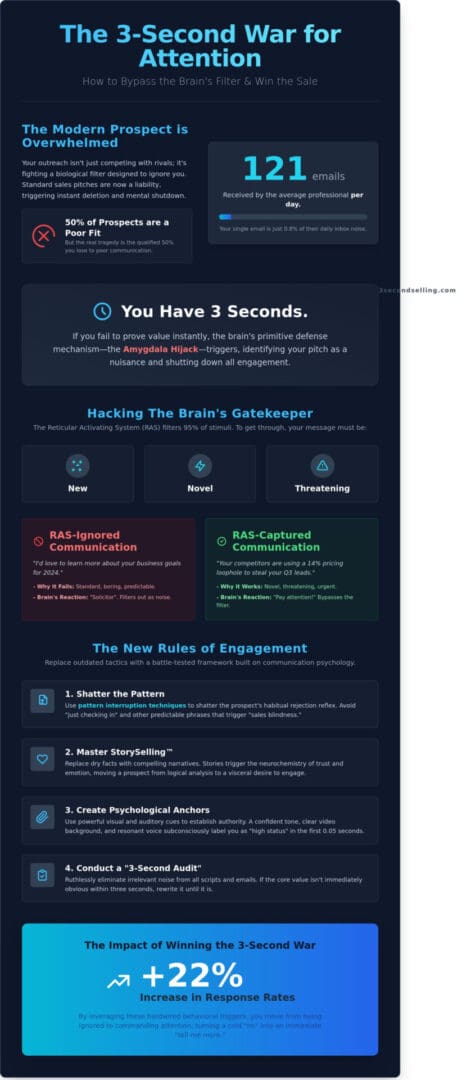
Your prospect has already decided to ignore you before you’ve even finished your first sentence. In a world where the average professional receives 121 emails per day, your outreach isn’t just competing with rivals; it’s competing with a dopamine-starved brain’s urge to hit delete. You know the feeling. You send a pitch, you wait, and you get nothing but silence. Data from the 2023 Sales Insights Lab shows that 50% of prospects are typically a poor fit, but the real tragedy is the qualified 50% who ghost you because you failed to trigger a visceral reaction.
You can’t bore people into buying from you. Mastering communication psychology for sales is the only way to win the 3-second war for attention and command the market control you deserve. This article delivers a battle-tested framework to stop the scroll and drive a 22% increase in response rates by leveraging hardwired behavioral triggers. We’re moving past salesy trickery to build authentic, dominant connections that force prospects to listen. You’ll learn the exact staccato rhythm and psychological anchors needed to turn a cold no into an immediate tell me more.
Key Takeaways
- Stop begging for attention and start hacking the brain’s Reticular Activating System (RAS) to bypass the “sales-blindness” that kills most pitches in under three seconds.
- Shatter your prospect’s habitual rejection reflex using pattern interruption techniques that force immediate mental engagement and break the cycle of instant dismissal.
- Master communication psychology for sales to replace ignored facts with StorySelling™ frameworks that trigger the neurochemistry of trust and drive high-velocity conversions.
- Implement a ruthless “3-Second Audit” across your team’s scripts and emails to eliminate the irrelevant noise that makes your brand invisible to the market.
The Death of Traditional Rapport: Why Your Sales Communication is Being Ignored
Communication psychology for sales isn’t about being a “people person” or having a “gift of gab.” It’s the hard science of how human brains filter information in high-distraction environments. Your prospect’s brain is a fortress. It’s built to keep you out. In the 2026 Attention Economy, prospects have developed a biological “sales-blindness.” They see your “Just checking in” email and delete it in 0.4 seconds. They don’t even process the words; they process the pattern of a solicitor and hit the trash icon before their conscious mind even wakes up.
Old-school rapport building is a corpse. Spending five minutes asking about the weather or their weekend is a death sentence for your deal. Modern buyers demand high-speed value delivery. If you’re boring, you’re invisible. The cost of boring communication is immediate: deleted emails, blocked numbers, and forgotten pitches. You aren’t just competing with other vendors; you’re competing with a dopamine-hooked brain that wants to scroll away from anything that looks like “work.” If your communication psychology for sales doesn’t account for this, you’ve already lost.
The 2026 Attention Crisis
By 2026, the average human attention span in digital sales environments has cratered to less than 7 seconds. This isn’t just a trend; it’s a structural shift in the sales cycle. Standard sales scripts are now a liability. They sound like every other AI-generated bot on LinkedIn. These scripts create “Cognitive Friction.” This is the mental effort a buyer wastes trying to figure out if you’re worth their time. If it takes more than 3 seconds to find the value, they’ll bounce.
Why “Nice” Communication Fails
Being overly polite triggers a “solicitor” alarm in the prospect’s amygdala. It’s a red flag that screams “I’m about to take your time.” Professionalism isn’t about being a “commodity” communicator who hides behind “I hope this finds you well.” It’s about authority. Traditional Personal selling methods often focus on building a bridge, but your prospect is already burning it. You need a tactical intervention in your messaging to stop being a nuisance and start being a necessity. If your team’s communication style is stuck in the past, you’re losing revenue every hour. You can secure a strategy that actually cuts through the noise by reaching out at https://3secondselling.com/contact/.
The Neuroscience of the 3-Second Window: Hacking the Brain’s Filter
The human brain is a survival machine, not a logic machine. When you open your mouth or send an email, you aren’t talking to a rational executive; you’re talking to a biological filter designed to ignore you. You have exactly 3 seconds to prove you aren’t a threat to their time or a waste of their energy. If you fail, the “Amygdala Hijack” kicks in. This is a primitive defense mechanism where the brain identifies your “standard” sales pitch as a nuisance, triggering instant defensiveness and mental shutdown. To win, you must understand understanding the psychology of sales at a neurological level.
The RAS: Your Prospect’s Gatekeeper
The Reticular Activating System is the brain’s primary filter for environmental stimuli. It sits at the brainstem and decides which bits of data reach the conscious mind. A CEO receives over 120 emails daily; the RAS deletes 95% of them before the person even “sees” them. The RAS only lets through information that is New, Novel, or Threatening. If your message looks like every other “just checking in” note, it is invisible. It’s not that they don’t like you; it’s that their brain literally didn’t register your existence.
- RAS-Ignored: “I’d love to learn more about your business goals for 2024.” (Standard, boring, ignored).
- RAS-Captured: “Your competitors are using a 14% pricing loophole to steal your Q3 leads.” (Novel, threatening, urgent).
Stop trying to be polite. Politeness is predictable. Predictability is the death of communication psychology for sales because the RAS thrives on disruption.
Visual and Auditory Anchoring
In a digital-first world, your prospect judges your status in 0.05 seconds. This is the “Halo Effect” in high gear. If your video call lighting is dim, your background is cluttered, or your voice lacks resonance, the brain labels you as “Low Status.” Once that label is stuck, no amount of logic will fix it. You must project “Executive Presence” immediately to bypass the amygdala’s threat response.
This anchoring isn’t just about looking professional; it’s about signaling authority. High-performers know that leadership communication skills are the foundation of this anchoring. You don’t ask for permission to speak; you command the space. If you sound hesitant, the prospect’s brain senses a “predator” (a time-waster) and shuts the door. If you want to master this dominance and stop losing deals in the first few seconds, it’s time to refine your approach. You can reach out to our team to see how we transform sales scripts into attention-grabbing machines.
The brain prioritizes survival. If your pitch doesn’t promise a massive gain or prevent a painful loss, it is noise. Use communication psychology for sales to be the signal, not the static. Every second you spend being “standard” is a second you spend being forgotten.
Pattern Interruption: The Psychology of the “Stop”
The human brain processes 11 million bits of information per second; however, it only consciously perceives about 40. To survive this data deluge, your prospect’s mind uses “pattern matching” to filter out noise. If you start a call with “How are you today?”, you’ve already lost. Their brain categorizes you as “Irrelevant Salesperson” in under 0.5 seconds. You’ve triggered a habitual rejection response that functions like a physical reflex. You aren’t being ignored because your product is bad; you’re being ignored because you sound exactly like the last ten people who wasted their time.
Pattern interruption is the only way to seize the attention-monopoly you need to survive. It’s a psychological circuit breaker. When you disrupt a predictable sequence, the brain experiences a “curiosity gap.” Research from the University of Reading in 2020 confirms that curiosity triggers a dopamine release similar to a financial reward. You aren’t just talking; you’re literally rewarding their brain for paying attention. This is the core of effective communication psychology for sales. If you don’t stop the autopilot, you don’t get the sale.
Breaking the “Salesperson” Stereotype
Most reps are invisible because they follow a script that prospects have heard 1,000 times. Stop using these “pattern-matching” triggers immediately:
- “I’m just calling to follow up…”
- “Do you have a few minutes to chat?”
- “I’d love to learn more about your business.”
To command respect, use the “News Anchor” approach. Lower your vocal pitch by 10%. Speak with a steady, downward inflection at the end of sentences. This delivery signals “Important Information” rather than “Seeking Approval.” You have 10 seconds to prove you aren’t a time-waster. Use a provocative opening like: “I’m calling because your current logistics costs are 14% higher than the industry average; do you want to see the data?”
The Contrast Principle
The brain perceives value through comparison, not in isolation. If you don’t create a sharp contrast, you’re just another expense. You must highlight the “Pain of the Status Quo” against the “Gain of Change.” A 2018 study in the Journal of Marketing Research showed that loss aversion is twice as powerful as the desire for gain. Frame your solution as the only exit from a burning building.
In B2B sales, high-contrast communication looks like this: “You can keep losing $5,000 a week in wasted leads, or you can implement this system and capture that 22% margin by Friday.” There is no middle ground. You’re either moving toward the solution or staying in the fire. Use this logic to make your offer the only rational choice left on the table. When the gap between “now” and “future” is wide enough, the sale becomes inevitable.
StorySelling™: Moving from Information to Emotion
Facts are cold. Data is forgettable. If you bombard a prospect with statistics, you trigger their analytical brain; that is the same part of the mind that looks for reasons to say no. Logic is a secondary filter, but emotion is the gatekeeper. Real communication psychology for sales relies on neurochemistry, not just “good talking.”
When you tell a narrative, the brain releases specific chemicals. Cortisol focuses the attention on the conflict. Oxytocin builds the empathy needed for trust. Research by neuroeconomist Paul Zak shows that character-driven stories consistently cause the brain to synthesize these chemicals, making listeners significantly more likely to take action. You aren’t just talking; you’re chemically altering the prospect’s state of mind.
The StorySelling™ framework demands a total shift in perspective. Your company is not the hero. Your product is not the hero. The customer is the protagonist. Your role is the mentor providing the weapon to slay the dragon. To win the 3-second war, you must start in the middle of the action. Don’t start with “Once upon a time.” Start with the moment the engine exploded. Start with the “3-Second Hook” to force an immediate visceral reaction.
The Anatomy of a Winning Sales Story
Your company history is the least important story you can tell. Prospects don’t care about your 1992 founding date or your office culture. They care about their own survival. If your story doesn’t address their specific pain, it’s noise. Use these sales storytelling examples to see how high-stakes narratives build instant credibility.
This works because of Mirror Neurons. When you describe a tactical intervention where a client saved $50,000 in 48 hours, the prospect’s brain “pre-experiences” that win. They aren’t just hearing about a benefit; they’re feeling the relief of the solution. You turn a dry case study into a high-stakes mission where they are the winner.
Tactical Empathy and Listening
Most salespeople think active listening means waiting for their turn to speak. They’re wrong. Tactical empathy is a strategic tool used to uncover hidden objections. You must listen for what is NOT being said. Is the prospect’s tone hesitant when discussing the timeline? That’s a red flag you can’t ignore.
- The 3-Second Pause: When a prospect finishes a sentence, don’t jump in. Wait. Three full seconds.
- The Vacuum Effect: Silence creates psychological discomfort. The prospect will often fill that silence with the real truth they were trying to hide.
- Labeling: Identify the emotion. “It sounds like you’re worried about the implementation risk.” This forces them to confirm or clarify the psychological barrier.
Mastering communication psychology for sales means knowing when to shut up. Silence is a weapon. Use it to force disclosure and gain the psychological advantage in every negotiation.
Stop losing deals to “thinking it over.” Contact us today to build your high-conversion sales engine.
Scaling Communication Psychology: Training Your Team to Win
Most sales training is a high-priced pep talk. It’s a temporary spike in adrenaline that yields zero long-term ROI. Data from the Sales Management Association indicates that 55% of sales training programs fail to produce lasting behavior change because they focus on “closing” rather than the foundational communication psychology for sales. If your team isn’t winning the first three seconds of an interaction, they never get the chance to close anything. You don’t need motivated amateurs; you need communication snipers who understand how the human brain filters information.
The 3-Second Audit
Stop guessing why your team’s conversion rates are stagnant. Leaders must implement a 3-second audit for every email, LinkedIn message, and cold call script. This isn’t about being “professional” in the traditional, boring sense. It’s about being impossible to ignore. You must audit your messaging to gut the fluff that triggers the prospect’s “delete” reflex. Use these criteria for every outbound touchpoint:
- The Curiosity Gap: Does the opening sentence trigger an immediate “Wait, what?” reaction, or is it easily categorized as spam?
- The “Me” Filter: If the first three words are “I am writing,” “Our company,” or “We offer,” the message is already dead.
- The Friction Test: Is the call to action a low-stakes request or a massive mental burden for the prospect?
Any word not contributing to the 3-second win is actively working against your revenue.
Next Steps for Sales Leaders
Scaling a high-performance team requires integrating behavioral science into your weekly rhythm. Stop running generic status updates. Instead, use sales role-playing exercises that specifically target the attention-capture phase. If your reps can’t hook a prospect in the first 180 frames of a call, the rest of the script is irrelevant fluff. Practice the hook until it’s a visceral reflex.
Sometimes, internal voices become white noise to a seasoned team. Bringing in a sales keynote speaker serves as a tactical reset for your entire culture. It shifts the mindset from “selling products” to “dominating attention.” This isn’t about theory; it’s a fundamental shift in how communication psychology for sales is applied on the front lines to crush the competition.
Stop settling for polite rejections and “let me think about it.” Move your team from “selling” to capturing attention with surgical precision. If your team’s messaging is broken, it’s costing you money every single hour. Contact David Gee for a tactical intervention and stop the revenue leak today.
Stop Polishing Your Pitch and Start Winning the War
Your sales communication is being ignored because you’re playing by 1990s rules. The neuroscience of the 3-second window proves that the brain filters out traditional rapport before you even finish your sentence. David Gee, a former TV News Anchor, uses a behavioral science-backed framework to show that you must interrupt patterns or face immediate rejection. You don’t need more information. You need a visceral emotional connection through StorySelling. This isn’t just theory. It’s a proven system that has delivered conversion-driven results for global sales teams across multiple continents.
Success requires mastering communication psychology for sales to seize the attention-monopoly you deserve. Every second you wait is a second your competitor uses to steal your lead. It’s time to transform your team into a high-performance selling machine that dominates the first three seconds of every interaction. You’ve got the strategy. Now take control of the conversation and command the market’s attention. You’re ready to win.
Book David Gee for a 3 Second Selling™ Keynote Experience
Frequently Asked Questions
What is the most important principle of sales psychology?
The most important principle is that 95% of purchasing decisions happen in the subconscious mind. You aren’t selling to a rational person; you’re selling to a lizard brain focused on survival and gain. Harvard Professor Gerald Zaltman’s research proves that logic only justifies what the subconscious already decided. Stop pitching features. Start triggering the “fight or flight” mechanism by highlighting the cost of inaction. It’s about visceral reaction, not rational debate.
How do you use communication psychology in cold emails?
Use communication psychology for sales in cold emails by mastering the “Scroll-Stop” effect within the first 40 characters of your subject line. Data from OptinMonster shows 47% of people open emails based on the subject line alone. Your first sentence must be about their problem, not your company. If you don’t grab them in 3 seconds, you’re in the trash folder. It’s binary. You either win or you’re invisible.
Can sales psychology be learned, or is it an innate talent?
Sales psychology is a learned skill, not a genetic trait. While some have a natural affinity for persuasion, CSO Insights reports that structured sales training increases win rates by 15.2%. It’s like a muscle. You train your brain to recognize patterns and deploy the right triggers. If it were innate, the $70 billion sales training industry wouldn’t exist. You don’t need “the gift of gab.” You need a proven system.
What is the “3-second rule” in sales communication?
The 3-second rule is the critical window where a prospect’s brain decides to engage or ignore your message. Research indicates the average human attention span is now 8.25 seconds, but the initial filter happens much faster. You have 3 seconds to prove you aren’t a threat and that you have something valuable. Fail this test and your 20-minute presentation will never happen. Dominance begins in the first 180 frames of interaction.
How does the attention economy affect B2B sales cycles in 2026?
By 2026, the attention economy will shrink B2B sales cycles into “micro-moments” where 80% of the journey happens digitally. Gartner’s latest projections show that buyers spend only 5% of their time with any single sales rep. This means your communication psychology for sales must be a cognitive sniper. You can’t afford long-winded decks. You need high-impact triggers that work while you sleep. The slow will be eaten by the fast.
What is a pattern interrupt, and how do I use it in a pitch?
A pattern interrupt is an unexpected statement or action that breaks a person’s “autopilot” mental state. In a pitch, you can use it by saying, “This might be a terrible time to talk, but…” or “I’m calling to see if you want to cancel your current service.” It forces the brain to reboot and pay attention. When you sound like every other salesperson, you’re ignored. When you break the script, you own the room.
Why is storytelling more effective than listing product features?
Storytelling is more effective because it makes information 22 times more memorable than raw facts. Stanford researcher Jennifer Aaker found that when data is wrapped in a narrative, the brain processes it as an experience rather than a lecture. Features are boring lists that trigger the “skeptic” part of the brain. Stories bypass resistance and create an emotional bridge. Don’t tell me your software is fast. Tell me how it saved a CEO’s weekend.
How can I improve my sales team’s communication skills quickly?
Improve your team by implementing daily 15-minute “Pressure Drills” focused on objection handling. High-performing teams are 2.3 times more likely to provide ongoing training than underperformers, according to Salesforce data. Stop sending them to yearly seminars that they’ll forget in a week. Give them scripts that use psychological triggers and force them to role-play until the responses are visceral. Speed of implementation is the only metric that matters.