
Behavioral Science in Marketing: The 3-Second Biological Hack for 2026
Your prospect’s amygdala deletes your marketing message in exactly 400 milliseconds. That’s faster than a human blink. While you’re obsessing over font choices, their primitive brain has already filtered you out as noise. You’re losing the war for attention because you’re fighting biology with polite fluff. If your ad spend increased by 20% last year while your engagement hit a plateau, you’re experiencing the brutal reality of the attention economy. You aren’t just competing with rivals; you’re competing with a biological “delete” button.
You’ve seen the conversion rates drop and the “me-too” messages fail. It’s time to stop guessing and start using behavioral science in marketing to seize a total attention monopoly. This article reveals how to bypass the biological filters that kill 90% of digital content before it’s even read. You’ll gain a proven framework to stop the scroll, drive immediate revenue, and provide scientific justification for every creative decision you make. We’re moving past marketing theories to build a high-speed conversion machine for 2026.
Key Takeaways
- Master the biology of the “scroll” by targeting System 1 thinking, where 95% of all purchasing decisions are made subconsciously.
- Stop losing sales to abstract jargon and start using the “Vividness Effect” to bypass the brain’s instant biological delete filter.
- Exploit proven cognitive biases like Loss Aversion and the Anchoring Effect to command attention and dictate the terms of every negotiation.
- Apply the principles of behavioral science in marketing to base your strategy on what customers actually do, rather than what they claim they will do.
- Implement the tactical 3 Second Selling™ framework to transform your communication into a high-speed revenue engine that dominates the attention economy.
Beyond the Buzzwords: What Behavioral Science in Marketing Actually Means in 2026
Stop pretending your customers are rational. They aren’t. They never were. Behavioral science in marketing isn’t about reading minds; it’s about predicting the specific, irrational shortcuts the human brain takes every single day. Most marketers waste years trying to appeal to the “Rational Man,” a mythical creature who weighs options logically and makes sensible decisions. That person doesn’t exist. In reality, you’re selling to a bundle of biases and biological reflexes that hasn’t changed since the Stone Age.
By 2026, the “Attention Monopoly” will be the only market that matters. With global data creation projected by IDC to exceed 200 zettabytes by the end of 2026, your prospect’s brain is under siege. It has developed a biological armor that your standard “features and benefits” list can’t pierce. Psychology is no longer a “nice to have” bonus; it’s the only currency that buys you entry into the consumer’s mind. If you aren’t building your strategy on cognitive architecture, you’re just throwing money at a wall and hoping it sticks. You’re either the one who understands the rules of the game, or you’re the one paying for everyone else’s education.
The Irrational Buyer: Why Facts Don’t Sell
Facts don’t sell. In fact, they often kill the deal. When you present more data to a skeptical prospect, you trigger “Confirmation Bias.” A landmark 1979 Stanford University study showed that people interpret new evidence as a reason to believe their original bias even more strongly. You aren’t convincing them; you’re arming them against you. Logic is the wrapper, but emotion is the gift. Neuroscientist Antonio Damasio found that patients with damaged emotional centers couldn’t make simple choices, even if their logic remained intact. No emotion, no sale. Period.
- The Backfire Effect: More data doesn’t change minds; it reinforces existing walls.
- Emotional Gatekeeping: If they don’t feel it, they don’t buy it.
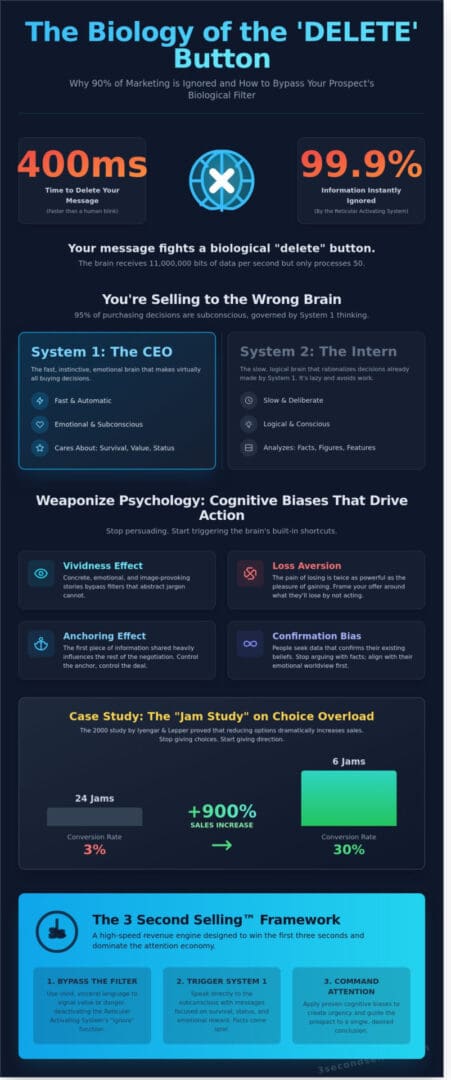
- Choice Overload: The 2000 “Jam Study” by Iyengar and Lepper proved that reducing options from 24 to 6 increased sales by 900%. Stop giving choices. Start giving directions.
The 3-Second Threshold: Your Marketing’s Make-or-Break Moment
The human brain is a deletion machine. It receives roughly 11 million bits of data per second but only lets about 50 bits through to the conscious mind. This is the Reticular Activating System (RAS) at work. It’s a biological filter that ignores 99.9% of your marketing. If you don’t scream “Value” or “Danger” in the first three seconds, you’re deleted. You don’t get a second chance to make a first impression; you don’t even get a fourth second. Behavioral marketing is the science of winning that first 3-second window.
If you’re ready to stop being invisible and start dominating that window, it’s time to change your approach. Contact us here to see how we do it.
The Biology of the “Scroll”: How System 1 Thinking Governs the Attention Economy
Your prospect isn’t thinking. They’re reacting. Nobel Prize winner Daniel Kahneman proved that the human brain operates in two distinct modes. System 1 is fast, instinctive, and emotional. System 2 is slow, logical, and incredibly lazy. In the war for attention, System 2 is irrelevant because it never even gets invited to the party. Harvard professor Gerald Zaltman found that 95 percent of purchasing decisions originate in the subconscious mind. This means the sale is won or lost before the buyer even realizes they’re looking at an offer.
Applying behavioral science in marketing means you stop selling to the executive suite of the brain and start selling to the survival center. The brain prioritizes “Cognitive Ease.” If a message requires effort to decode, the amygdala flags it as a threat or a waste of energy. The modern buyer’s brain has been rewired by a decade of infinite scrolling to ignore anything that looks like “corporate speak.” Boring is dangerous. Boring is invisible. To win in 2026, you must bypass the friction filters and trigger a visceral response.
System 1: The Gatekeeper of Your Revenue
Speak to the lizard brain or prepare to be ignored. This primitive part of the mind cares about three things: survival, value, and status. If your marketing doesn’t immediately signal one of these, you’re dead on arrival. You need a pattern interrupt. This is a psychological jolt that stops the habitual scroll. Most marketers make the mistake of over-polishing their content. They make it look like a “perfect” advertisement. That’s a mistake. High-gloss, sterile marketing is a signal to the brain to tune out. Raw, high-contrast, and punchy messaging triggers the System 1 “hey, look at this” reflex.
- Visual Shock: Use imagery that contradicts expectations.
- Direct Address: Use “You” to force an immediate mental connection.
- Urgency: Trigger the fear of missing out (FOMO) to keep System 2 from over-analyzing.
The Cost of Cognitive Friction
Friction is the silent killer of conversions. Every time you use a complex word, a hard-to-read font, or a cluttered layout, you trigger System 2 rejection. Once the logical brain wakes up, it starts looking for reasons to say no. This is the “Fluency Effect” in action. Research shows that simple language and clean design actually increase trust. People believe things that are easy to understand. If your sales email looks like a legal brief, it’s going to the trash.
Modern behavioral science in marketing proves that clarity beats cleverness every single time. Do you want to be “professional” or do you want to be profitable? Most businesses fail because they demand too much mental “heavy lifting” from their leads. The 3 Second Selling methodology solves this by stripping away every ounce of cognitive friction. You have a three-second window to dominate the mind. If you’re ready to stop guessing and start winning, it’s time to reach out and master the machine.
Cognitive Biases That Move the Needle: From Loss Aversion to the Pratfall Effect
Your customers aren’t rational. They’re biological machines driven by prehistoric wiring. If you ignore behavioral science in marketing, you’re essentially shouting into a void. You need to trigger the lizard brain before the prefrontal cortex even wakes up. Logic is a secondary filter; emotion and instinct are the gatekeepers.
Loss Aversion: The Ultimate Sales Catalyst
Daniel Kahneman and Amos Tversky demonstrated in their 1979 Prospect Theory that the pain of losing is twice as powerful as the joy of gaining. Most marketers fail because they sell “benefits.” Stop doing that. Your prospect doesn’t want another “advantage”; they want to stop the bleeding. Reframe your offer. Instead of “Save $500 a year,” try “Stop wasting $500 every year on outdated tech.”
Scarcity works for the same reason. It’s not about being a “used car salesman.” It’s about reality. A 2023 experiment in the retail sector showed that “Only 3 left at this price” generated a 42% higher conversion rate than “New stock available.” In 2026, predictive analytics allow brands to show users exactly what they will lose if they don’t act. A recent fintech campaign used personalized “lost interest” counters to double click-through rates by showing users the exact dollar amount they missed by not switching accounts.
The Power of Vulnerability: The Pratfall Effect
Perfect is boring. Worse, perfect is suspicious. Modern consumers have a high-tuned “fake” detector. Social psychologist Elliot Aronson discovered the Pratfall Effect in 1966: when a competent person or brand makes a mistake, their perceived attractiveness increases. Admitting a small, non-essential flaw makes your biggest strengths believable.
If your product is expensive, don’t hide it. Say it. “We are the most expensive option because we use 30% more durable materials than the industry standard.” By admitting the “flaw” (high price), you instantly validate the “strength” (durability). You can master this by incorporating “The Struggle” into your sales storytelling examples. Show the mess before the success. It creates a human connection that a sterile corporate brochure never will.
Anchoring and Social Proof 2.0
The first number your prospect hears becomes their mental anchor. If you mention a $10,000 industry average before revealing your $3,000 price, you’ve already won. Without that anchor, $3,000 is just an expensive number. The brain needs a reference point to calculate value. Give it one before your competitor does.
Social Proof 2.0 moves beyond generic testimonials. It utilizes the “Wisdom of the Crowds.” Don’t just show a quote from “John D.” Show data. “Used by 92% of Fortune 500 CTOs” is a biological signal of safety. Use behavioral science in marketing to turn your sales process into a series of inevitable “yes” responses. You aren’t just selling; you’re facilitating a biological imperative.
Weaponizing Psychology: A Practical Framework for 3-Second Messaging
Stop wasting your budget on invisible marketing. If your message doesn’t clear the biological filter in 3 seconds, you’re dead in the water. This is where behavioral science in marketing moves from theory to the front lines. You need to bypass the logical brain and hit the amygdala. Run the 3-Second Audit on every piece of content you produce. Blur your landing page. If you can’t identify the core offer and the call to action while the screen is fuzzy, your design is failing your business. Most companies fail this test because they hide their value behind clutter.
The Vividness Effect is your primary weapon for recall. In a 1982 study by Nisbett and Ross, researchers proved that concrete, sensory-rich information has a significantly higher impact on memory than abstract data. Don’t tell your prospects you provide “scalable enterprise solutions.” That’s corporate static. Tell them you provide “a dashboard that turns red when you lose money.” Use the Zeigarnik Effect to dominate their inbox. Named after Bluma Zeigarnik’s 1927 research, this principle shows that the human brain experiences tension when a task or story is left unfinished. Use “open loops” in your email subject lines. Start a story, then break it. Your open rates will climb because the reader’s brain demands closure.
You can drive massive click-through rates without resorting to cheap clickbait by using the Curiosity Gap. This is based on George Loewenstein’s 1994 Information Gap Theory. It’s the mental itch that occurs when there’s a void between what we know and what we want to know. Give them the “what” but hide the “how.” Make them click to find the missing piece of the puzzle.
Step 1: The Visual Hook
Your eyes are drawn to contrast and movement. Use high-contrast colors to isolate your primary button. Directional cues are equally vital. If a person in your hero image looks toward your sign-up form, the user’s eyes will follow that gaze. The human face is the ultimate pattern interrupt. Research published in 2005 by Todorov and colleagues shows we judge trustworthiness and dominance in less than 100 milliseconds. A direct, confident gaze from a human face can stop a scroll faster than any graphic. Audit your top-of-fold content today. If there isn’t a clear, high-contrast focal point, you’re losing 80% of your audience before they read a single word.
Step 2: The Emotional Bridge
Once you have the eyes, you must capture the heart. Every high-converting message bridges the hook to a core human desire: Status, Security, or Freedom. You aren’t selling a service; you’re selling a shortcut to a better version of the customer. Leverage Mirror Neurons to build this connection. When a prospect watches a video of you speaking with conviction, their brain simulates those same feelings of confidence. It creates instant rapport. This biological synchronization is why David Gee’s media training is a non-negotiable for executives. Mastering the “emotional bridge” on camera turns a cold viewer into a motivated lead. If you want to dominate your niche, you must stop being a vendor and start being an authority.
Ready to stop being ignored and start being a market leader?
From Theory to Keynote: Implementing Behavioral Science with 3 Second Selling™
Reading about behavioral science in marketing is a hobby. Implementing it is a business strategy. Most teams treat psychology like a trivia night. They know the terms, but they still lose the sale. You don’t need more theory. You need a tactical intervention that rewires how your team speaks to the primitive brain. We move beyond the “what” and focus entirely on the “how” of immediate conversion. In an era where digital attention spans have dropped to 8.25 seconds, your team has exactly three seconds to win or lose.
The David Gee Advantage
David Gee brings a perspective most sales coaches lack. He spent years as a TV news anchor. In the newsroom, you have exactly three seconds to stop a viewer from switching channels. If your message doesn’t pass the Newsroom Filter, it dies. This isn’t about being “polished.” It’s about being biologically irresistible. Your product isn’t the hero; the biological trigger is. David Gee translates these newsroom secrets into sales revenue by showing you how to strip away the corporate fluff that puts prospects to sleep. If your pitch wouldn’t lead the 6 PM news, it won’t sell your product. This high-stakes approach makes him the premier sales keynote speaker for organizations ready to dominate the 2026 attention economy.
Next Steps for Your Team
Boring corporate training is a death sentence for your 2026 sales kickoff. Traditional methods offer a 10% retention rate. That is a waste of your budget and your team’s time. Our StorySelling™ workshops move beyond the classroom. We provide a messaging audit that exposes why your current pitch is failing. We replace feature-dumping with behavioral triggers that force a visceral response. The ROI is clear. When your team masters behavioral science in marketing, they stop chasing and start attracting. They close deals faster because they stop fighting the prospect’s brain and start working with it.
- Book a StorySelling™ workshop for your 2026 kickoff to transform your results.
- Stop using 1990s sales tactics in a 2026 attention economy.
- Get a direct assessment of your current sales scripts and messaging.
Stop guessing. Start winning. The competition is already moving. If you aren’t first in the prospect’s mind, you are invisible. Contact 3 Second Selling today for a messaging audit. See how your current communication measures up against the biological 3-second rule.
Stop Renting Attention and Start Owning It
The attention economy isn’t a theory; it’s a biological battlefield. By 2026, your audience’s System 1 brain will decide your brand’s fate in less time than it takes to blink. If you aren’t leveraging behavioral science in marketing, you’re invisible. You’ve seen how the Pratfall Effect builds more trust than perfection and why loss aversion triggers immediate action. Knowledge alone won’t save your margins. You need a system that converts biology into revenue. David Gee, a former Network TV News Anchor, mastered the 3-second hook in the high-stakes world of live broadcasts. He distilled that expertise into the 3 Second Selling™ proprietary framework. This methodology is the gold standard at National Sales Meetings and Leadership Summits because it works. Don’t let your message die in the scroll. It’s time to weaponize psychology and dominate your market. You have the tools to win the fight for focus.
Stop wasting money on ignored marketing; Book David Gee for your next event
Frequently Asked Questions
What is the most effective behavioral science principle in marketing?
Loss aversion is the most powerful weapon in your arsenal because humans feel the pain of losing twice as much as the joy of gaining. Daniel Kahneman proved this in 1979 through Prospect Theory. Stop talking about benefits. Start talking about what your customer loses by ignoring you. If you don’t trigger that biological fear of missing out, you’re invisible. Behavioral science in marketing isn’t a suggestion; it’s survival. Use it or lose the sale.
Is using behavioral science in marketing unethical?
Behavioral science is a tool, not a crime. Richard Thaler, who won the Nobel Prize in 2017, calls it “libertarian paternalism.” You aren’t forcing anyone; you’re just making the right choice easier to find. Is it unethical to help a confused customer make a decision? No. It’s only unethical if you lie. If your product delivers, using psychology to close the deal is your professional duty. Results don’t care about your feelings.
How do I start using behavioral science if I have a small budget?
You don’t need a million dollar lab; you need a brain and an A/B testing tool. Start by rewriting your headlines using the “Scarcity” principle. Limit your offer to 50 spots or a 24 hour window. Monitor your conversion rates. Behavioral science in marketing doesn’t require a massive budget, just a commitment to testing one bias at a time. Change your button color to contrast. Watch the numbers move. Stop making excuses and start testing.
What is the “3-second rule” in marketing psychology?
The 3-second rule is the biological deadline to capture a prospect’s System 1 brain before they scroll away. Research from Microsoft in 2015 suggests human attention spans have dropped, but the initial gut reaction happens in under 3 seconds. You must trigger a visceral response immediately. If your landing page doesn’t scream relevance in 3 seconds, you’re dead. Your headline must hit their lizard brain instantly. Win the first 3 seconds or lose the customer.
Can behavioral science help with B2B sales, or is it just for B2C?
B2B buyers don’t leave their brains at the door; they’re just as prone to the “Halo Effect” and “Authority Bias” as any shopper. A 2023 study by Google and CEB found that B2B customers are 50% more likely to buy if they feel an emotional connection. You’re selling to people, not buildings. Use social proof from industry leaders to crush their fear of making a bad corporate decision. Logic justifies, but emotion decides.
How does the “Attention Economy” change behavioral marketing strategies in 2026?
By 2026, the Attention Economy demands you stop asking for time and start earning it with “Micro-Moments.” Consumers see over 10,000 ads daily. Your strategy must pivot from broad messaging to hyper-relevant nudges that reduce cognitive load. If your checkout process has more than three steps, you’ve already lost. Friction is the enemy. Speed is the only currency that matters in a world of infinite distractions. Dominate the moment or be forgotten.
What is the difference between a nudge and a cognitive bias?
A cognitive bias is the internal hard-wiring of the brain, while a nudge is the external push that exploits it. Think of a bias as a pre-existing path in a forest. A nudge is the signpost you place to guide someone down that path. You don’t create the bias; you simply design the environment to trigger it. Master the bias to build the nudge. It’s that simple. Stop guessing and start engineering the choice.