
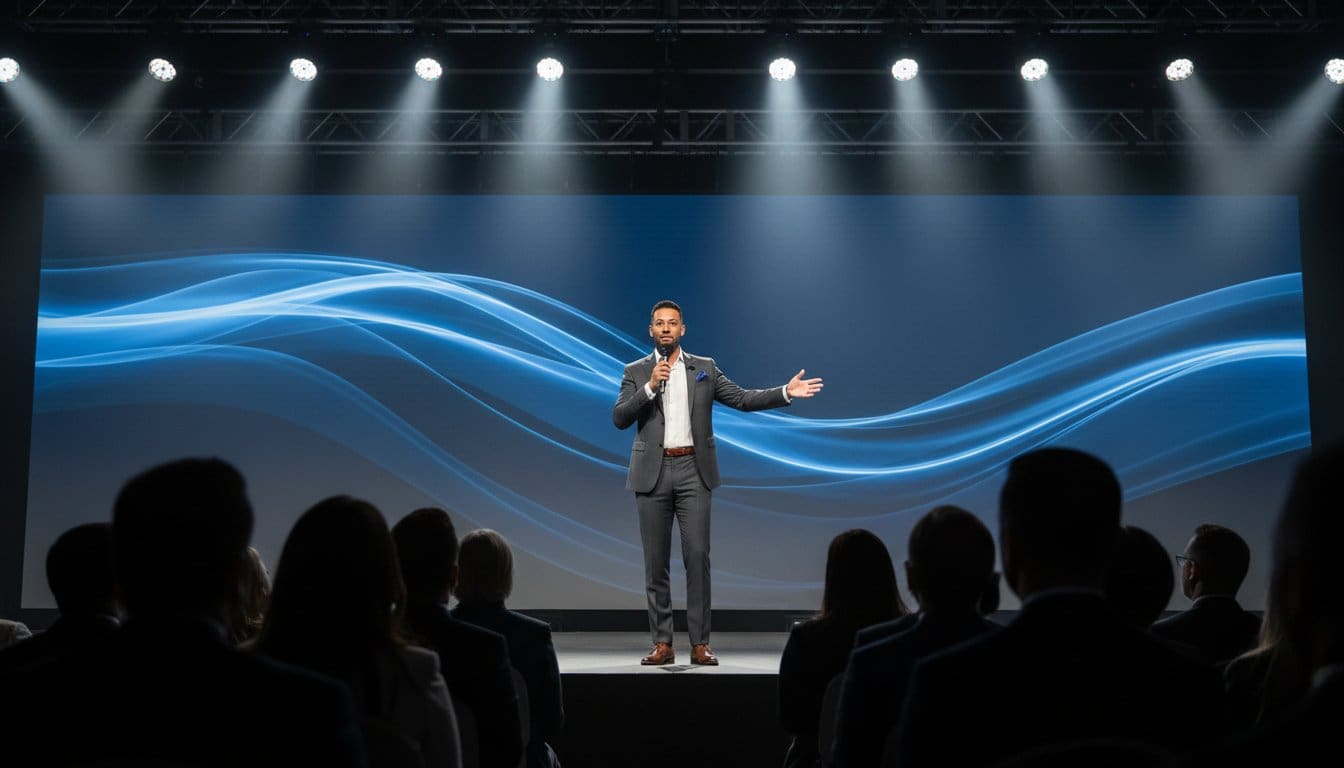
Hire a Master of Ceremonies: The Strategic Guide to Event ROI
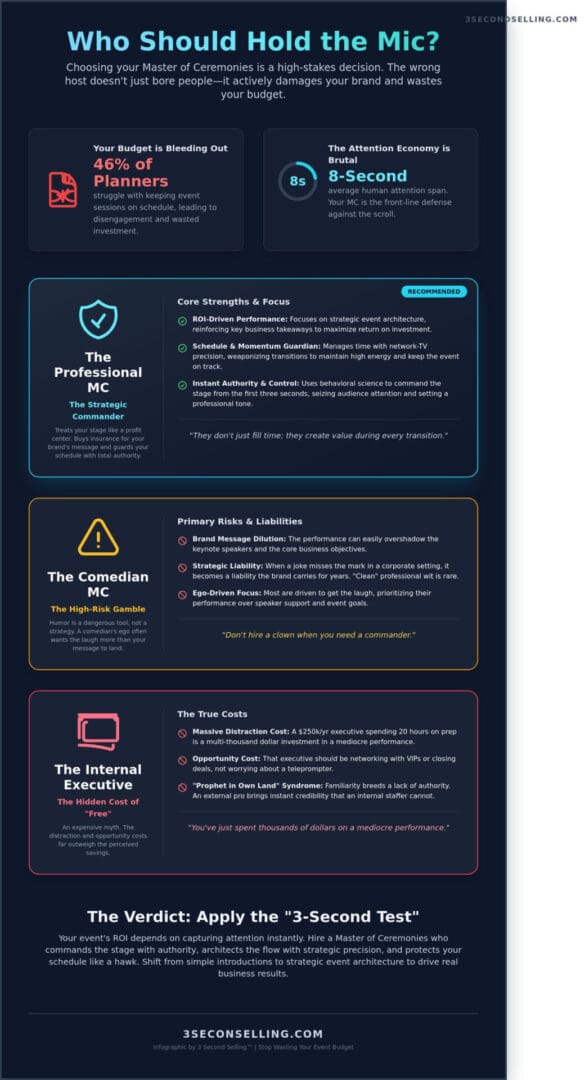
Your $100,000 event budget is bleeding out. It happens the moment a guest looks at their phone or a speaker ignores their time limit. Data from EventMB indicates that 46% of planners struggle with keeping sessions on track, and that’s a recipe for a dead room. To stop the rot, you must hire a master of ceremonies who treats your stage like a profit center. A professional doesn’t just read names. They manufacture momentum and guard your schedule with total authority.
You’ve seen the energy evaporate when a nervous executive stumbles through a script. It’s painful. It’s expensive. This guide shows you how to hire a master of ceremonies who captures the attention economy and turns your event into a revenue-driving machine. You’ll learn the exact framework to find a host who bridges segments with strategic messaging and keeps your audience locked in from the first three seconds to the final applause.
Key Takeaways
- Stop setting your event budget on fire and learn how to dominate the attention economy to drive real ROI.
- Understand why humor is a tool, not a strategy, and why a comedian is often a strategic liability for your corporate message.
- Apply the “3-second test” to hire a master of ceremonies who commands the stage with instant authority and professional presence.
- Leverage behavioral science and network-TV precision to “stop the scroll” and keep your audience locked into your brand’s narrative.
- Shift from simple introductions to strategic event architecture to protect your schedule and reinforce your most critical business takeaways.
What Does a Master of Ceremonies Actually Do?
Stop thinking of a Master of Ceremonies as a glorified human teleprompter. If you pay someone just to read names off a card, you’re lighting your budget on fire. A professional is the strategic architect of your event’s flow and the primary guardian of your audience’s focus. They don’t just “introduce people”; they weaponize transitions to keep momentum high. When you hire master of ceremonies experts, you’re buying insurance for your brand’s message. They act as the bridge between your corporate objectives and the audience’s emotional state, ensuring the “red thread” of your theme never breaks.
Every second on stage is a high-stakes battle against distraction. According to a 2015 Microsoft study, the average human attention span has plummeted to just eight seconds. This means your MC is your front-line defender against the smartphone in every attendee’s pocket. They manage technical glitches with such grace that the audience thinks the mistake was scripted. They reinforce key takeaways so your message actually sticks. Without this strategic oversight, your event is just a series of disconnected speeches. With it, it becomes a high-conversion machine.
The Timekeeper vs. The Strategic Host
A bio is not a script. Amateurs read facts; strategic hosts build anticipation. If you hire master of ceremonies talent who only watches the clock, you’ve failed. A pro prepares for the 15% of event elements that inevitably go wrong, like a speaker’s late arrival or a mic failure. They maintain the event’s “red thread” by connecting every speaker’s point back to your core business goals. They don’t just fill time; they create value during every transition.
The Psychology of the First Three Seconds
Your event lives or dies in the opening 180 seconds. Attention Economy is the primary currency of modern events. A 2018 Prezi report found that 55% of professionals say a great story keeps them engaged, while 49% admit to being distracted during average presentations. Professional MCs use behavioral cues like the “power stance” and purposeful silence to command immediate authority. They don’t ask for attention. They seize it, setting a high-energy tone that dictates the success of the entire day.
Comedian vs. Professional vs. Internal: Comparing Your Options
Stop treating your stage like an open mic night. Your event ROI depends entirely on who holds the microphone. If you hire master of ceremonies talent based on “personality” alone, you’re gambling with your brand. Choosing the wrong host doesn’t just bore people; it actively alienates your audience and dilutes your core message. You need a strategist who controls the room, not a warm body filling space.
Professionalism isn’t a luxury. It’s the engine of your production. A professional MC offers the highest ROI because they treat your schedule as a legal contract. They don’t just talk. They manage energy, fix technical glitches on the fly, and ensure your speakers look like rockstars. This level of control is what separates a high-stakes corporate event from a disorganized hobbyist gathering.
The Comedian MC: High Risk, High Reward?
Humor is a dangerous tool. It’s not a strategy. When a comedian misses the mark, they become a liability that your brand carries for years. Corporate settings require “clean” professional wit, not a stand-up set. Most comedians are ego-driven; they want the laugh more than they want your message to land. If their performance overshadows your keynote, you’ve failed. An effective master of ceremonies knows that the audience’s attention belongs to the event goals, not the host’s ego. Don’t hire a clown when you need a commander.
The Internal Executive Host: The Hidden Cost of “Free”
The “free” internal host is an expensive myth. Calculate the distraction cost. If your VP of Sales earns $250,000 annually and spends 20 hours prepping, rehearsing, and obsessing over microphone checks, you’ve just spent thousands of dollars on a mediocre performance. That VP should be in the hallways closing deals or networking with VIPs, not worrying about the teleprompter.
There is also the “prophet in your own land” syndrome. Your team sees this executive every Tuesday in the breakroom. Familiarity breeds a lack of authority. An outside professional brings an air of importance that an internal staff member cannot replicate. When you hire master of ceremonies experts from the outside, you’re buying instant credibility and room control. If you want to stop wasting your leadership’s time and start seeing real engagement, you must optimize your stage presence with a dedicated pro.
- Professional MCs: Focus on ROI, timing, and speaker support.
- Comedians: Focus on laughs, often at the expense of the schedule.
- Internal Hosts: Focus on survival, costing you thousands in lost opportunity.
Results require a specialist. Every second your host is on stage is a second you’ve paid for. Make it count by choosing the only option that views your event as a business objective rather than a performance opportunity.
Why Your Event ROI Depends on the Attention Economy
Stop setting your event budget on fire. If your audience is scrolling through LinkedIn while your $15,000 keynote speaker is on stage, you’ve lost. You aren’t just competing with other events; you’re competing with every notification, email, and dopamine hit sitting in your attendees’ pockets. Attention is the only currency that matters in a ballroom. When you hire master of ceremonies professionals, you aren’t just paying for a host. You’re buying a human firewall against distraction.
Professional MCs use StorySelling™ techniques to transform even the most mundane segments. Housekeeping announcements about fire exits or lunch locations are usually the moment people tune out. A pro turns these into narrative hooks. They explain the “why” before the “where,” ensuring the brain stays engaged. This isn’t fluff. It’s biological necessity. Research from the University of New South Wales shows that split attention can reduce information retention by over 50%. An MC prevents this drop-off by commanding the room’s collective focus.
Managing the “afternoon slump” is a technical skill, not a happy accident. Between 2:00 PM and 3:00 PM, human circadian rhythms cause a natural dip in glucose and alertness. A mediocre host ignores this. A master MC recognizes the shift in body language and uses physical triggers to reset the room’s energy levels. They don’t just talk; they engineer the environment to ensure your ROI doesn’t plummet after the lunch break.
Capturing and Keeping Visual and Auditory Focus
Focus is fragile. A pro MC uses vocal variety and deliberate stage movement to keep the audience’s eyes off their phones. They utilize the 3-Second Rule: if the sensory input doesn’t change or provide new value every few seconds, the brain seeks stimulation elsewhere. By varying their pitch and moving to specific “power spots” on stage, they force the audience’s reticular activating system to stay alert. When you hire master of ceremonies experts, they act as the ultimate wingman for your “hero” speakers, priming the audience so the message actually lands.
Reinforcing the Message through Strategic Recaps
Most attendees forget 70% of what they hear within 24 hours. A master MC stops this leakage through active listening and strategic synthesis. They don’t just introduce the next person; they bridge the gap. They turn complex 45-minute keynotes into three actionable soundbites. This creates a cohesive narrative out of disparate sessions. By repeating the core themes in different ways, the MC ensures the “big ideas” of your event are the ones that actually make it home in the attendees’ notebooks.
How to Hire a Master of Ceremonies: The 3-Second Test
Stop hiring for laughs. Comedy is cheap; command is expensive. When you hire master of ceremonies talent, you aren’t buying a stand-up routine. You’re buying a psychological anchor for your audience’s attention. If they don’t own the room in the first three seconds, your ROI is already bleeding out. Every second of silence or awkwardness is a withdrawal from your brand’s credibility bank.
Run the “Sound Off” test. Watch their highlight reel with the volume at zero. Do they look like a leader or a cheerleader? If their body language doesn’t project authority without a single word, they’ll never hold a room of 400 distracted executives. Authority is visceral. It’s in the posture, the eye contact, and the stillness. If they’re fidgeting on screen, they’ll lose your audience to their smartphones in minutes.
Demand a “disaster recovery” plan. A 2023 industry report by EventMB noted that 82% of event planners face technical glitches. Ask your candidate exactly how they handled a total audio failure or a speaker who fainted. You don’t want a script-reader; you want a combat-ready professional who can turn a 15-minute delay into a brand-building moment. Finally, evaluate their prep. If they only ask for speaker bios, they’re a hobbyist. A master asks for your conversion goals and your audience’s pain points.
Vetting the Experience Level
There is a massive chasm between a wedding DJ and a corporate MC. A wedding DJ manages a playlist; a corporate MC manages energy and economics. Prioritize candidates with live broadcasting or TV news backgrounds. These professionals are trained to handle live pressure where every second can represent $5,000 in lost ad revenue. Check references for “ease of collaboration” and “professionalism.” You need a partner who simplifies your logistics, not a diva who adds to your stress.
The Pre-Event Strategy Call
The strategy call is your final filter. Ask three specific questions: How do you handle a speaker who runs five minutes over? What is your strategy for the post-lunch energy slump? How do you ensure the tone aligns with our brand voice? If their answers are vague, move on. Ensure they understand the 3-Second Selling framework for introductions. Every intro must grab the gut, not just list credentials. If they can’t sell the speaker in three seconds, the audience won’t buy the message.
Level Up Your Event with 3 Second Selling™
David Gee brings the surgical precision of a network TV news anchor to your stage. In a newsroom, you have exactly three seconds to stop a viewer from changing the channel. Your event operates under the same brutal reality. We don’t just host; we apply behavioral science to keep your audience locked in. Most corporate events lose 25% of their audience’s mental focus within the first ten minutes. Our approach stops that bleed immediately. We provide MC services designed specifically for environments where the message is too important to be ignored. You need to capture attention. You must hold it. You have to convert it into event success. Anything less is a waste of your budget.
The David Gee Advantage: From TV News to Your Stage
High-stakes communication training translates to flawless event execution. David Gee spent years in the high-pressure environment of live television, where every syllable costs money and every mistake is public. This background allows him to handle stage disruptions with total composure. The 3 Second Selling approach focuses on stage presence and immediate audience connection. When you hire master of ceremonies experts who understand psychology, you win the battle for the room. David is the primary choice for national sales meetings and leadership summits because he understands that attention is a monopoly. You either own it or your competitors do. He ensures your leadership’s message lands with 100% impact.
Booking Your Strategic Event Partner
Our collaborative process is rigorous. It begins with a deep-dive briefing where we dissect your goals and ends only after the final applause. We don’t just show up and read a script. We integrate professional emcee services with keynote experiences to create a seamless, high-energy narrative. This ensures your ROI isn’t left to chance. If you want a partner who treats your event like a mission-critical operation, we should talk. Every second on that stage has a price tag attached to it. Make sure those seconds are working for you, not against you.
Stop leaving your audience engagement to luck.
Schedule a strategy call with 3 Second Selling today to secure David Gee for your next high-stakes event.
Stop Gambling With Your Audience’s Attention
Your event budget is a dead weight if your audience checks out within the first 3 seconds. Data on human focus suggests you have less than a heartbeat to hook a room before they retreat to their smartphones. Why risk your entire ROI on a nervous internal manager or a generic comedian who doesn’t understand your bottom line? It’s a fast track to a flat atmosphere and wasted capital. You need a professional who understands the attention economy at a visceral level to maintain a total monopoly over the room’s energy.
David Gee applies the 3 Second Selling™ framework to ensure your message hits with the impact of a sledgehammer. As a former Network TV News Anchor, he brings the high-stakes precision of a broadcast professional to your stage. He has already secured the success of national sales and leadership summits for organizations that demand measurable results. When you hire master of ceremonies experts with this level of front-line experience, you aren’t just filling a slot on the agenda. You’re installing a high-speed conversion engine. You don’t just want a speaker; you want a master of the stage who leaves nothing to chance.
Don’t leave your event’s attention to chance. Hire David Gee today.
Take control of the room and watch your engagement metrics climb. Your audience is ready for a leader, so give them the best.
Frequently Asked Questions
How much does it cost to hire a professional Master of Ceremonies?
Expect to pay between $2,500 and $10,000 for a high-caliber professional who understands event ROI. Top-tier talent with national broadcast experience or specialized industry expertise often commands $15,000 or more per day. Don’t gamble your entire budget on a bargain-bin host. A 20% increase in audience engagement justifies the premium price tag every single time.
What is the difference between an MC and an Emcee?
There’s zero functional difference between the two terms. “Emcee” is simply the phonetic spelling of the abbreviation for Master of Ceremonies. Whether you use the formal title or the phonetic version, the objective remains the same: total audience control. Focus on their track record and ability to command a room rather than the spelling on their business card.
Can an MC also provide a keynote presentation?
Yes, elite professionals often double as keynote speakers to maximize your budget efficiency. Booking one person for both roles can save you 30% on travel and logistical costs while ensuring a seamless narrative thread throughout the day. Ensure they have a proven 45 minute signature talk that aligns with your specific theme. If they can’t deliver a high-impact message and manage the clock, they aren’t the right fit for your stage.
How far in advance should I book an MC for a corporate conference?
You should hire a master of ceremonies 6 to 9 months before your event date. The top 5% of performers book their calendars 12 months in advance. Waiting until 90 days out means you’re picking from the leftovers who couldn’t fill their schedule. Secure your lead talent early to ensure they are integrated into your strategy from the very first planning meeting.
What information does a professional MC need during the planning phase?
Hand over the granular details: the 3 core objectives, detailed attendee demographics, and the full speaker list. They need the “who, what, and why” for every single segment. Provide the sponsor list 4 weeks early so they can weave brand mentions naturally into the transitions. If you hide the internal politics or “landmines,” they can’t protect your reputation on stage.
Does an MC help with the event script and run-of-show?
A true pro doesn’t just read the script; they fix it. Expect them to audit your run-of-show to eliminate “dead air” and timing bottlenecks. 80% of corporate agendas are overstuffed and lose the audience by lunch. Your MC will cut the fluff to ensure the energy stays high. If they don’t ask to see your timeline during the first discovery call, you’re talking to an amateur.
How does an MC handle a virtual or hybrid event differently?
Virtual events demand a “TV host” mentality rather than a traditional stage presence. The MC must look directly into the lens to maintain a 1:1 connection with the 40% of your audience watching remotely. They bridge the gap by acknowledging the digital chat and keeping the pace tight. In hybrid settings, they act as the glue, ensuring the remote viewers never feel like an afterthought.
What happens if a speaker runs over their allotted time?
The MC is your enforcer. When a speaker hits the 120 second mark past their limit, the MC uses pre-arranged visual cues from the wings. If the speaker ignores the signal, the MC physically enters the stage to lead the audience in applause and transition to the next segment. It’s not rude; it’s necessary. Protecting the schedule is the only way to respect the audience’s time and your event’s credibility.