

Empathy in Sales: The 3-Second Edge for Closing Deals in 2026
Your “soft” approach to empathy is killing your pipeline. In a market where 92% of B2B buyers ignore cold outreach, trying to be “nice” makes you look like every other desperate commodity seller. If you aren’t using empathy in sales as a tactical weapon to hijack the prospect’s attention in the first three seconds, you’re already invisible. You’ve felt the sting of a prospect hanging up before you even finish your opening pitch. It is brutal. Building trust over a grainy virtual meeting often feels like trying to win a marathon in quicksand while your competition sprints ahead.
You deserve a sales machine that works. I am going to show you how to weaponize empathy to seize an absolute attention monopoly. This isn’t about “feeling” for your client; it is about high-speed psychological dominance that builds instant, unshakable trust. You’ll walk away with a repeatable framework designed to spike your conversion rates and turn cold outreach into a predictable stream of revenue. We are breaking down the exact neurobiology of the 3-second edge and the tactical shifts required to dominate the 2026 selling environment.
Key Takeaways
- Stop treating empathy as a soft emotion and start using cognitive empathy to map your prospect’s mental state and logic with surgical precision.
- Hack the amygdala to silence the “salesy” alarm and crush defensive barriers in the first three seconds of every interaction.
- Deploy tactical empathy in sales through a 4-step framework that turns active listening and emotional labeling into a high-speed closing weapon.
- Identify the “fake empathy” traps that signal manipulation and learn why forced rapport is the fastest way to kill your conversion rates.
- Scale your influence by integrating the StorySelling™ framework into your collateral, proving you understand the prospect’s world better than they do.
What is Empathy in Sales? Redefining the Ultimate Revenue Tool
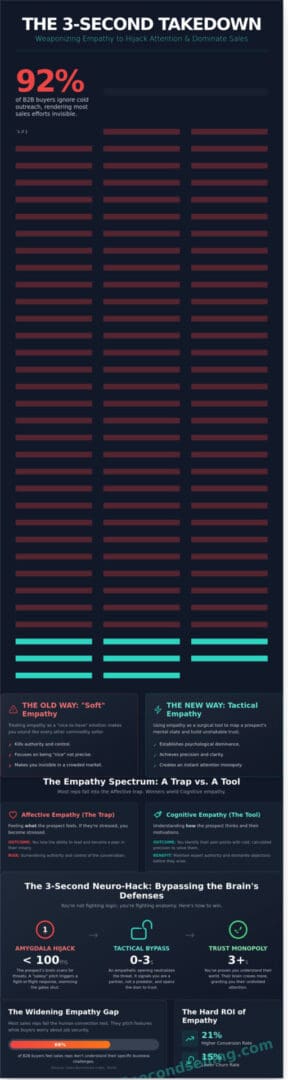
Stop thinking about empathy as a “nice-to-have” personality trait. In the high-stakes environment of 2026, mastering empathy in sales is about psychological mapping. It is the surgical ability to plot a prospect’s mental state with 100% accuracy. If you can’t see the world through their lens, you’re just another noise in their inbox. Most reps fail because they mistake empathy for being “nice.” Nice doesn’t close deals. Precision does.
You must distinguish between two distinct types of connection. Affective Empathy is the act of feeling what the prospect feels. This is a trap. If your prospect is stressed and you become stressed, you lose your ability to lead. Cognitive Empathy is the superior tool for high-stakes negotiation. It is the cold, calculated understanding of their logic and motivations. You don’t need to share their pain; you need to identify it so you can solve it. This logical clarity allows you to dismantle objections before they are even voiced.
The “Empathy Gap” is widening. A 2024 study by the Sales Benchmark Index revealed that 68% of B2B buyers feel sales reps don’t understand their specific business challenges. Most pitches are “me-centric” ego-dumps. They focus on features while the prospect is worried about their quarterly bonus or job security. In 2026, the human-connection test is the only filter that matters. If you don’t pass it in the first few seconds, you’re deleted.
The Difference Between Sympathy and Tactical Empathy
Sympathy is a deal-killer. When you pity a prospect, you surrender your authority as a consultant. You become a peer in their misery rather than the expert who can lead them out of it. We use Tactical Empathy instead. This is the conscious act of recognizing emotions without absorbing them. It allows you to stay in control while the prospect feels completely understood.
- Tactical Empathy: The deliberate application of emotional intelligence to identify and label a prospect’s perspective to influence their decision-making process.
- Authority: You remain the dominant expert while validating their reality.
- Leverage: Labeling a fear often de-escalates it instantly.
Why Empathy is a Hard Skill, Not a Soft One
Stop calling it a soft skill. Empathy in sales is a revenue driver with measurable ROI. Companies that prioritize buyer-centric empathy see 15% lower churn rates and 21% higher conversion on discovery calls. Ego-selling, where the rep talks 80% of the time, is a cost center. It drives prospects away and burns your lead list.
The “3-Second Trust Window” is your only opportunity. In this timeframe, a prospect’s lizard brain decides if you’re a threat, a nuisance, or a partner. You win that window by proving you understand their specific situation better than they do. When you nail their pain points in the first three seconds, you gain a monopoly on their attention. This isn’t about being friendly; it’s about being the only person in the room who actually knows what’s at stake for them.
The Behavioral Science of the 3-Second Connection
Your prospect’s brain isn’t looking for a solution. It’s looking for a threat. Within the first 100 milliseconds of a call, the amygdala performs a “friend or foe” scan. If you sound like a typical salesperson, the gates slam shut. Using empathy in sales isn’t just a soft skill; it’s a tactical neuro-hack that bypasses this biological security system. You aren’t fighting their logic; you’re fighting their anatomy.
The Mirror Neuron system ensures that your emotional state is contagious. If you approach a virtual meeting with the “commission breath” of a desperate closer, your prospect’s brain mirrors that anxiety. However, when you project genuine understanding, their mirror neurons fire in sync with yours. This creates a shared neural state that makes resistance nearly impossible. The brain craves being understood more than it craves a bargain. Stop pitching and start proving that you see the world through their eyes.
Bypassing the Amygdala Hijack
A cold call triggers the same physiological response as a predator in the wild. Cortisol spikes. Heart rate increases. The prospect enters a “fight or flight” state. Research from Princeton University in 2006 confirms that humans form a judgment on trustworthiness in less than a tenth of a second. You don’t have minutes to build rapport; you have a heartbeat. An empathetic opening statement, such as acknowledging their current pressure or a specific industry pain, neutralizes this reaction. It signals to the brain that you aren’t a predator, effectively shutting down the hijack before it starts.
The Dopamine Hit of Being Heard
The human brain rewards self-disclosure. A 2012 Harvard study revealed that talking about oneself activates the same reward centers as food and money. Specifically, it triggers the nucleus accumbens. When you use empathy in sales to make the prospect the hero of the conversation, you’re giving them a hit of dopamine. This is why the 3 Second Selling philosophy focuses on earning attention through deep listening. You aren’t just talking; you’re triggering a chemical reward that makes them want to keep the conversation alive.
- The 100ms Rule: Trust is decided in the time it takes to blink.
- Self-Disclosure: Roughly 30% to 40% of everyday speech is used to inform others about our private experiences because it feels good.
- Neural Coupling: When a salesperson shows empathy, the listener’s brain activity mirrors the speaker’s, creating a “oneness” that closes deals.
How to Practice Tactical Empathy: A 4-Step Framework
Stop talking. Most salespeople lose deals because they’re addicted to the sound of their own pitch. In 2026, buyers are exhausted by AI-generated noise and scripted sequences. They don’t want a presentation; they want to be understood. Tactical empathy in sales isn’t about being “nice” or agreeing with the prospect. It’s about the cold, calculated acquisition of emotional data to dismantle objections before they’re even voiced.
- Step 1: Level Up Your Listening. Stop waiting for your turn to speak. Listen for the subtext. 93% of communication is non-verbal or tonal. If their voice drops when mentioning “budget,” you’ve found a pain point.
- Step 2: Labeling. Give the emotion a name. This deactivates the amygdala; the brain’s fear center.
- Step 3: Mirroring. Repeat the last 1 to 3 critical words the prospect said. It forces them to elaborate without you asking a single intrusive question.
- Step 4: Calibrated Questions. Shift the burden of the solution onto them. Use “How” and “What” to move from raw emotion to logical problem-solving.
The Art of Labeling and Mirroring
Labels always start with “It seems like,” “It sounds like,” or “It looks like.” Never use “I.” Using “I” makes it about you; using “It” makes it about them. When you mirror, you’re a human echo. If a prospect says, “The implementation timeline is too aggressive,” you simply say, “Too aggressive?” and shut up. They’ll fill the silence with the real reason they’re scared. This is how you master empathy in sales without looking like a therapist.
| Bad Response (Sympathy) | Empathetic Label (Tactical) |
|---|---|
| “I understand your frustration with the price.” | “It seems like you’re worried about the ROI on this.” |
| “Don’t worry, we can move faster.” | “It looks like you feel pressured by the deadline.” |
Asking Questions That Open Doors
Eliminate “Why” from your vocabulary. “Why” is an accusation. It puts people on the defensive. Instead, use “How” and “What.” Ask: “How am I supposed to do that?” or “What is it about this project that keeps you up at night?” These questions force the prospect to think. They stop reacting and start collaborating. You aren’t selling anymore; you’re helping them navigate their own internal bureaucracy to get the deal done.
Mirroring vs. Mimicking: Avoiding the Fake Empathy Trap
Stop treating empathy like a manipulative script. Most sales reps fail because they try to hack rapport with surface-level mirroring. They repeat the prospect’s last three words or comment on the weather. It’s transparent. It’s weak. A 2023 analysis of sales call data indicates that forced rapport building at the start of a call can actually decrease success rates by 2.1 percent. Using empathy in sales as a tactical weapon is a recipe for disaster. Prospects don’t want a friend; they want a solution. Real empathy in sales is a surgical tool, not a social lubricant.
The Danger of Scripted Rapport
Asking “How is the weather?” is the fastest way to signal you have nothing of value to say. It’s the opposite of empathy. You’re wasting their most precious asset: time. Switch to micro-empathy. If a prospect sounds stressed, label it immediately. Say, “It sounds like you’re handling a crisis.” This isn’t small talk. It’s a demonstration that you understand their current reality. Genuine curiosity uncovers the 15 percent of the problem they haven’t told anyone else yet. Tactical manipulation just gets you a “not interested” click.
High-Stakes Communication Lessons
Professional news anchors don’t have time for pleasantries. They have 90 seconds to get to the heart of a story. They use vocal tonality to command the room. In sales, your vibe speaks louder than your pitch. A 2022 study on vocal patterns found that a downward inflection at the end of sentences increases perceived authority and trust. If you sound like you’re asking for permission, you’ve already lost the attention monopoly.
Perform a tonality check today. Record your discovery calls and listen to your pitch. If you sound like a scripted robot, your prospect’s BS detector is already screaming. You don’t need more time on a 15-minute call; you need more intensity. Master the art of the 3-second emotional connection to stop losing deals to fake rapport.
Scaling Empathy with the StorySelling™ Framework
Empathy isn’t a soft skill for coffee breaks. It’s the high-octane fuel for your sales collateral. If your ads and decks look like every other generic pitch, you’re invisible. You have three seconds to prove you understand their pain better than they do. Scaling empathy in sales requires moving beyond one-on-one calls into your entire marketing DNA. You bake it in by identifying the specific, visceral frustrations your prospect faces at 2:00 AM. Stop selling features. Start selling the fact that you’ve been in the trenches with them. The StorySelling™ framework transforms you from a vendor into a guide. It shifts the narrative from “Look what I can do” to “I know exactly where you’re stuck, and here’s the exit.”
Using Stories to Demonstrate Empathy
Your prospect is the hero. Your product is merely the tool they use to slay the dragon. Most case studies are boring lists of ROI. They fail because they skip the blood, sweat, and tears. Research from the Stanford Graduate School of Business shows that stories are remembered up to 22 times more than facts alone. Focus on the struggle. Describe the sleepless nights and the failing systems that preceded the win. If you don’t describe the pain, the solution feels cheap. Use this template for your next pitch:
- The Conflict: The Hero faces a specific Villain, like a 15% drop in lead quality.
- The Empathetic Pivot: You demonstrate you’ve felt that exact pressure.
- The Resolution: The Hero uses your method to regain market dominance.
Next Steps: Level Up Your Team
Stop letting your team wing it. Most sales scripts are empathy deserts. They’re filled with “we” and “our” instead of “you” and “your.” Audit your scripts today. Count the “you” vs. “we” ratio. If it’s not at least a 3:1 ratio, you’re losing money. Use role-playing to build empathy muscles. Don’t just practice the pitch; practice the active listening. Force your reps to repeat the prospect’s emotional state before they’re allowed to offer a solution. This ensures the prospect feels seen, not just processed. Ready to turn your team into a high-conversion machine? Book David Gee for a StorySelling™ Workshop and start dominating your market through radical understanding.
Own the First 3 Seconds or Lose the Deal
The sales landscape of 2026 does not tolerate hesitation. You have exactly 3 seconds to trigger a visceral connection or your prospect’s attention vanishes. This is not a theory. It is the hard reality of communication psychology. If you fail to weaponize empathy in sales, you are essentially handing your market share to competitors who understand behavioral science. Tactical empathy is the difference between a closed deal and a cold trail.
David Gee developed the 3 Second Selling™ proprietary framework during his career as a Network TV News Anchor. He knows how to capture a distracted audience instantly. By applying his 4-step framework and the StorySelling™ method, you transform from a vendor into a trusted authority. You stop mimicking and start mirroring the exact psychological needs of your buyer. This is how you build an unstoppable sales machine that dominates the market. Every second you spend using outdated tactics is a second your revenue decreases.
The window of opportunity is closing. You can either master these science-backed techniques or continue wondering why your conversion rates are stalling. Stop the scroll and start closing. Book David Gee for your next sales keynote. Take control of your results today. You have the tools to win.
Frequently Asked Questions
Is empathy in sales the same as being a “pushover”?
Empathy is a tactical weapon, not a sign of weakness. Being a “pushover” means you cave on price or terms; empathy means you demonstrate you understand the prospect’s world so they lower their guard. According to Chris Voss, a former FBI negotiator, empathy is about identifying the external forces and internal emotions driving the other party. You don’t have to agree with their perspective to use it to close the deal.
How do I show empathy in a cold email without it looking fake?
Stop using generic “I hope you are well” fluff that 90% of sellers use. Real empathy in sales starts with a specific observation about their business or a recent 2024 industry shift. Use a “label” like “It seems like you are frustrated with [Specific Problem].” This shows you did the work. If you don’t name a concrete pain point, you aren’t being empathetic; you’re just being another spammer in their inbox.
Can empathy be taught to salespeople who are naturally analytical?
Analytical minds excel at empathy once they realize it’s a data-gathering exercise. You don’t need to “feel” their pain; you need to identify it. A 2023 study by Gong found that top performers spend 15% more time labeling emotions than average reps. Teach your analytical team to look for verbal cues like tone shifts or specific “trigger words.” It’s a skill set, not a personality trait.
What is the “Empathy Reflex” and how do I develop it?
The Empathy Reflex is an immediate, non-judgmental response to a prospect’s emotional state. You develop it through “Tactical Labeling” practice. When a prospect says “We’ve tried this before,” your reflex shouldn’t be to defend. Instead, say “It sounds like you’ve been burned by past vendors.” Do this 20 times a day. By the 21st time, your brain will automatically hunt for the emotion instead of the argument.
How does empathy help in handling price objections?
Price objections are rarely about the math; they’re about the fear of making a mistake. When a prospect says “It’s too expensive,” an empathetic seller responds with “It seems like you’re worried about the ROI on this investment.” This shifts the conversation from your pocket to their security. Data shows that 74% of buyers choose the salesperson who first provides value and insight into their specific challenges.
What happens if I misidentify a prospect’s emotion when labeling?
Mislabeling is actually a shortcut to the truth. If you say “It seems like you’re worried about the timeline” and they respond with “No, I’m worried about the integration,” you just won. They corrected you and gave you the real objection. Don’t fear being wrong. A 2022 Harvard Business Review report suggests that being corrected by a prospect increases their feeling of being heard and understood.
Does empathy work in B2B sales as well as B2C?
Companies don’t sign contracts; people with mortgages and reputations do. In B2B, the stakes are higher because a bad decision can cost someone their job. Empathy in sales is even more critical here because you’re navigating a committee of 6 to 10 stakeholders. Each person has a different fear. If you can’t identify those individual pressures, your 2026 sales targets are dead on arrival.
How many seconds do I actually have to establish an empathetic connection?
You have exactly 3 seconds before a prospect’s “sales filter” kicks in. In that window, your tone must signal that you aren’t a threat. Research on first impressions shows that humans make snap judgments about trust in under 100 milliseconds. If your first sentence isn’t focused on them, you’ve lost. Use those 3 seconds to prove you’re an ally, or get used to hearing dial tones.