

Sales Psychology Myths: Why Everything You Learned About Persuasion is Failing in 2026
Your “proven” sales templates are currently being ignored by 91% of your prospects. It’s a cold reality. You’re likely watching your response rates crater while your competition treats you like a replaceable commodity. You’ve mastered traditional sales psychology, but the triggers that worked in 2020 are failing in 2026. Your audience’s attention span has shrunk to a mere 3 seconds. If you don’t trigger a visceral reaction in that heartbeat, you’re invisible. You’re not just fighting for a sale; you’re fighting for a monopoly on their focus.
You need a system that forces a “yes” before they even realize they’re being sold to. This guide will show you how to weaponize the 3-second rule to dominate the modern market and stop the endless scroll. We’ll provide a practical framework to apply behavioral science to every email and pitch you send. You’ll discover how to transform from a desperate seller into a dominant market leader. Get ready to reclaim control and drive immediate action.
Key Takeaways
- Stop wasting time on outdated persuasion tactics that prospects now treat as noise; win the battle for cognitive bandwidth instead.
- Learn to bypass the Amygdala’s 3-second attention filter before the prospect’s brain decides to ignore your message forever.
- Discover why “classic” triggers like reciprocity are actually killing your deals and how to pivot using modern sales psychology.
- Weaponize “Vivid Pain” and “Micro-Curiosity” to bypass logic and keep prospects leaning in through a strategic dopamine loop.
- Replace broken messaging with the 3 Second Selling™ framework to turn your sales process into a dominant, result-oriented market force.
The Great Persuasion Lie: Why Traditional Sales Psychology No Longer Closes Deals
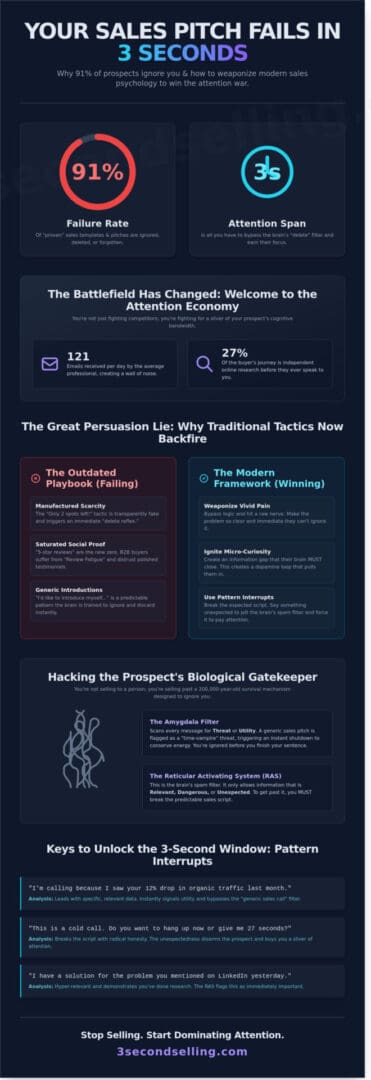
Your prospect’s brain is a fortress. Old-school sales psychology tricks are the equivalent of throwing pebbles at a tank. You aren’t just fighting competitors; you’re fighting for cognitive bandwidth. In 2024, the average professional receives 121 emails per day according to Radicati Group data. They don’t have time for your “influence” tactics. We’ve exited the Information Age and entered a brutal Attention Economy. If you can’t seize focus in three seconds, you’re invisible.
The principles of influence have become the sounds of the jungle. They are background noise. Every amateur with a LinkedIn account tries the same hacks. This has forced prospects to adopt a “Truth Protocol.” They are smarter, faster, and more skeptical than any generation before them. They don’t just want information; they want to know if you’re wasting their time. If they sense a script, they’re gone. Modern sales psychology is no longer about pulling emotional levers. It is about winning the war for mental energy.
The game has changed because the stakes have risen. Buyers now conduct 27% of their purchase journey through independent online research before ever speaking to you. They aren’t looking for a pitch; they’re looking for a reason to trust you. If your strategy relies on 40-year-old psychological shortcuts, you’ve already lost the deal.
The Saturation of Social Proof
5-star reviews are the new zero. A 2023 BrightLocal survey indicates that while 46% of consumers might trust reviews, B2B decision-makers suffer from “Review Fatigue.” They’ve seen too many “Best in Class” badges bought for a few hundred dollars. Manufactured credibility is now a liability. Organic credibility requires raw, unpolished proof. Prospects want to see the struggle and the solution, not a sanitized testimonial that sounds like it was written by your marketing department.
The Death of Manufactured Scarcity
The “only 2 spots left” line is a relic of the 90s. It triggers an immediate delete reflex because it’s transparently fake. When you use manufactured pressure, you lose authority immediately. High-pressure tactics backfire because people hate being sold but love to buy. Psychological Reactance is the unpleasant motivational arousal that emerges when people experience a threat to or loss of their free behaviors. Stop pushing. Start positioning your offer as the only logical choice for their survival.
The Biological Reality: Survival Instincts and the 3-Second Attention Filter
Your prospect’s brain doesn’t care about your sales quota. It cares about survival. The Amygdala acts as a ruthless gatekeeper, scanning every incoming stimulus for two things: threat or utility. If you lead with a generic pitch, you’re immediately flagged as a “time-vampire.” The brain shuts down to conserve energy. You lose the deal before you’ve even finished your name. This is the foundation of sales psychology; you aren’t fighting a competitor, you’re fighting a biological filter designed to ignore you.
Boredom isn’t just a nuisance. It’s a biological tax. When the brain detects a repetitive or predictable pattern, it stops allocating glucose to that task. If you don’t spark curiosity in three seconds, the “Stop the Scroll” reflex kicks in. You’ve got exactly 180 frames of video or roughly 10 words to prove you aren’t a waste of space. If you fail, the prospect’s attention moves to the next dopamine hit. Your next 30 minutes of presentation are worthless if you don’t win the first three seconds.
The Reticular Activating System (RAS) in Sales
The RAS is the brain’s spam filter. It only lets in what’s relevant, dangerous, or unexpected. To bypass it, you must use a pattern interrupt. Stop saying “I’d like to introduce myself.” It’s a mental trigger for “delete.” Instead, use lines that break the expected script. Try these cold call openers:
- “I’m calling because I saw your 12% drop in organic traffic last month.”
- “This is a cold call. Do you want to hang up now or give me 27 seconds?”
- “I have a solution for the problem you mentioned on LinkedIn yesterday.”
These lines disrupt the pattern. When you break the “expected” sales script, the RAS forces the brain to pay attention to the new, unexplained stimulus. You’ve effectively hacked the gatekeeper.
The 3-Second Rule of Engagement
The first three seconds are your Golden Window. Research from 3M shows the human brain processes visuals 60,000 times faster than text. This means your visual “Anchor” is set before you even speak. If you’re on a video call, your background and posture communicate authority or desperation instantly. On a phone call, your tonality takes over. A hesitant, rising inflection at the end of a sentence signals a lack of conviction. You must project a “Dominance Anchor” to be taken seriously. You can master these instant persuasion triggers to ensure you never get filtered out again. Every second you spend being “polite” and “standard” is a second you spend losing the deal. In the world of sales psychology, speed and authority always beat a long-winded explanation.
Myth vs. Reality: Why “Classic” Sales Triggers Often Backfire
Your prospects are smarter than you think. They’ve read the same books you have. If you’re still using 1980s-era sales psychology, you’re not closing deals. You’re triggering alarms. The old “compliance triggers” now act as red flags that scream “manipulation” to a modern buyer.
The Reciprocity Backfire
Giving a “free gift” used to be a gold mine. Now, it’s a burden. When you provide value with a hidden string, the prospect feels a debt they never asked for. This creates “psychological reactance.” They don’t feel grateful; they feel trapped. Stop giving to get. Authentic contribution means providing value that stands alone. If your value feels like a bribe, you’ve already lost the lead. 68 percent of B2B buyers now prefer to research independently because they fear the “reciprocity trap” of early-stage sales calls.
The Authority vs. Authenticity Debate
The “Expert” pedestal is crumbling. Total perfection is suspicious. Social psychologist Elliot Aronson proved this in 1966 with the Pratfall Effect. His research showed that competent people who make a small mistake are perceived as significantly more likable and trustworthy. Admitting a flaw doesn’t kill your authority. It humanizes it. David Gee uses news anchor secrets to project authority without the ego. He focuses on “Relatable Expertise.” You need the poise of a professional but the transparency of a partner. If you look like you’re hiding something, no amount of certificates will save the deal.
The “Consistency” paradox is the biggest deal-killer in your pipeline. You’ve been told to get a series of small “yes” answers to lead to the big “yes.” This is a mistake. When a prospect realizes they’re being led down a path, they snap back to protect their autonomy. They’ll give you a big “no” just to prove they’re still in control. The #1 misconception about “Building Rapport” in 2026 is that it’s about being liked. It isn’t. It’s about business alignment. Stop asking about their dog. Start solving their 2 a.m. problems.
- Kill the “Yes-Set”: It feels like a trap. Let them say “no” early to build real safety.
- Ditch the small talk: 82 percent of buyers want reps who understand their business, not their hobbies.
- Embrace the flaw: Use the Pratfall Effect to build instant, “non-salesy” trust.
Weaponizing Modern Sales Psychology: The 3-Second Hook and the Dopamine Loop
Stop selling to the prefrontal cortex. It’s too slow; it’s too logical; it’s too distracted. Harvard Business School professor Gerald Zaltman proved that 95% of purchasing decisions occur in the subconscious mind. If you aren’t hitting the lizard brain in the first 3 seconds, you’ve already lost the deal. You must use sales psychology to hijack their attention before they have a chance to look at their phone. This isn’t a conversation. It’s a battle for the prospect’s neural pathways.
Step 1 is identifying the Vivid Pain. Forget general benefits. If your prospect is losing $1,450 every day due to inefficient lead routing, name that specific number immediately. Pain is a stronger motivator than gain. The amygdala processes threats in milliseconds; use that to your advantage. Step 2 involves Micro-Curiosity. Keep them leaning in by withholding the “how” until they’ve fully committed to the “why.” Step 3 builds a Reward Loop. You need small, constant wins to keep their brain chemistry on your side throughout the pitch. Finally, use Step 4: Future Pacing. Force their mind to inhabit a reality where their problem was solved on October 1st. If they can’t mentally touch the result, they won’t pay for the bridge.
Engineering Micro-Curiosity
The Zeigarnik Effect, discovered in 1927, shows that the human brain experiences tension when a task or story is left unfinished. It creates a mental itch that must be scratched. In a sales pitch, you open loops to maintain a 40% higher engagement rate than traditional linear presentations. Tell them there is one specific reason their conversion rate is stuck at 2.1%, then pivot to a different topic. They will hang on every word just to close that mental gap.
- Template 1: The 14% mistake in your current funnel…
- Template 2: Why I deleted my LinkedIn account on June 12th…
- Template 3: The one question that killed a $50,000 deal…
The Dopamine-Driven Sale
Modern sales is a game of neurochemistry. Every time a prospect agrees with you or discovers a new insight, their brain releases dopamine. This keeps them tethered to the interaction. You aren’t just giving a demo; you are managing their internal reward system. Use micro-conversions by asking for small “yeses” every 4 minutes. This gamification makes the final “yes” feel like the natural conclusion of a winning streak. Sales psychology dictates that a bored prospect is a lost prospect.
Introducing a radical, unexpected feature in the first 60 seconds of a demo triggers a dopamine spike in the prospect’s brain, instantly categorizing your solution as a high-value reward rather than another boring pitch.
Ready to dominate your market? Stop guessing and start winning with 3 Second Selling strategies that lock in deals before the competition even opens their mouth.
Implementing Attention-Based Selling: How David Gee Transforms Sales Teams
Most sales training is a graveyard of forgotten theories. David Gee doesn’t do “theory.” He delivers the 3 Second Selling™ framework. This is a high-stakes execution model designed for one thing: winning the fight for attention. Your team’s messaging is likely broken because it’s built on logic, but buyers decide on instinct. If you don’t hook a prospect in three seconds, you’re invisible. You’re just background noise.
The gap between knowing sales psychology and executing it is where deals go to die. David Gee closes that gap by forcing teams to stop selling and start dominating the mental space of the buyer. The ROI of attention is binary. You either own the room, or you’re ignored. There is no middle ground in a crowded market. Companies that master this move from being “bored browsers” in their industry to aggressive market leaders who dictate terms.
Fixing broken messaging requires a total audit of your opening gambit. 80% of sales reps start with a polite introduction that signals “salesperson” to the prospect’s brain. This triggers immediate resistance and mental shut-down. David Gee replaces this with a pattern interrupt. You don’t ask for permission to speak; you earn the right to be heard through immediate, visceral value. Every second spent on pleasantries is a second spent losing the deal.
The StorySelling™ Workshop
Stop presenting case studies. Nobody cares about your 10-page PDF. David Gee’s workshop turns dry data into high-stakes psychological narratives that trigger a visceral response. Most “About Us” pages are ego-driven disasters that kill momentum. They focus on the company’s past instead of the client’s survival. Learn more about our StorySelling™ workshops to fix your narrative before it costs you another lead.
Winning the Attention Economy
David Gee’s background as a TV anchor taught him one brutal truth: if you’re boring, you’re dead. In the newsroom, you have seconds to keep a viewer from changing the channel. He applies this same high-pressure communication secret to your sales force. This isn’t a “motivational” speech that fades by Monday morning. It’s a behavioral shift that creates a permanent sales psychology advantage. You need a team that dominates every interaction from the first word. Stop being ignored. Book David Gee for your next sales summit.
Own the Attention Monopoly Now
The 2026 market doesn’t care about your classic persuasion tactics. Those outdated triggers now signal a threat to the prospect’s survival instincts. You’re losing deals because you’re fighting a biological filter that closes in exactly 3 seconds. Former network TV news anchor David Gee developed the 3 Second Selling™ framework to solve this specific crisis. He’s already transformed leadership summits and national sales meetings using behavioral science that actually works.
Why keep using sales psychology myths that turn buyers away? It’s time to weaponize the dopamine loop and force a visceral reaction from your audience. You can either adapt to the new reality or watch your competitors dominate the feed. Every second you wait is a second your prospect spends looking at someone else. Stop making excuses for low conversion rates. The choice is yours. You have the tools to win. Now use them.
Stop the scroll and win the attention war; Book David Gee for your next keynote
Frequently Asked Questions
What is the most powerful principle of sales psychology in 2026?
Cognitive ease is the undisputed king of sales psychology in 2026. Research from the 2024 Behavioral Economics Guide confirms that 95% of human decisions originate in System 1 thinking, which prioritizes speed and simplicity. If your offer requires more than 2 seconds of mental effort to decode, the prospect’s brain classifies it as a threat or a chore. You must make the “yes” the path of least resistance to win.
Is sales psychology ethical or is it just manipulation?
It’s a tool for alignment, not a weapon for deception. Ethical selling occurs when you use psychological triggers to help a prospect solve a documented problem, like a 15% drop in annual revenue. Manipulation involves using these same triggers to sell a solution that doesn’t work. One builds a sustainable sales machine; the other leads to legal disputes and a ruined reputation. Choose your side.
How does the attention economy affect B2B sales cycles?
The attention economy has compressed B2B decision windows by 40% since 2019. Buyers are currently managing an average of 10 stakeholders and 100 daily interruptions. You don’t have a 30-minute meeting; you have a series of 3-second battles to maintain their focus. If you fail to secure a monopoly on attention in the first 180 seconds, the rest of your pitch is white noise.
Can sales psychology be used in cold emailing?
Yes, specifically through pattern interrupts that shatter the prospect’s autopilot mode. Data from 2023 indicates that subject lines with 1 to 3 words increase open rates by 22% compared to longer, traditional titles. Stop using “Quick Question” and start using a specific, visceral pain point. Your goal isn’t to sell the product in an email. Your goal is to sell the next 5 minutes of their time.
What is the “3-second rule” in sales?
The 3-second rule is the critical window where a prospect’s amygdala decides if you’re a benefit, a bore, or a threat. Princeton psychologists found that first impressions form in 0.1 seconds, but you have 3 seconds to prove relevance. If you don’t trigger a positive visceral reaction immediately, the buyer’s brain filters you out. Every second after that is just an uphill battle against biological indifference.
How do I train my sales team in behavioral science?
Ditch the 200-page manuals and implement 15-minute “Sprints” focused on a single psychological trigger. Teams that practice role-playing for 30 minutes weekly see a 19% increase in quota attainment according to 2023 industry benchmarks. Focus on the practical application of social proof and scarcity. Turn your office into a laboratory where results are the only metric that matters. Do it now.
What happens if a prospect realizes I am using sales psychology on them?
They’ll respect your professional craft if you’re delivering actual value. If a prospect calls out a technique, use radical transparency to build higher-level rapport. Tell them you value their time too much to waste it with fluff. This “me and you vs. the problem” dynamic creates a partnership that amateurs can’t replicate. High-level buyers want to work with experts, not order-takers.
Does sales psychology work differently for introvert vs. extrovert buyers?
Sales psychology must adapt to the buyer’s need for autonomy or validation. Introverts typically require “Cognitive Autonomy,” meaning you provide the data and step back to let them decide. Extroverts crave “Social Validation” and status. Use 3 specific case studies for the introvert and 1 high-profile testimonial for the extrovert. One size fits nobody in a high-stakes environment. Tailor your approach or lose the deal.