

Why Your Sales Training is a Waste of Money: The Ineffective Sales Training Checklist
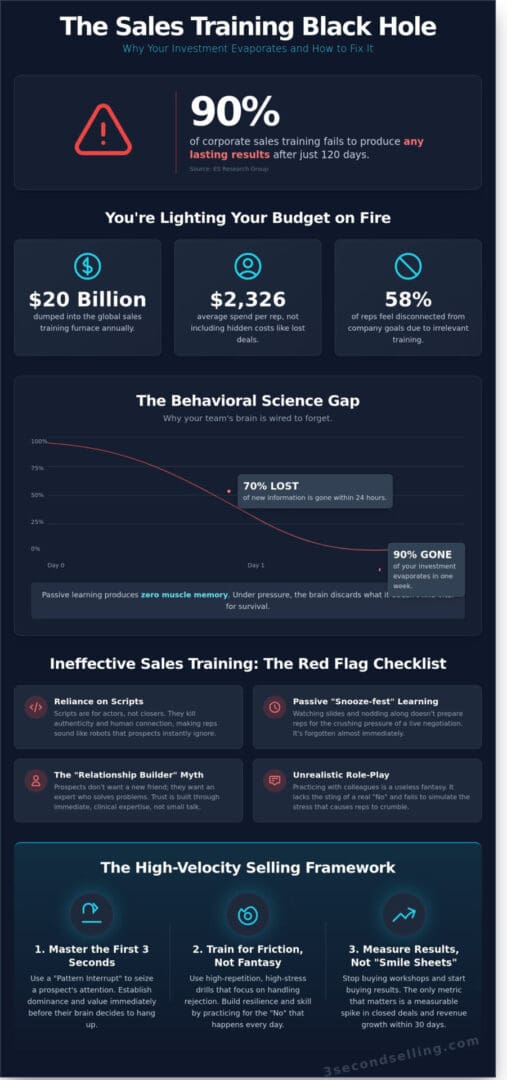
Stop lighting your money on fire. Data from the ES Research Group shows that 90% of corporate sales training fails to produce any lasting results after just 120 days. That’s not just a statistic; it’s a funeral for your profit margins. You see it in the declining response rates and the eye-rolls from your veterans when you introduce another robotic, canned script. Most ineffective sales training programs are built for a world that died a decade ago. They ignore the reality of the 2026 attention economy where prospects have zero patience for generic pitches.
You want a team that dominates, not a team that begs. You need a framework that actually converts in a high-speed market. You’re about to get the exact checklist to identify training red flags before you waste another dollar of your budget. We’ll strip away the fluff and give you the tools to build a high-velocity selling machine. If you’re ready to stop the bleeding and start seeing double-digit growth in your conversion rates, pay attention. The fight for market control starts now.
Key Takeaways
- Stop burning your budget on programs that fail to deliver lasting revenue growth or genuine behavioral shifts.
- Identify the red flags of ineffective sales training and discover why your team loses 70% of what they learn within 24 hours.
- Master the “Pattern Interrupt” to seize a prospect’s attention in under three seconds before they mentally scroll past your pitch.
- Stop buying workshops and start buying results by measuring success in closed deals rather than “smile sheets.”
The $20 Billion Illusion: Defining Ineffective Sales Training
Stop lighting your budget on fire. Every year, corporations dump $20 billion into the global sales training furnace. The result? A staggering 80% of these programs fail to deliver any lasting impact after 120 days, according to data from ES Research Group. It’s a massive waste of capital that most CEOs simply accept as a cost of doing business. They shouldn’t. This is a systemic failure of leadership and strategy.
Ineffective sales training is any program that fails to trigger a permanent behavior change or a measurable revenue spike within 30 days. If your reps are back to their old, lazy habits by next month, you didn’t buy a solution; you bought a very expensive lunch for a consultant. Most workshops are “snooze-fests” because they focus on passive learning. They teach your team what to do, but they fail to train them on how to execute under the crushing pressure of a live negotiation. Knowing a technique is useless. Executing it while a prospect is demanding a 20% price cut is the only thing that matters.
The High Cost of “Good Enough” Training
Settling for mediocre training is a leadership failure, not just a line item issue. The 2023 Training Industry Report puts the average spend per rep at $2,326. That is just the tip of the iceberg. You must calculate the hidden costs: the $100,000 deals lost to competitors, the weeks of wasted prime selling time, and the toxic cynicism that grows when a team realizes their training is just a “check-the-box” exercise. When reps are forced to sit through irrelevant sessions, 58% of them report feeling disconnected from their company goals, based on 2021 Salesforce research. They don’t just lose skills; they lose the will to win.
Scripts are for Actors, Not Closers
Prospects can smell a “trained” salesperson from a mile away. It’s the “Flirting from a Textbook” syndrome. If you follow a rigid script, you kill the one thing that actually closes deals: human connection. Forced rapport feels like a cheap parlor trick. By 2026, buyers have zero patience for canned responses or manipulative “pain point” questions. Authenticity is the only currency that still trades at par. If your training relies on scripts rather than teaching reps to think on their feet, you aren’t building closers. You’re building robots that prospects will ignore without a second thought. Real dominance in the market requires a visceral, psychological understanding of the buyer, not a rehearsed monologue.
The Behavioral Science Gap: Why Your Team Forgets Everything
Your sales team is leaking money. It’s not a lack of talent; it’s a lack of biology. Hermann Ebbinghaus proved the Forgetting Curve back in 1885, and your current “state-of-the-art” seminars haven’t solved it. Data shows that 70% of new information is lost within 24 hours of training. By the end of the week, 90% of your investment has evaporated into thin air. This is the hallmark of ineffective sales training that treats the human brain like a hard drive instead of a survival organ.
Passive learning is a death sentence for your conversion rates. Watching slides and nodding along produces zero muscle memory. When a rep enters a high-stakes call, their brain floods with adrenaline and cortisol. The prefrontal cortex, the part of the brain that remembers those “clever” slide deck tips, shuts down. If the training didn’t trigger a dopamine response through active winning or a stress response through real pressure, it won’t stick. The brain discards what it doesn’t find vital for survival. Stop teaching theories and start mastering the first three seconds where the brain actually decides to pay attention.
The Myth of the ‘Friendly’ Cold Call
Most ineffective sales training tells your team to build rapport. They’re wrong. A 2011 study of 6,000 sales reps found that “Relationship Builders” are the least likely to be top performers. Prospects don’t want a new best friend; they want an expert who solves a problem. You have exactly 3 seconds to establish dominance and value. If your rep sounds “warm and wasting time,” the prospect hangs up. Trust isn’t built through small talk about the weather. It’s built through immediate, clinical expertise that proves you know their pain better than they do.
Role-Play vs. Real World Pressure
Role-playing with a colleague is a useless fantasy. It lacks the “No” that stings. Your team needs the “Anchor Strategy”: practicing for the camera and a ticking clock. Training must prioritize the rejection. If they aren’t practicing for the “No,” they’ll crumble when they hear it. True skill comes from high-repetition, high-stress drills. Don’t train for the “Yes” that rarely happens; train for the friction that happens every single day.
The Ineffective Sales Training Red Flag Checklist
Stop burning your budget on speakers who haven’t sold anything since the fax machine was high-tech. Use this checklist to audit your current provider or that expensive keynote speaker you’re eyeing. If they fail even one point, they’re delivering ineffective sales training that will stall your growth. You need a system built for the Attention Economy, not a 1990s time capsule.
- The Attention Test: Does the program teach your team how to win the first 3 seconds, or does it start with a 10 minute “about us” slide?
- The Reinforcement Reality: According to the Ebbinghaus Forgetting Curve, humans forget 70% of new information within 24 hours. Does the trainer provide a 30, 60, or 90 day reinforcement mechanism?
- The Trench Factor: Can the trainer show you a CRM win from the last 12 months?
Red Flag #1: The “Guru” Without a Track Record
Ask point-blank: When was the last time you actually closed a deal against a hostile prospect? Theoretical experts are dangerous. They teach “safe” sales techniques that crumble the moment a lead says “I’m busy.” You don’t need a career HR trainer; you need a combat veteran. A former TV news anchor has more to teach you about sales than most academics. Why? Because anchors understand that if they don’t hook the viewer in 3 seconds, the audience disappears. Sales is exactly the same. No hook, no deal.
Red Flag #2: Generic “Off-the-Shelf” Content
If the workbook looks like it was printed in bulk for five different industries, run. Universal sales truths are usually just universal platitudes. They don’t help your team handle the specific objections of a skeptical CTO or a budget-conscious CFO. Research from the Sales Executive Council shows that 87% of ineffective sales training is lost within a month when it lacks industry specificity. You need messaging audits and role-plays that mirror your actual market. If the trainer can’t speak your customers’ “street language,” your team won’t listen, and your prospects won’t buy. Demand a program that targets your specific conversion bottlenecks, not a generic pep talk.
Capturing Attention: The 3-Second Rule for Modern Sales
By 2026, you won’t have the luxury of spending five minutes on rapport building. You have exactly three seconds to earn the right to keep talking. Most ineffective sales training programs still teach “small talk” as a door opener. That is a strategic death sentence for your conversion rates. If you start a call by asking about the weather or “how their day is going,” you’re signaling that your time is worthless. Your prospect has already mentally checked out.
Winning in the Attention Economy
The human brain is wired to filter out 99% of incoming stimuli to prevent sensory overload. To bypass this biological gatekeeper, you must achieve an “attention monopoly” instantly. We use Visual Radio techniques to do this. You have to paint a high-contrast mental picture using punchy, evocative language that demands a visceral reaction. The 3-second rule is absolute; if you haven’t hooked their curiosity by the time they’ve blinked twice, you’ve lost the sale. Your message must cut through the noise like a siren in a library.
StorySelling™: The Cure for Boring Pitches
Facts are forgettable. Data is dry. A 2024 Stanford University study proved that stories are 22 times more memorable than raw facts alone. Stop presenting features and start narrating high-stakes battles. Use the Newsroom Approach: lead with the headline. Don’t tell a prospect you provide “efficiency software.” Tell them how you “recovered 14 lost hours per week for a CEO in just 10 days.” Turn your case studies into narratives where the prospect is the hero and your product is the weapon that slays their biggest problem.
To dominate the conversation, follow this aggressive three-step protocol:
- Step 1: The Pattern Interrupt. Say something they don’t expect. Break their mental “scrolling” by shattering the standard salesperson persona.
- Step 2: The Value Hook. Give them a concrete reason to listen for another 30 seconds. This must be a specific, high-impact result, not a vague promise.
- Step 3: The Pivot. Shift the energy immediately. Move from the hook into a conversion-driven conversation that forces the prospect to engage or exit.
Stop pouring money into ineffective sales training that ignores the brutal reality of the modern attention span. Apply the 3-Second Selling method to your team today.
Implementing Sales Training That Actually Drives ROI
Stop buying workshops. Start buying behavioral shifts. Most organizations flush a significant portion of their budget down the drain annually on ineffective sales training that delivers zero lasting change. If your team returns from a seminar with a binder they will never open again, you didn’t invest; you gambled and lost. Real ROI isn’t measured by “smile sheets” or how much the team liked the catering. It’s measured by the number of closed deals and the immediate spike in your conversion rate.
David Gee and 3 Second Selling™ bridge the gap between abstract theory and cold revenue. Research based on the Ebbinghaus Forgetting Curve shows that humans forget 70% of new information within 24 hours. Without a system that forces immediate execution, your training budget is just a donation to a consultant’s vacation fund. You need a methodology that sticks. You need a system that dominates the first three seconds of every interaction. If you are tired of ineffective sales training that produces nothing but yawns, it is time to change the game.
The 3 Second Selling™ Keynote Experience
What happens when you combine the surgical precision of a TV news anchor with advanced sales psychology? You get a room full of people who finally understand how to win the attention monopoly. In the StorySelling™ Workshop, corporate teams stop pitching and start connecting. We don’t do boring; we do results. Your team will walk away with a repeatable framework that turns “maybe later” into “where do I sign?” This is the session your team will actually talk about six months from now because they’ll see the results in their commission checks.
Your Next 3 Seconds
The clock is ticking. Every second you spend with a weak message is a second your competitor uses to steal your lead. It’s time to stop the bleeding. Audit your current training using our checklist. If it doesn’t pass, trash it. Sign up for a messaging audit today to pinpoint exactly where you are losing the prospect’s attention. Don’t wait for the next quarterly slump. Book David Gee for your next sales kickoff and transform your sales force into a high-conversion engine. Your revenue depends on what you do in the next three seconds. Move now.
Stop Burning Your Budget and Own the Attention Economy
The $20 billion spent annually on corporate training often vanishes because it ignores how the human brain actually processes information. Research into the forgetting curve shows your team forgets 70% of what they hear within 24 hours. This happens because most programs lack the behavioral science foundations required to bridge the gap between theory and real-world execution. David Gee, a former network TV news anchor, developed the 3 Second Selling™ framework to fix this specific failure. He applied high-stakes communication psychology to ensure your message doesn’t just land; it sticks.
Continuing to fund ineffective sales training is a choice to lose market share. You need a “Stop the Scroll” strategy that captures a prospect’s focus in the first three seconds of any interaction. Without this visceral reaction, your sales process is dead before it starts. It’s time to replace outdated checklists with a proven system that drives immediate ROI and dominates the competition. You have the power to transform your team into an elite sales machine.
Stop the waste. Book a 3 Second Selling™ Keynote for your next event.
Take the first step toward unstoppable growth and market dominance today.
Frequently Asked Questions
How can I tell if my current sales training is ineffective?
Measure your 90-day retention rate and closing ratios immediately. Research from the Sales Management Association shows that 75% of sales training content is forgotten within 30 days. If your team’s conversion rate hasn’t jumped by at least 15% within one quarter, you are wasting money on ineffective sales training. Watch your reps; if they still use “feature-dumping” instead of solving pain, the training failed.
What is the ROI of professional sales training in 2026?
High-performing training programs deliver a 353% return on investment based on recent Accenture benchmarks. By 2026, the primary ROI driver is the 20% reduction in sales cycle length through AI-integrated behavioral tactics. Companies that invest $1,500 per rep annually see profit margins 24% higher than those who ignore skill development. You aren’t buying “lessons,” you’re buying a faster cash machine.
Why do sales teams resist traditional training programs?
Reps hate “theatrical” training that lacks real-world grit. A 2023 Gartner study found that 70% of sales reps feel traditional training is irrelevant to their daily survival. They resist because they lose commission-earning hours for generic advice. If you don’t teach them how to win a deal in the next 48 hours, they’ll check out mentally before the first coffee break.
What is the 3-second rule in modern sales?
You have exactly 3 seconds to capture a prospect’s “reptilian brain” before they delete your email or hang up. This rule, the core of 3 Second Selling, dictates that your opening must trigger visceral curiosity or immediate fear of loss. If you don’t dominate their attention instantly, your 20-minute pitch is dead. Stop being polite and start being unavoidable.
Can virtual sales training be as effective as in-person workshops?
Virtual training works better when it’s built on micro-learning, not 4-hour Zoom marathons. Data from the RAIN Group suggests that 91% of top-performing sellers prefer virtual training when it’s broken into 15-minute “sprints.” It reduces travel costs by 60% and allows reps to apply a new script 5 minutes after learning it. Efficiency beats “team building” every single time.
How do I choose between a motivational speaker and a sales trainer?
Hire a sales trainer if you want revenue; hire a speaker if you want a 2-hour “high” followed by a crash. Motivational speakers provide temporary dopamine hits that vanish by Monday morning. Sales trainers provide repeatable, clinical systems. Look for trainers who demand a 6-month follow-up program, as one-off events result in an 80% drop in skill retention within weeks.
What is behavioral science in sales and why does it matter?
Behavioral science is the study of why people actually buy, focusing on cognitive biases like loss aversion. It matters because 95% of purchasing decisions occur in the subconscious mind. Using Harvard’s research on “nudging,” sales teams can increase conversion rates by 40% simply by reframing a price as the “cost of inaction.” Stop selling to their logic; start selling to their biology.
How often should a sales team undergo training to avoid the forgetting curve?
Schedule “booster” sessions every 30 days to smash the Ebbinghaus Forgetting Curve. Without reinforcement, reps lose 90% of new material within one month. Implement weekly 10-minute role-play sessions to keep instincts sharp. This consistent “drip” method ensures that ineffective sales training doesn’t drain your budget while your competitors steal your leads.