

Effective Team Communication: Winning the War for Attention Inside Your Office
Your office is a graveyard for focus. According to a 2023 report from Atlassian, the average employee wastes 31 hours every month in unproductive meetings. That’s nearly four full workdays lost to corporate noise and useless chatter. You know the feeling. You see the decision paralysis. You see the glazed eyes during the third “sync” of the day. You know that effective team communication is the only way to save your bottom line, yet your internal channels still look like a digital landfill. It’s frustrating. It’s expensive. It stops today.
Stop playing nice with your team’s attention. This article teaches you how to apply hard behavioral science and the 3-second rule to strip away the fluff that’s killing your momentum. I’m going to show you how to dominate the internal narrative to drive faster execution and permanently eliminate meeting fatigue. We’re diving into the exact mechanics of how to turn your internal messaging into a high-performance engine that demands instant action instead of another week of “circling back.” Here’s how you win the war for attention inside your own walls.
Key Takeaways
- Stop dumping data into a void. Learn to transfer meaning instantly to win the internal war for attention and keep your team focused.
- Break the “Curse of Knowledge.” Understand how dopamine-driven notifications rewired your team to ignore you-and how to take that focus back.
- Escape the “Tool Trap.” Prioritize strategy over software to finally establish effective team communication that eliminates expensive corporate noise.
- Master the 3-second rule. Use newsroom-style language and “Headline First” messaging to ensure your directives grab focus immediately and trigger action.
- Weaponize the StorySelling™ Framework. Turn dry internal data into a high-impact narrative that transforms you from a manager into a “Chief Storyteller.”
What is Effective Team Communication in the Attention Economy?
Stop treating your inbox like a digital filing cabinet. Most leaders think they’re communicating when they’re actually just dumping data. That’s a mistake that kills your growth. Real effective team communication isn’t about the volume of words you send. It’s about the transfer of meaning. If your team reads your message but doesn’t change their behavior, you haven’t communicated. You’ve just made noise. You’re shouting into a void and wondering why nobody is listening.
The Attention Economy isn’t just a marketing buzzword for social media giants. It’s the brutal reality of your office hallways. Your employees are bombarded every second. They’re fighting for focus. A 2022 report by Axios HQ found that “ineffective communication” costs U.S. businesses an estimated $1.2 trillion annually. That’s a staggering $12,505 per employee every single year wasted on confusion. You’re literally burning cash because your emails are boring, long, and pointless.
You need to move from passive listening to active execution. Behavioral science shows that the human brain prioritizes immediate, clear signals over complex ones. If your communication looks like a wall of text, the brain identifies it as “high effort” and skips it. Effective team communication triggers a visceral reaction. It demands a response. It forces a decision. If you aren’t driving action, you’re just typing for your own health. You need to dominate the mental space of your team before you can dominate your market.
The Internal Attention Deficit
Your team ignores 70% of internal emails within the first 3 seconds. That’s a fact. The “Always-On” culture has fried their cognitive capacity. Deep understanding teamwork requires recognizing that focus is a finite resource. When leadership is distracted, the front lines lose the plot. Every unnecessary CC or “just checking in” ping adds mental sludge. This sludge slows down production and kills morale. Stop being the source of the distraction.
Communication as a Performance Metric
Stop being nice and start being clear. Communication is a sales tool. You’re selling an idea, a task, or a vision. Treat it like a high-stakes pitch. Clarity equals velocity. A study from the Project Management Institute showed that 56% of project risk is due to poor communication. Use “3-Second Selling” principles in your huddles. Grab attention. State the value. Demand action. If your team doesn’t know exactly what to do in 3 seconds, you’ve failed as a leader. Results don’t come from polite suggestions; they come from dominant clarity.
Look at your last five emails. Are they tools for growth or anchors for your team? If you want a team that executes, stop writing novels. Start driving results. Every word must serve the mission. If it doesn’t, cut it. Your revenue depends on it. You don’t have time for fluff, and neither does your team. Get to the point or get out of the way.
The Behavioral Science of Why Teams Stop Listening
Your team isn’t ignoring you because they’re lazy. They’re ignoring you because your emails are biologically invisible. You are fighting a war against millions of years of evolution, and right now, you are losing. To achieve effective team communication, you must understand that the human brain is a ruthless filter. If your message doesn’t scream “survival” or “reward” within three seconds, it gets dumped into the mental trash can. Stop blaming your staff and start blaming your delivery.
The Curse of Knowledge
You know too much. In a 1990 Stanford study, researcher Elizabeth Newton asked “tappers” to tap out a famous song while “listeners” guessed the tune. The tappers predicted a 50% success rate. The actual result? Only 2.5% of listeners got it right. You are the tapper. You hear the full symphony of your project in your head, but your team only hears random, disconnected thuds. When you skip context because it seems obvious to you, you create a vacuum of confusion. Clarity isn’t a gift; it’s a discipline you’re currently neglecting.
Dopamine and Distraction
Your team’s brains have been rewired by a decade of digital slot machines. Research from UC Irvine indicates it takes an average of 23 minutes and 15 seconds to return to a task after a single interruption. Every Slack ping and “quick check-in” triggers a dopamine hit that kills deep work. By the time they see your 500-word update, their prefrontal cortex is exhausted. You aren’t just competing with other work; you’re competing with the neurological addiction to the “New Message” notification. If you aren’t the most interesting thing in their inbox, you’re just noise.
The Vividness Effect
Abstract data is forgettable. Human memory prioritizes sensory, emotional, and vivid information. If your internal memo looks like a tax return, it will be treated like one. A 2007 study by Carnegie Mellon researchers found that people are twice as likely to take action when presented with a single, vivid story rather than a mountain of statistics. Boring updates are a choice. You can either paint a picture of the “burning house” your team needs to escape, or you can keep sending spreadsheets that nobody opens. The choice determines your authority.
Overcoming the Status Quo Bias
The human brain is hardwired to prefer the current state of affairs, even if that state is failing. This Status Quo Bias means your team will default to their old habits 66% of the time unless the pain of staying the same is perceived as greater than the pain of changing. Your messaging fails because it lacks urgency. You ask for “improvements” when you should be demanding “survival.” Without a clear “why now,” your instructions are just suggestions. Use proven psychological triggers to force a decision instead of a shrug.
The Mechanics of Attention
The brain’s Reticular Activating System (RAS) filters “essential” versus “non-essential” info in under 3 seconds. It looks for threats, opportunities, or ego-shattering news. If your subject line is “Weekly Update,” you’ve already lost. Emotional resonance is the only way to bypass this gatekeeper. Use words that spark curiosity or immediate concern. Cognitive friction is the mental resistance experienced when a team member encounters information that is so poorly structured or dense that the brain chooses to ignore it to conserve energy. Eliminate the friction, or lose the audience.
Breaking Through the Digital Noise
Slack is a graveyard for good ideas. A 2023 survey showed that 70% of employees feel overwhelmed by the volume of digital pings. To break through, you need “Pattern Interrupts.” If you always email, send a 60-second video. If you always use Zoom, hold a 5-minute standing meeting in a hallway. Sudden changes in format force the brain to pay attention. Citing team communication best practices shows that leading by example is the only way to reset these standards. Stop the long-form presentations that trigger “Selective Hearing.” If you can’t say it in 3 minutes, you don’t understand it well enough to lead. Master effective team communication by being brief, being bold, and then being gone.
Tools vs. Strategy: Why Your Software Won’t Save You
You think a 12 dollar per user Slack subscription fixes your broken culture. It doesn’t. It just makes the chaos louder. Most leaders fall into the “Tool Trap” where they buy more apps to solve a lack of clarity. Adding a new project management tool to a team that can’t write a clear subject line is like putting a spoiler on a car with no engine. It looks fast; it goes nowhere. Research from the University of California, Irvine shows it takes exactly 23 minutes and 15 seconds to return to a task after a single interruption. If your team is juggling five different apps, they aren’t working. They’re just managing notifications. Stop buying software to solve a leadership problem.
Real effective team communication isn’t about the platform; it’s about the protocol. You need to audit your “Attention ROI” immediately. If a tool doesn’t save more time than it takes to manage, delete it. A 3-second face-to-face answer destroys a 30-minute email thread every single time. Stop typing and start leading. Your profit depends on how fast information moves, not how many shiny icons are on your taskbar. Strategy must come first. Platform comes second. If you don’t have rules for how you talk, the software will eventually own your team’s schedule.
The Myth of Connectivity
Your team is connected 24/7, but they’re zero percent aligned. Being reachable isn’t the same as being productive. “Reply All” is a productivity tax that drains your payroll every single day. Every time someone hits that button without a specific reason, you lose money. RescueTime data indicates that workers check communication apps every 6 minutes on average. This constant context switching kills your profit margins. You don’t need more connectivity. You need more focus. Stop rewarding the person who replies fastest and start rewarding the person who finishes the most valuable work. High-frequency noise is the enemy of high-impact results.
- Connection: Having 500 unread messages in a group chat.
- Alignment: Knowing exactly what the goal is without checking an app.
- The Cost: Every app switch costs a 10 percent drop in cognitive function.
Building a Communication Manifesto
You need a set of rules, not another login. Define your channels or prepare for total collapse. Slack is for quick pings that require a 10-word answer. Email is for formal records and external clients. Meetings are for decisions, not “updates.” If an update takes more than three sentences, it’s a memo, not a chat message. Establish “No-Meeting” blocks; 4-hour windows where silence is mandatory and work is the only priority. This is the only way to reclaim effective team communication and stop the bleeding of your team’s most valuable asset: their attention.
Enforce brevity without sacrificing culture. Short messages aren’t rude; they’re respectful of the other person’s time. If you can’t explain the task in 30 seconds, you don’t understand it well enough to delegate it. Use these three rules to build your manifesto:
- Urgent: Use the phone or walk to their desk.
- Asynchronous: Use the project management tool for everything else.
- Brevity: Any message longer than two paragraphs becomes a 2-minute call.
Kill the threads. End the “Reply All” culture. If you want results, stop hiding behind your dashboard and start setting the standards for how your team actually talks to each other. Speed is the only currency that matters in this market. Don’t let a “productivity” app slow you down.
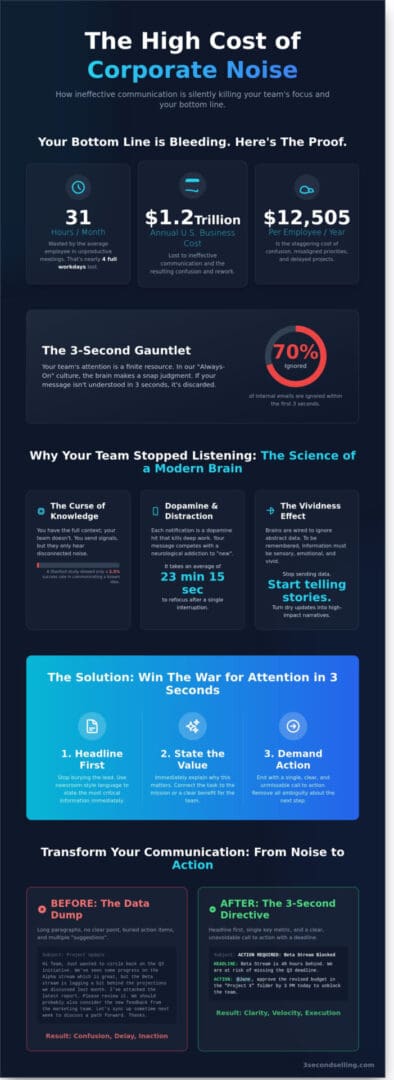
The 3-Second Rule: Actionable Steps for Clearer Messaging
Attention is the only currency that matters in your office. A 2023 study by the Radicati Group shows the average professional receives 121 emails every single day. If your message doesn’t trigger a visceral reaction in three seconds, you’ve already lost. Your team isn’t ignoring you because they’re lazy; they’re ignoring you because your communication lacks urgency and clarity. Stop writing novels and start writing results. To achieve effective team communication, you must treat every internal message like a high-stakes sales pitch.
The “Headline First” method is your primary weapon. Most managers bury the lead under layers of polite “How was your weekend?” fluff. Cut it out. Start with the result. If you need a report by Friday, the first sentence should be “I need the Q3 Sales Report by 4:00 PM Friday,” not a paragraph about why the report is being requested. This approach respects the recipient’s time and eliminates ambiguity immediately. It forces a decision the moment the email is opened.
Kill the “Corporate Speak” before it kills your productivity. Phrases like “circle back,” “synergize,” or “low-hanging fruit” are mental static. They signal to the brain that the message is unimportant. Use newsroom language instead. Use active verbs. Use concrete nouns. Instead of saying “We need to facilitate a discussion regarding our current workflow,” say “Our current process is slow; we need to fix it today.” This shift in tone creates a “So What?” filter. If you can’t explain why a message matters in one sentence, don’t send it. Every communication must have a clear call to action that answers the recipient’s internal question: “What do I need to do right now?”
Mastering the ‘Headline First’ Approach
Your subject line is a gatekeeper. Use a “Result-Action-Deadline” structure. A subject line like “Meeting” is a failure. “Action Required: Approve Q4 Budget by 5 PM” is a victory. Apply the 10-word rule for meeting invites; if you can’t define the meeting’s sole purpose in ten words, the meeting shouldn’t happen. Your “Lead” must capture attention in three seconds by stating the most important piece of news first. This ensures effective team communication by front-loading the value.
Running Meetings Like a News Anchor
David Gee, a veteran in high-stakes communication, advocates for controlling the room through the “Newsroom” philosophy. Every meeting needs a producer and a clock. Respect the “Hard Stop” religiously. A 2023 survey by Otter.ai revealed that 46% of employees feel overwhelmed by the number of meetings they attend. If a meeting is scheduled for 20 minutes, end it at 19 minutes. When the conversation drifts into irrelevant territory, pivot back immediately. Use phrases like “That’s a separate segment; let’s get back to the headline.” This keeps the momentum high and the focus sharp.
- Visual Brevity: Use bullet points and bold text to make your emails skimmable. No one reads blocks of text.
- Imagery: A single screenshot often replaces five paragraphs of explanation. Use it.
- Feedback Loops: Don’t ask “Do you understand?” Ask “What are your next three steps based on this?”
Stop letting your messages die in an overflowing inbox. If you want to dominate your market, you must first dominate the attention of your own team. Every second they spend decoding your vague requests is a second they aren’t spent generating revenue. Implement these rules today and watch your response rates explode.
Ready to transform your communication into a high-conversion engine? Master the art of 3-Second Selling here.
Level Up Your Leadership: The StorySelling™ Framework
Stop sending memos. Start selling visions. Your title says Leader, but your inbox says Ignored. To drive results, you must step into the role of Chief Storyteller. If your team isn’t moving, your narrative is failing. Most executives dump raw data on their employees and hope for the best. Hope is not a strategy. It’s a recipe for stagnation. You need to dominate the internal conversation before you can dominate the market.
The StorySelling™ Framework turns dry internal data into a compelling narrative that demands action. This isn’t about bedtime stories. It’s about mapping your business objectives to a framework that triggers a visceral reaction. When you master this, you achieve effective team communication that bypasses the mental filters of a distracted workforce. You stop being background noise and start being the signal. You convert boring updates into a powerful engine for results that motivates your staff to hit every KPI.
The stakes are high. Consider the impact of a October 2022 communication audit conducted for a mid-sized logistics firm. They were on the verge of losing a $1.4 million contract because of internal friction. The audit found that critical project updates were buried in 1,200-word email threads. By implementing the StorySelling™ Framework, the leadership team cut internal email volume by 38% and saved the 7-figure deal. They replaced confusion with 3-second clarity. They stopped talking and started winning.
The path forward requires a total shift in how you handle the Age of Distraction. You aren’t just competing with other emails. You’re competing with TikTok, Slack, and the general noise of a digital world. Training your team to win in this environment means teaching them to respect the attention of others. Every message must have a hook, a value, and a clear call to action. If it doesn’t, don’t send it.
Authentic Connection in a Virtual World
The best communicators actually talk the least. They use the Listening Advantage to identify the specific pain points of their team before they open their mouths. Trust isn’t built through long, boring speeches. It’s built through radical transparency and 3-second clarity. If your team has to guess your intent, you’ve already failed. David Gee’s Media Training techniques teach you to project executive presence by speaking in headlines. You must win the attention monopoly in every Zoom call. Stand tall. Speak in punchy sentences. If you can’t explain the goal in 3 seconds, you’ve lost the room.
Transform Your Team Today
Standard sales training fails because it ignores the psychological roots of effective team communication. It teaches scripts instead of strategy. It focuses on the “what” instead of the “why.” A StorySelling™ workshop for your leadership team provides an immediate ROI by eliminating the “clarification” meetings that drain 22% of your weekly productivity. You’ll build a culture of high-stakes precision where every word counts. Stop settling for a team that ignores your emails. Demand their focus. Command their respect. Get results.
Take the next step: Book David Gee for your next Sales Keynote or Leadership Summit and stop the bleed of ignored messages today.
Command the Room or Get Filtered Out
Your team is currently drowning in a sea of 120 daily emails and endless Slack pings. It’s not a software problem. It’s a biology problem. Most leaders waste hours on messages that never land because they ignore how the human brain actually processes information. You have exactly three seconds to hook your team before their focus shifts to the next notification. Stop relying on hope as a communication strategy. Use the StorySelling™ framework to turn every internal update into a high-stakes broadcast. David Gee, a former TV news anchor, built this system on behavioral science to ensure your voice cuts through the noise. This isn’t just theory. It’s a proven method that has delivered measurable ROI at national sales meetings and leadership summits across the country. Master effective team communication by treating every interaction like a headline. You can own the room or you can stay invisible. The choice is yours. Success doesn’t wait for those who mumble. It’s time to lead with authority and clarity.
Stop the scroll and start the sale-book your 3 Second Selling™ Keynote Experience today
Frequently Asked Questions
What are the 3 pillars of effective team communication?
The 3 pillars are clarity of intent, consistent frequency, and a closed feedback loop. You can’t lead in silence. MIT Human Dynamics Lab research shows that 35% of a team’s performance variation depends on the number of face-to-face exchanges. If your message isn’t clear in 3 seconds, you’ve already lost. Effective team communication requires you to cut the fluff and demand a response now.
How do you improve communication in a remote sales team?
Use asynchronous video updates and 10 minute daily huddles to bridge the digital distance. Remote sales teams fail when they rely solely on static text. Vidyard reports that sales pros using video see 26% more replies. It builds trust faster than a 500 word email. Stop hiding behind your keyboard and show your face to drive real results.
What is the biggest barrier to effective communication in 2026?
Digital noise and cognitive fatigue are the primary killers of focus in 2026. The Radicati Group predicts 392 billion daily emails by 2026. Your team is drowning in 120 notifications every hour. If your message doesn’t trigger a visceral reaction, it gets deleted. You aren’t just competing with work; you’re fighting for the 47% of attention lost to digital distractions.
How can behavioral science improve how my team works?
Behavioral science uses psychological triggers like loss aversion and social proof to force immediate action. Nobel laureate Richard Thaler proved that “nudges” increase desired behaviors by up to 40%. Stop asking for help. Instead, frame the request as a way to avoid a specific $10,000 loss. People move faster to keep what they have than to gain something new.
What is the ‘3-second rule’ for internal business emails?
The 3-second rule dictates that your recipient must understand the value and the “ask” within 3 seconds of opening. If they have to scroll to find the point, you failed. Use a “Action Required” subject line and put the deadline in the first five words. Statistics show that 55% of readers spend less than 15 seconds on an email. Capture their attention monopoly immediately.
How do I deal with a team member who doesn’t listen?
Use the “Repeat Back” protocol to force active engagement during every interaction. When someone ignores instructions, ask them to summarize the goal in 20 words or less. Harvard Business Review links 70% of workplace errors to communication breakdowns. If they can’t repeat it, they didn’t hear it. Stop being nice and start being clear. Accountability is the only cure for selective hearing.
Why is storytelling important for internal leadership?
Storytelling turns boring data into a mission that triggers a dopamine response in your listeners. Stanford research proves stories are 22 times more memorable than raw statistics. Don’t show a spreadsheet of falling sales. Tell the story of the one client you lost because the team was too slow. Use conflict and resolution to make your strategy stick. Facts provide information, but stories drive commitment.
How can I measure the ROI of team communication training?
Track the reduction in project “re-work” hours and the 47% higher shareholder returns reported by Willis Towers Watson. Effective team communication isn’t a “soft skill” it is a profit center. Measure how many hours are wasted in unnecessary meetings. If training cuts meeting time by 20%, you’ve just bought back a full day of productivity every week. Calculate the hourly rate and look at the cash.