

How to Capture Attention: The 3-Second Rule for Modern Sales and Marketing
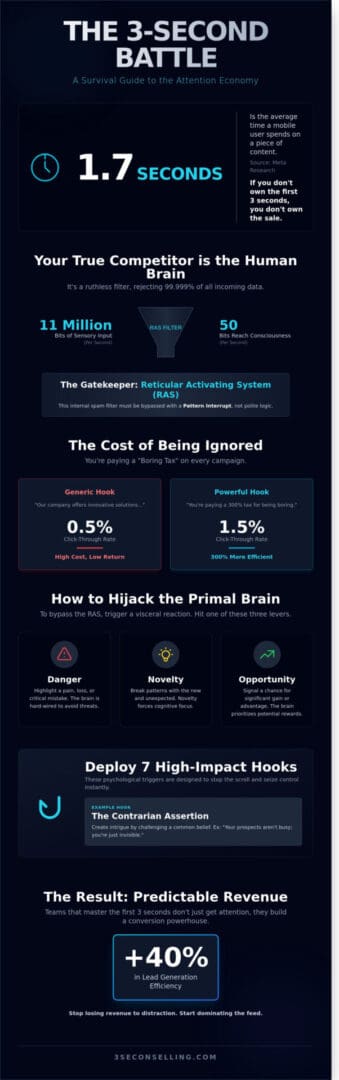
Your prospects aren’t ignoring you because they’re busy; they’re ignoring you because you’re invisible. In a world where Meta research shows the average mobile user spends just 1.7 seconds on a piece of content, learning how to capture attention isn’t a soft skill anymore. It’s a survival mechanism for your bank account. If you don’t own the first three seconds, you don’t own the sale. Period.
It’s exhausting to watch your marketing spend vanish into ads that nobody sees or emails that get deleted before the first sentence. You’ve felt that sting of a prospect tuning out halfway through a presentation you spent ten hours preparing. I’m going to show you how to stop the bleeding by mastering the behavioral science of the first three seconds. You’ll learn a repeatable framework to hijack the brain’s primal triggers and turn instant distraction into predictable revenue. We’re moving past theory and diving straight into the three psychological levers that force your audience to stop, look, and listen.
Key Takeaways
- Stop losing revenue to distraction by mastering the critical three-second window where the brain decides to engage or ignore.
- Discover how to capture attention by hacking the Reticular Activating System (RAS) to trigger visceral reactions that bypass the conscious mind’s spam filter.
- Deploy seven high-impact hooks, including the Contrarian Assertion, to instantly seize control of your audience and stop the scroll.
- Apply tactical execution strategies to your cold emails and social media to turn every first line into a high-conversion audition.
- Transform your sales team into an attention-capturing powerhouse by moving from outdated theories to front-line, 3-second dominance.
The Attention Economy: Why Your First 3 Seconds Decide Your Revenue
You’re losing money every single millisecond your prospect spends scrolling past your content. It’s not a lack of interest in your product. It’s a failure of your entry point. In the modern marketplace, The Attention Economy dictates that human focus is the only currency that matters. If you can’t buy three seconds of their time, you’ll never see a cent of their money. Nobel Laureate Herbert A. Simon noted as early as 1971 that a wealth of information creates a poverty of attention. Today, that poverty is an epidemic. Your sales pipeline isn’t leaking; it’s being choked off at the very top because you don’t know how to capture attention in a world designed to ignore you.
The 3-Second Rule isn’t a suggestion. It’s biological law. Your prospect’s brain decides to stay or flee before their conscious mind even processes your logo. The amygdala and the limbic system filter for relevance and danger in less than 200 milliseconds. If your headline or visual doesn’t trigger a “stay” response immediately, they’re gone. You’ve been deleted. This isn’t about being “nice” or “professional” anymore. It’s about survival. Polite selling is a relic of the 1990s. In 2024, you need a Pattern Interrupt. You must break their trance. If you don’t shock the system, you’re just background noise.
Every ignored post or skipped ad carries an Ignored Message Tax. Let’s calculate the damage. If you spend $5,000 on a campaign with a 0.5% click-through rate, but a better hook could move that to 1.5%, you’re effectively paying a 300% “boring tax” on every lead. You’re subsidizing your competitors’ growth with your own inefficiency. Invisibility is the most expensive mistake in business. Stop treating your marketing like a lecture. Start treating it like a heist where the prize is the user’s focus.
The Survival of the Loudest
Content that is merely “good enough” is a liability. It’s a waste of server space. Your prospects aren’t suffering from short attention spans. They can binge-watch a ten-hour series in one sitting. They have highly selective attention. They’re actively looking for any excuse to hit “skip” or “delete.” If you don’t provide a visceral reason to stop within 1.7 seconds, which is the average mobile scroll speed recorded by Facebook in 2023, you’re a ghost. You don’t need more content; you need content that demands to be seen.
Winning the Zero-Moment of Truth
The 3-second window is the ultimate gatekeeper for your entire conversion funnel. This is the Zero-Moment of Truth where the psychological shift happens from “just browsing” to “I need this.” Teams that prioritize how to capture attention outpace traditional sales forces by 40% in lead generation efficiency. They don’t start by selling features. They start by stopping the scroll. They dominate the feed by owning the first three seconds, ensuring their message is the only one that survives the mental filter. If you don’t win the start, you’ve already lost the finish.
The Behavioral Science of Attention: How the Human Brain Filters Information
Your prospect’s brain is a ruthless executioner. It kills 99 percent of the data it encounters before that information ever reaches conscious thought. If you want to learn how to capture attention, you must stop acting like a polite salesperson and start acting like a biological disruptor. You aren’t fighting your competitors; you’re fighting millions of years of evolution designed to keep your prospect focused on survival, not your product. The human brain processes roughly 11 million bits of sensory information every single second, yet the conscious mind only handles about 50 bits. That is a staggering 99.999 percent rejection rate. If your hook doesn’t trigger a primal response, you are invisible.
The RAS: Your Prospect’s Gatekeeper
The Reticular Activating System (RAS) is the brain’s internal spam filter. It’s a bundle of nerves at the brainstem that decides what is worth your limited mental energy. Most marketing content hits the floor because it looks exactly like everything else the brain has already categorized as “noise.” To bypass the RAS, you have to hit one of three specific triggers: danger, food, or novelty. Research on Behavioral and Brain Mechanisms of Attention confirms that the brain prioritizes stimuli that signal a sudden change in the environment. Novelty triggers an immediate cognitive focus shift because the brain must determine if a new stimulus represents a threat or an opportunity.
Visceral Reactions vs. Logical Arguments
Logic is slow. Survival is fast. If you lead with a logical benefit or a list of features, you’ve already lost the battle. The brain requires a visceral, gut-level reaction in the first 3 seconds to stay engaged. This isn’t a suggestion; it’s neurochemistry. When you create a hook that works, you trigger an involuntary “Tell me more” response. You do this by leveraging the “Gap Theory” of curiosity developed by George Loewenstein in 1994. Curiosity isn’t just a feeling. It’s a state of deprivation. When there is a gap between what someone knows and what they want to know, the brain experiences a mental itch. Your content must be the only way to scratch that itch. Mastering these triggers is the only way to build a high-conversion sales machine that actually commands the market.
To maintain the focus you’ve just captured, you must feed the brain dopamine. Dopamine is the “seeking” chemical. It’s released when the brain anticipates a reward or a solution to a problem. If your hook promises a revelation, the brain will lock on until it finds it. This is how you sustain how to capture attention over the long term. You aren’t just getting a click; you’re hijacking the brain’s reward system to ensure they read the next sentence.
Finally, you must use “safe tension” to force a mental stop. This involves a process called amygdala hijacking. The amygdala is the brain’s alarm system. By highlighting a specific, immediate problem or a counter-intuitive fact, you create a micro-moment of tension. The brain pauses its current thought process to resolve this tension. It’s a forced mental stop that demands full cognitive resources. Don’t be boring. Don’t be predictable. If you don’t shock the system, the system will ignore you. Use these biological shortcuts to move from being a background noise to becoming a market authority.
7 High-Impact Hooks to Stop the Scroll and Capture Any Audience
The feed is a graveyard of ignored content. If your opening doesn’t punch the reader in the gut within two seconds, you’ve already lost. You aren’t competing with your rivals; you’re competing with dopamine hits and viral distractions. Mastering how to capture attention requires moving past polite introductions and adopting a predator’s mindset toward the scroll. Stop playing nice and start commanding the screen.
- The Contrarian Assertion: Kill a sacred cow immediately. If everyone says “consistency is key,” tell them “consistency is why your brand is invisible.” Challenging a deeply held industry truth creates instant mental friction. Friction stops the thumb.
- The Visual Shock: Describe a scene that shouldn’t exist. “A CEO burning a pile of $100 bills in the boardroom.” It forces the brain to reconcile the image with reality, dragging the reader into the next sentence.
- The ‘In Media Res’ Opening: Start in the heat of a crisis. “The server crashed at 2:01 AM during our biggest launch of 2024.” Don’t set the stage; throw them into the fire.
- The Specific Shocking Stat: Use data that quantifies a hidden pain. A 2023 report from the Content Marketing Institute revealed that 67% of B2B marketers struggle to create content that provides actual value. Numbers turn a vague worry into a concrete problem.
- The Relatable Failure: Admit you messed up. “I lost $14,200 on a single email campaign last Tuesday.” Vulnerability builds a bridge of trust that “perfect” gurus can’t touch.
- The Direct Challenge: Call out the reader’s ego. “You aren’t failing because of the algorithm; you’re failing because your offer is average.” It’s aggressive, but it demands a response.
- The “Secret” Reveal: Hint at hidden knowledge. “The one setting my top 1% clients changed to double their reach in 30 days.” Curiosity is a biological itch that must be scratched.
Mastering the Pattern Interrupt
Identify the “standard” message in your niche and do the exact opposite. If you’re a fitness coach, the standard is “5 ways to lose weight.” Flip it. Tell them “Why you should stop exercising today.” This is the “Wait, What?” factor. It forces a second read because it violates expectations. In cold emails, 2024 data shows that subject lines like “Quick question” are dying. Use “Your website’s 404 error” instead. It’s specific, urgent, and impossible to ignore. You must understand The Behavioral Science of Attention to see why contrast is the only way to trigger a reflexive stop in a saturated market. If you look like everyone else, you’re invisible.
The StorySelling™ Framework
A hook gets the click; a story gets the conversion. Stories are the ultimate retention tool because they bypass the logical filter and hit the brain’s emotional core. Use a 3-part structure: The Pit (the struggle), The Pivot (the discovery), and The Peak (the result). Don’t dwell on your own glory. Move from “What happened” to “Why it matters to THEM” within two sentences. Your failure is only valuable if it illustrates their potential solution. If you don’t pivot to their benefit quickly, they’ll bounce. Every word must serve the sale. This is how to capture attention and keep it long enough to close the deal. Stop telling stories to be liked. Start telling stories to be followed.
Tactical Execution: Applying Attention Science to Every Channel
Stop treating your marketing like a polite conversation. It’s a street fight. Whether you’re sending a cold email or launching a million-dollar ad campaign, you’re competing against dopamine hits, news alerts, and the “delete” button. Learning how to capture attention isn’t a soft skill; it’s a survival mechanism for your revenue. If you don’t win the first three seconds, you’ve already lost the sale.
Your cold email subject line is a 3-second audition for the body copy. A 2023 study by OptinMonster shows that 47% of email recipients open messages based on the subject line alone. If your subject line doesn’t promise immediate value or trigger intense curiosity, your carefully crafted pitch is just digital noise. Similarly, on social media, the first line of your caption is more important than your Call to Action (CTA). If the hook doesn’t stop the thumb, the CTA never gets seen. You aren’t writing for fans; you’re writing for scanners who are looking for a reason to keep moving.
In the world of paid advertising, the “Thumb-Stop” ratio is your only true north metric. This is the percentage of people who watched at least the first 3 seconds of your video compared to total impressions. A 30% thumb-stop ratio is the minimum benchmark for a winning ad. If you’re below 15%, your creative is failing. Don’t guess what works. Use rapid testing to run 5 different hooks against the same body copy for 48 hours. Kill the losers and scale the one that stops the scroll.
The 3-Second Email Audit
Most emails die during the “Morning Delete” ritual. The 2022 Deloitte Global Mobile Consumer Survey found that 80% of users check their phones within 15 minutes of waking. They aren’t looking for “I hope this finds you well” or “Checking in” messages. They’re looking for reasons to clear their inbox. If you want to master how to capture attention in a crowded inbox, start by deleting your introduction. Use your preview text to extend your hook, not to repeat your name. If the preview text doesn’t offer a specific benefit, it’s wasted real estate.
- Kill the pleasantries: Delete “I hope you’re having a great week.” It’s a red flag for spam.
- Lead with the gap: Mention a specific problem your recipient is currently facing.
- The 5-word rule: Keep subject lines under 5 words to ensure they don’t get cut off on mobile screens.
Keynote and Presentation Openers
The first 30 seconds of your talk are decided in the first 3. Most speakers waste this window by thanking the organizers or showing an “About Us” slide. Nobody cares about your company history yet. Kill the “About Us” slide and start with “The Stake.” Tell the audience exactly what they lose by not listening. Use silence for 3 full seconds before you speak. This physical presence commands the room and forces eyes away from smartphones.
When you finally speak, don’t introduce yourself. Introduce the crisis. If you’re presenting to a board, start with the $50,000 they’re losing every month due to inefficiency. By defining the loss immediately, you create a psychological “itch” that only your presentation can scratch. This is how you dominate a room before you even reach your second slide.
Stop losing prospects to the scroll and start dominating your market today.
Transform Your Team into Attention-Capturing Powerhouses
Generic sales training is a liability. If your team still relies on 20th-century rapport-building and slow-burn pitches, they’re losing. The modern buyer decides your value in the time it takes to inhale. Research from the 2023 Attention Economy Report indicates that the average human attention span has plummeted to just 8.25 seconds. Your sales force doesn’t have minutes to establish authority; they have moments. Most corporate training fails because it prioritizes theory over the brutal reality of the front line. It ignores the fact that distraction is the default state of every prospect you target.
Mastering how to capture attention is no longer a “soft skill” for your marketing department. It is a survival requirement for your entire sales organization. When your team sounds like every other vendor, they become invisible. They’re deleted, ignored, and bypassed. To win, you must shift from being a “seller” to becoming a “StorySeller.” This means building a culture where every interaction is designed to trigger a visceral, immediate response. You must audit your current messaging immediately. If your team can’t articulate their value in three seconds, your competitors will do it for them.
The 3 Second Selling™ Advantage
David Gee didn’t develop his framework in a boardroom; he forged it in the high-pressure environment of TV news. In broadcasting, if you don’t hook the viewer in the first three seconds, they change the channel. This background translates directly into corporate wins. David’s 3 Second Selling™ methodology applies that same “breaking news” urgency to your sales process. It’s about grabbing the “attention monopoly” before the prospect can look away.
Customized workshops take your team’s specific friction points and turn them into magnets. We don’t use cookie-cutter templates. We analyze your 2024 sales data, identify where the drop-off happens, and re-engineer those touchpoints. The ROI of Attention isn’t a vague metric. It shows up as a 35% increase in cold-call duration and a 50% jump in email open rates. We move your team from being ignored to being the only voice in the room that matters.
Book Your Keynote Experience
Stop hiring “motivational” speakers for your national sales meetings. Motivation is a temporary chemical spike that disappears before the flight home. You need a behavioral transformation. The 3 Second Selling™ Keynote Experience is a high-octane, confrontational shift in how your team perceives their role. We don’t just tell them how to capture attention; we demonstrate the psychological triggers that force a prospect to stop the scroll and listen. We replace passive habits with dominant, result-oriented communication strategies.
This is the difference between a talk and a total system overhaul. David Gee brings the intensity of the newsroom to your stage, forcing your team to confront their own boring messaging. If you’re ready to stop the bleeding and start dominating your market, the choice is simple. You can continue with the status quo, or you can Secure David Gee for your next event. The clock is ticking. Every three seconds you wait is a missed opportunity for a conversion. Lock in your date and transform your team into an unstoppable elation machine today.
- Eliminate Fluff: Cut the “I hope you’re having a great day” and get to the point.
- High-Stakes Execution: Use TV news tactics to command the room instantly.
- Behavioral Shift: Move from asking for permission to asserting authority.
- Measurable Impact: Track the shift from “No thanks” to “Tell me more.”
Dominate the First Three Seconds
The clock starts the moment you speak, click, or post. You have exactly three seconds to prove you’re worth a prospect’s time before their brain filters you out as background noise. This isn’t just marketing theory; it’s hard behavioral science. By mastering the seven high-impact hooks and understanding how to capture attention, you transform from an ignored distraction into a market leader. David Gee, a former network TV news anchor, developed the 3 Second Selling™ framework specifically for high-stakes corporate sales and leadership environments. In these arenas, every missed second results in lost revenue and wasted opportunity. You can’t afford to be polite while your competitors are aggressive. You either control the narrative or you disappear into the scroll. Apply these tactical execution steps to your entire team to build a high-performance sales engine that demands immediate respect. Success belongs to those who seize the moment while others are still clearing their throats. Take charge of your results and ensure your message never gets skipped again. You have the tools to win; now use them.
Stop being ignored. Book the 3 Second Selling™ Keynote Experience today.
Frequently Asked Questions
How do you capture attention in a virtual meeting when everyone is distracted?
Break the silence with a “Pattern Interrupt” within the first 10 seconds. Don’t waste time on “Can you hear me?” or tech checks. Ask a provocative question that forces a one-word answer in the chat. Microsoft’s 2015 study proves human attention spans have dropped to 8 seconds. If you don’t demand engagement immediately, you’ve already lost the room to their inbox.
What is the most effective way to start a sales pitch to ensure they keep listening?
Lead with a “Benefit-First” hook that targets their most expensive pain point. Salesforce data shows 92% of B2B buyers want a value-led pitch from the first sentence. Forget the “About Us” slides. Tell them how you’ll increase their revenue by 20% or cut costs by 15% before they have a chance to look at their phone. Start at the finish line.
Can you capture attention without being ‘clickbaity’ or unprofessional?
You don’t need “clickbait” when you have a “Curiosity Gap” backed by truth. Professionalism isn’t about being boring; it’s about being relevant. The New York Times has maintained its 173-year reputation by using compelling headlines that deliver on their promise. Focus on the transformation you provide, not the hype you can manufacture. If the value is real, the hook isn’t bait.
How long do you really have to capture someone’s attention online?
You have exactly 3 seconds to win or lose. Google’s 2017 research indicates 53% of mobile users abandon a site if it takes longer than 3 seconds to load. Mentally, the clock is even faster. Learning how to capture attention in this tiny window is the difference between a conversion and a bounce. If you aren’t relevant instantly, you’re invisible.
What are the best hooks for cold emails that actually get responses?
Use “Personalized Observations” that prove you did your homework. Backlinko analyzed 12 million cold emails and found that personalized subject lines boost response rates by 32.7%. Don’t say “I like your site.” Mention their Q3 2024 product launch or a specific 12% market share increase they just announced. Specificity is the only way to bypass the mental spam filter.
How does behavioral science help in capturing customer attention?
Behavioral science uses “Loss Aversion” to trigger a visceral reaction. Tversky and Kahneman’s 1979 study proved humans feel the pain of loss twice as intensely as the joy of gain. Stop talking about what they’ll get. Start talking about the $5,000 they’re losing every month by ignoring your solution. Fear of missing out is a survival instinct, not just a marketing trick.
What is the ‘3-second rule’ in marketing and how do I apply it?
The “3-second rule” is your deadline for relevance. You must answer “What’s in it for me?” before the user’s thumb moves. Nielsen Norman Group research from 2010 shows that users decide to stay or leave in those first moments. Apply it by putting your strongest benefit in the headline. Don’t hide the gold; put it where they can’t miss it.
Why is storytelling effective for maintaining attention after the initial hook?
Storytelling works because it creates “Neural Coupling” between the speaker and the listener. Paul Zak’s 2014 research found that character-driven narratives trigger oxytocin, which sustains focus and builds trust. A hook gets them in the door, but a story keeps them in the seat. It’s the engine that powers how to capture attention over the long haul by making your data feel human.