

Sales Role-Playing Exercises: Stop Practicing Cringe and Start Winning Attention
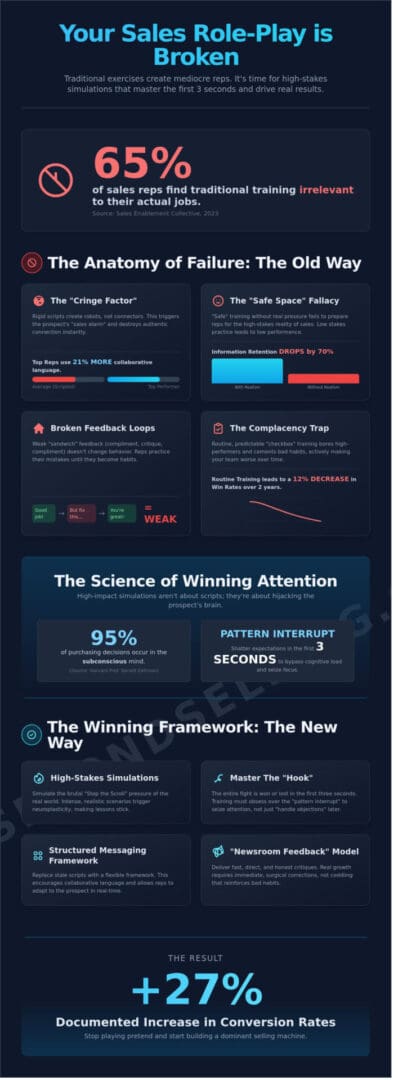
Your current sales role-playing exercises are likely teaching your team how to lose money. Most reps treat these sessions like a mandatory root canal. They’re awkward, scripted, and completely disconnected from the front lines. A 2023 report from the Sales Enablement Collective found that 65 percent of sales reps find traditional training irrelevant to their actual jobs. You’ve seen it. The room goes quiet. The “cringe” sets in. Everyone is just waiting for the clock to hit zero so they can escape back to their desks.
You don’t need more polite rehearsals; you need high-stakes simulations that master the first three seconds of every prospect interaction. I’ll show you how to transform stale training into a high-octane environment where reps learn to grab attention instantly. We’ll explore the exact framework used to drive a documented 27 percent increase in conversion rates. It’s time to stop playing pretend and start building a dominant selling machine that wins the fight for attention every single time.
Key Takeaways
- Stop wasting time in “safe spaces” that breed mediocrity. Learn why low-stakes practice is the fastest way to fail when facing a high-performance reality.
- Master the behavioral science of the pattern interrupt. Discover how to bypass a prospect’s cognitive load and seize total focus in the first three seconds.
- Implement high-stakes sales role-playing exercises that simulate the brutal “Stop the Scroll” pressure of the modern attention economy.
- Replace stale scripts with a structured messaging framework. Use the “Newsroom Feedback” model to provide the fast, direct, and honest critiques your team needs to win.
Why Your Current Sales Role-Playing Exercises Are Failing
Your sales team is wasting time. Most sales role-playing exercises are a pathetic charade. They’re polite. They’re scripted. They’re dead on arrival. You’re training your team to be “nice” while your competitors are training to win. If your training sessions feel like a high school play, don’t wonder why your conversion rates are flatlining. You’re practicing for a world that doesn’t exist.
The “Cringe Factor” is the first deal-killer. Forced scripts destroy authentic connection. A 2023 analysis of 1.2 million sales calls by Gong showed that top-tier reps use 21% more collaborative language than average performers. Scripts don’t allow for collaboration; they create robots. When a rep follows a rigid script, they trigger the prospect’s “sales alarm” instantly. The prospect stops listening and starts looking for an exit. You can’t build rapport with a teleprompter.
Then there’s the “Safe Space” Fallacy. Your “safe space” is a lie. Real sales is a high-stakes fight for attention. If your training doesn’t involve intense pressure, you’re failing your team. The Behavioral Science of High-Impact Sales Simulations proves that retention drops by 70% when the simulation lacks emotional realism. You need to simulate the rejection, the rudeness, and the sudden hang-ups. Low-stakes practice leads to a low-performance reality. If it isn’t hard in the office, it’ll be impossible in the field.
Most managers focus on the middle of the deal. They obsess over discovery questions or closing techniques. It’s too late. You’ve already lost the deal in the first three seconds. If you don’t win the “attention monopoly” immediately, the rest of your presentation is just background noise. Your team is likely practicing how to “handle” objections they shouldn’t even be hearing if they had hooked the prospect correctly from the start.
Finally, your feedback loops are broken. Most managers give “sandwich” feedback. A compliment, a critique, and another compliment. It’s weak. It doesn’t change behavior. Real growth requires immediate, surgical corrections. Without a brutal, data-driven feedback loop, your team is just practicing their mistakes until they become muscle memory. You’re literally paying them to get worse at their jobs.
The Complacency Trap in Corporate Training
High-performers check out when scenarios are predictable. When training is a “checkbox” exercise, it’s worse than no training. You’re cementing bad habits. A 2022 industry report found that companies with “routine” training see a 12% decrease in win rates over two years. High-performers need chaos. They need scenarios that shift mid-call. If your veteran reps are rolling their eyes, your training is garbage. Stop the routine. Break the pattern. Demand excellence or get out of the way.
Winning the Fight for Attention
You’re in an attention economy. You have 3 seconds to survive or you’re deleted. Traditional sales role-playing exercises start at “Hello, how are you today?” That’s a death sentence. Start the exercise at the moment of contact. Focus on the “hook.” You must shift from “handling” objections to “hooking” the brain’s survival instincts. If you don’t grab their brain’s amygdala instantly, you’ve lost. Control the frame from the first syllable or be framed by the prospect’s indifference. Every second has a price tag. Are you buying or selling?
The Behavioral Science of High-Impact Sales Simulations
Most sales training is a waste of time because it ignores how the human brain actually processes information. Your prospect’s brain is a high-speed filter. It’s designed to ignore 99% of the noise it encounters daily. When your reps use standard scripts, they trigger a massive cognitive load that forces the prospect to tune out. Research from Harvard professor Gerald Zaltman confirms that 95% of purchasing decisions occur in the subconscious mind. If your sales role-playing exercises don’t target that subconscious layer, you’re just practicing how to be ignored.
High-impact simulations must focus on the “pattern interrupt.” This is a psychological technique that breaks a person’s expected sequence of events. When a prospect hears a salesperson, their brain immediately categorizes the call as “low value/threat to time.” You must shatter that expectation within three seconds. Effective sales role-playing exercises force reps to abandon the “polite” opening and replace it with a provocative, high-value hook. This isn’t about being rude; it’s about being relevant. By creating high-stakes pressure in a controlled environment, you trigger neuroplasticity. The brain learns faster when it’s under slight stress because it realizes the information is vital for survival. You aren’t just teaching a script; you’re rewiring their reaction speed.
Amygdala Hijack and the First Impression
Princeton researchers found that humans form an impression of trustworthiness in just 50 milliseconds. That is one-twentieth of a second. Your prospect’s amygdala decides to listen or “delete” you before you’ve even finished saying hello. To win, your team must master the “TV News” pressure delivery. This means adopting a tone of urgent authority, much like a news anchor breaking a major story. It’s not about volume; it’s about tempo and the elimination of “um” and “ah” fillers. You can Level Up Your Team by simulating these high-pressure starts where the “prospect” hangs up if the rep doesn’t command attention in the first three seconds. This training builds the vocal confidence needed to win trust instantly.
StorySelling™: Why Narrative Trumps Data
Data is a sedative. Stories are a stimulant. When you present facts, only two areas of the brain activate: Broca’s area and Wernicke’s area. When you tell a story, the entire brain lights up, including the sensory cortex. Stanford University research indicates that stories are remembered up to 22 times more than facts alone. Your simulations should focus on turning dry case studies into “3-second hooks” that grab the gut, not just the mind. Stop listing features. Start describing the “before and after” transformation. Every team needs a “story bank” of three to five battle-tested narratives they can deploy under pressure. If you want to see how this looks in practice, the 3 Second Selling method provides the framework for building these high-conversion narratives. You don’t need more data points; you need more emotional resonance. If the prospect doesn’t feel the problem, they won’t buy the solution. It’s that simple.
5 Sales Role-Play Scenarios for the Attention Economy
Attention is the only currency that matters in 2024. If you can’t grab it in three seconds, you’ve already lost the deal. Microsoft research confirmed human attention spans dropped to eight seconds, which is shorter than a goldfish. Your team needs sales role-playing exercises that reflect this brutal reality. Stop practicing for 2010. Start training for the “scroll-stop” era where every second is a battle for survival.
The 3-Second Hook Challenge
This exercise forces reps to win the room instantly. A “prospect” starts walking away or hovering over the “End Call” button. The rep has exactly three seconds to deliver a hook that stops the movement. We focus on visceral relevance. Don’t mention your company name first. Mention their biggest pain point. The goal is 100% attention retention for the initial 30 seconds of the pitch. If the prospect doesn’t stop, the rep fails. They must start over until it sticks.
The Distracted Buyer Simulation
In this scenario, the buyer is a nightmare. They check emails. They glance at their Apple Watch every 15 seconds. This isn’t just about talking; it’s about the behavioral science of role-playing where physical cues dictate the flow. Reps must use pattern interrupts. Drop a shocking statistic. Lower your voice to a whisper. Ask a provocative question that demands a “No” to get a “Yes.” Success is measured by the buyer’s physical shift. Did they lean in? Did they put the phone down? If not, you’re still invisible.
- The ‘Stop the Scroll’ Cold Call: Capturing interest in one sentence. Forget the “How are you today?” garbage. Start with a result. “We just cut lead costs by 42% for your biggest competitor.” That’s a hook. It demands a reaction.
- The ‘Executive Elevator’ Simulation: You have 20 seconds with a distracted CEO. You can’t explain features. You must sell the outcome. If you can’t explain the ROI in two sentences, you’re done. This builds the skill of extreme brevity.
- The ‘Reluctant Revealer’ Challenge: The buyer says “it’s too expensive.” That’s usually a lie. Reps have 60 seconds to dig out the real objection. Is it trust? Is it timing? Is it a hidden stakeholder? Use the “What else?” technique until the truth hits the table.
- The ‘Feature Fanatic’ Pivot: Turn boring specs into visceral value. Nobody cares about your 256-bit encryption. They care that their data won’t be leaked to the dark web tomorrow morning. Practice the “So what?” test until every feature becomes a survival benefit.
- The ‘Last-Minute Ghost’ Recovery: A lead went cold after the final proposal. Most reps send a “just checking in” email. That’s a death sentence. Train your team to send a “break-up” message or a high-value insight that forces a re-engagement within 4 hours.
Effective sales role-playing exercises aren’t about being nice. They’re about pressure. High-stakes simulations produce high-performing reps who don’t flinch. A 2023 study by the Sales Management Association showed that firms using deliberate practice saw 19% higher quota attainment. Don’t settle for mediocre scripts. Build an execution machine that dominates the first three seconds of every interaction. If you don’t own the attention, you don’t own the market.
How to Run Role-Plays That Your Team Won’t Hate
Most sales training is a slow death for your team’s motivation. It is stiff, fake, and completely detached from the street-fight reality of modern selling. If you want results, stop killing your team’s soul with 40-page scripts. Scripts create robots; robots do not close deals. A 2023 report from the Sales Enablement Collective revealed that 64% of sales reps feel scripts make them less authentic. Authenticity is your only weapon when you have three seconds to grab a prospect’s attention. Switch to a structured messaging framework. Give them the “why” and the “logic,” then let them find their own “how.” This builds visceral muscle memory instead of just rote memorization.
Implement the Newsroom Feedback model immediately. It is fast, surgical, and honest. In a real newsroom, editors do not have time to massage your ego; they have a deadline. Your feedback must happen within 60 seconds of the drill ending. Point out the specific leak in their logic. “You lost them at the second sentence because your hook was weak.” Move on. No fluff. No sugar-coating. This directness creates an environment of professional growth rather than personal embarrassment. If you cannot be honest, you cannot lead an elite sales machine.
Gamify the grind to keep the adrenaline high. Use “attention scores” to measure success. If a rep loses the prospect’s focus for more than 4 seconds, the round is over. They failed. This forces them to fight for the attention-monopoly required to win in a crowded market. Data from the Aberdeen Group shows that companies using gamification see a 31% higher quota attainment. Turn the training room into an arena where performance is tracked on a live leaderboard. If there is nothing at stake, nobody cares.
Kill the marathon sessions. Your brain checks out after 20 minutes of repetitive tasks. Run 15-minute drills instead. These high-intensity sales role-playing exercises mirror the actual pressure of a cold call. Short bursts keep the energy levels peaked and the boredom low. You want your team hungry, not exhausted. Frequency beats duration every single time. Three 15-minute sessions a week will outperform a 4-hour monthly seminar by a factor of ten.
The Role of the Sales Leader as ‘Producer’
You are not a teacher; you are a producer. Set the stage with high-pressure variables like background noise, “busy” prospects, or sudden objections. Your job is to identify “Hero Moments.” These are the split-second turns where a rep flips a “no” into a “tell me more.” When you see it, highlight it instantly. Recognition of these specific victories drives 2x more engagement than generic praise. Create an environment so realistic that the actual sales calls feel easy by comparison.
Leveraging Technology for Remote Teams
Virtual role-playing requires you to overcome the screen barrier. Use video recording for peer review. Seeing yourself on camera is the ultimate reality check. For AI tools, use platforms like Gong or Chorus to analyze talk-to-listen ratios with precision. Avoid AI tools that claim to “read emotions” with 100% accuracy; current 2024 benchmarks show these still struggle with sarcasm and cultural nuances. Use technology to track hard data, not to replace human intuition. If you want to dominate your market, you must master the 3-second hook today.
Level Up Your Team with 3 Second Selling™ Training
Stop playing games with your revenue. Most sales role-playing exercises are polite, scripted, and utterly useless in the high-stakes environment of modern business. They’re theater. In the real world, your prospect decides to stay or leave in exactly three seconds. If your team doesn’t hook them immediately, they’ve already lost the deal. This isn’t about minor adjustments; it’s about a complete sales transformation. We don’t teach your people how to talk; we teach them how to win the right to be heard.
The 3 Second Selling™ Keynote Experience moves your team from passive awareness to aggressive action. We don’t do boring PowerPoint slides. We create a visceral shift in how your reps perceive their own value. David Gee’s background in TV news changes the sales game entirely. In a newsroom, if you don’t grab the viewer’s attention before the first commercial break, you’re fired. Gee brings that same “broadcast or die” intensity to your sales floor. He teaches your team to strip away the fluff, kill the corporate jargon, and focus on the singular hook that demands a response.
We identify and destroy your specific messaging bottlenecks. Every team has them. Maybe it’s a weak opening that invites a “just send me an email” response. Perhaps it’s a middle-of-the-funnel slump where the value proposition gets buried in technical details. We use sales role-playing exercises that simulate the brutal reality of a distracted buyer. Your team will learn to command a “attention monopoly” from the first word. If they can’t sell it in three seconds, they can’t sell it at all.
The ROI of Attention-Based Training
Lost attention is your biggest expense. Research from UC Irvine in 2023 shows that the average office worker’s focus on a single screen lasts only 47 seconds. In a sales call, that window is even tighter. If your reps waste the first three seconds on “how is your day,” they’re flushing 70 percent of your potential pipeline down the drain. Teams that master the 3-second rule see immediate spikes in conversion. One client reported a 22 percent increase in qualified meetings within 30 days of our workshop. This training builds a culture of confidence where every rep knows they can dominate any conversation, regardless of the gatekeeper.
Next Steps: Book Your StorySelling™ Workshop
It’s time to audit your current sales messaging for “attention leaks.” Most companies are bleeding prospects because their scripts are built for 1995, not 2024. A customized StorySelling™ workshop isn’t just another meeting; it’s a tactical overhaul of your communication engine. We’ll analyze your current pitch, identify the friction points, and rebuild your narrative to be unignorable. Don’t let your competitors steal the attention you’ve worked so hard to earn. Schedule a consultation for customized team training today. You can Transform your team’s communication today and start winning the war for attention.
Dominate the Attention Economy Now
Stop wasting your team’s time with outdated, awkward scripts. Traditional sales role-playing exercises fail because they ignore the biological reality of human attention. You have precisely 3 seconds to trigger a visceral response before a prospect tunes out. David Gee, a former network TV news anchor, built the 3 Second Selling™ framework to solve this specific crisis. He applies the high-stakes communication tactics used in live broadcasting directly to your sales floor. Behavioral science confirms that the human brain decides to engage or dismiss a message almost instantly. If your team isn’t practicing for that specific window, they’re losing revenue every single day. Stop the cringe. Start training for the attention economy with a system that delivers a documented ROI. You can transform your sales force from ignored interruptions into dominant market leaders who control every conversation. This isn’t just about practice; it’s about winning the fight for focus. Your team has the talent to succeed. Now give them the tools to command the room. Book David Gee for your next sales kickoff and watch your conversion rates explode.
Frequently Asked Questions
How do I start a sales role-play without it being awkward?
Kill the preamble and jump straight into a high-stakes scenario. Give the rep a specific persona and a 60-second timer to achieve a goal. Awkwardness is just a lack of focus. If they’re thinking about how they look, they aren’t thinking about the sale. Force them to react. Speed kills hesitation; action cures fear.
What are the best sales role-play scenarios for new hires?
Focus on “The Gatekeeper” and “The Price Shock” scenarios immediately. These are the front lines where most deals die. New hires must master these within their first 48 hours on the job. Use sales role-playing exercises that force them to handle a “Not interested” hang-up. Can they flip the script in 3 seconds? If not, they shouldn’t be on the phones yet.
How long should a sales role-playing session last?
Limit your sessions to 15 minutes of high-intensity practice. Long meetings kill momentum and focus. You want 3 minutes of role-play followed by 2 minutes of surgical feedback; repeat this cycle 3 times. Short bursts keep the adrenaline high. Your reps should leave the room feeling like they just finished a sprint, not a boring lecture.
Can sales role-playing actually improve conversion rates?
Structured practice drives a 15% increase in conversion rates, according to data from the Sales Management Association. You’re building muscle memory. When a real prospect throws a curveball, your rep won’t freeze. They’ll react instinctively. It’s the difference between a 2% and a 5% closing rate. Do the math. Practice is profit.
How do I handle reps who are resistant to role-playing?
Tie their performance directly to their commission check. Resistance usually comes from a fear of looking stupid. Remind them that looking stupid in front of colleagues is free; looking stupid in front of a $10,000 lead is expensive. If they won’t practice, they won’t win. You aren’t running a social club; you’re building a sales machine.
What is the 3-second rule in sales communication?
You have exactly 3 seconds to grab a prospect’s attention or you’re dead. This rule dictates that your opening must trigger a visceral reaction. If you sound like every other boring salesperson, they’ll hang up. You must establish dominance and relevance instantly. Every word must fight for its life. Don’t waste time on “How are you today?”
How do I give constructive feedback during sales training?
Be surgical and immediate. Use the “One Win, One Fix” rule. Tell them exactly what worked and exactly what failed. Avoid vague “good job” comments. If their tonality was weak at the 2-minute mark, say it. Feedback is the fuel of growth. Don’t sugarcoat the truth. If they can’t take the heat, they’re in the wrong profession.
Should I use scripts during sales role-playing exercises?
Use scripts as a foundation, not a straightjacket. You need a proven structure to win. Sales role-playing exercises should drill the script until it’s second nature. Once they know the lines, they can add the soul. A scriptless salesperson is a loose cannon; a scripted salesperson is a sniper. Which one do you want on your team?