

Leadership Communication Skills: Winning the 3-Second Battle for Your Team’s Attention
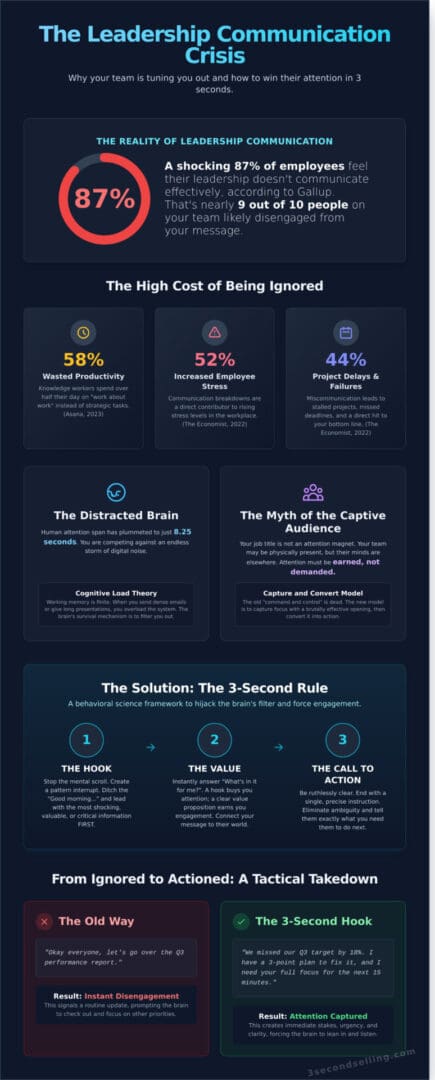
Gallup found that a shocking 87% of employees don’t believe their leadership communicates effectively. That’s nearly nine out of ten people on your team who are likely tuning you out. Right now. The message you thought was crystal clear is already lost in a fog of notifications, competing priorities, and digital exhaustion.
You feel it, don’t you? The blank stares on Zoom calls. The critical directives that stall because they were never truly absorbed. It’s a frustrating, friction-filled battle where your most important ideas fail to move the needle. This isn’t a problem of effort; it’s a problem of strategy. We’re here to give you a new one. This article will arm you with the behavioral science to master the essential leadership communication skills needed to win that battle in the first three seconds.
Prepare to learn how to cut through the noise, command instant attention, and ensure your message is not only heard but understood and acted upon with precision.
Key Takeaways
- Stop assuming “clarity” is enough. Discover why traditional leadership fails in an attention-starved environment and what you must do instead.
- Master the 3-Second Hook, a critical component of modern leadership communication skills, to instantly command attention in any meeting or email.
- Redefine executive presence as a powerful communication signal and learn why the most influential leaders are often the last to speak.
- Get a tactical playbook to eliminate “fluff” from your messaging and apply the Inverted Pyramid structure for emails that get read and acted upon.
The Attention Deficit: Why Traditional Leadership Communication is Failing
Stop talking. Nobody is listening. You think your carefully crafted emails and logical presentations are landing? They’re not. They’re digital debris in an endless storm of notifications, Slack pings, and competing priorities. Leadership communication in the 2026 Attention Economy isn’t about being clear. Clarity is the minimum requirement, a ticket to a game you’re already losing. Today, it’s about being sharp enough to cut through the noise. Instantly.
Your team is drowning. A 2023 survey by Asana revealed that knowledge workers spend 58% of their day on “work about work” instead of skilled, strategic tasks. They don’t have time for your 30-minute monologue or five-paragraph email. The cost of this failure is catastrophic. A 2022 report by The Economist Group found that communication breakdowns contribute to increased stress (52% of respondents) and project delays (44%). This isn’t just an HR issue; it’s a failure in basic communications management that bleeds revenue and kills momentum. Every missed deadline and every disengaged employee is a direct tax on your leadership.
The rules have changed. If you don’t win their attention in the first three seconds, you’ve already lost. The message, no matter how brilliant, is dead on arrival.
The Science of the Distracted Brain
Your team’s brains are full. Cognitive Load Theory confirms that working memory is finite; it can only process a few pieces of information at once. When you bombard your people with dense reports and back-to-back meetings, you overload the system. Their brains don’t just slow down; they actively start filtering you out. It’s a survival mechanism. Your “important update” is just more noise to be ignored. Attention-Based Selling applied internally means treating your ideas like products and your team like customers; you must earn their attention before you can ever hope to earn their buy-in. Their brains have a biological spam filter, and it’s trained to delete generic corporate jargon like “synergy,” “leveraging assets,” and “optimizing workflows” on sight.
The Myth of the Captive Audience
Your job title is not an attention magnet. It doesn’t guarantee you a single second of your team’s focused cognitive energy. They may be in the room, but their minds are a thousand miles away, planning dinner or worrying about a project you know nothing about. The old model of “command and control” is a fossil. The new battlefield demands superior leadership communication skills built on a “capture and convert” model. You capture their focus with a brutally effective opening, and you convert that focus into action. That’s it. Contrast a traditional, hour-long town hall that 80% of your team has tuned out of with a 3-second message that lands like a lightning strike. One is a waste of payroll. The other is true leadership.
The 3-Second Rule: Applying Behavioral Science to Executive Messaging
Your team isn’t listening. They’re physically in the room, but their minds are elsewhere, scrolling through an endless feed of deadlines, distractions, and internal chatter. You have three seconds to stop them. Not ten. Not five. Three. This isn’t a marketing gimmick; it’s a neurological reality. A 2015 Microsoft Corp. study confirmed the average human attention span has plummeted to just 8.25 seconds. You are losing the war for your own team’s attention before you even finish your first sentence.
The 3 Second Selling™ framework isn’t just for closing deals. It’s a weapon for leaders who need to cut through the noise and drive action. It’s a system built on behavioral science, designed to hijack the brain’s filtering mechanism and force engagement. It consists of three non-negotiable steps: The Hook, The Value, and The Call to Action. Forget your old playbook. This is how you win.
Stopping the Mental Scroll
Your team operates on autopilot. To break it, you need to create a pattern interrupt. Ditch the “Good morning, let’s review the agenda” nonsense. That’s a signal for their brains to check out. Instead, use the “News Anchor” approach: lead with the most shocking, valuable, or critical information first. Create immediate tension. Start with a question or a bold declaration that forces them to lean in.
- Old way: “Okay everyone, let’s go over the Q3 performance report.” (Translation: Time to check email on my phone.)
- 3-Second Hook: “We missed our Q3 target by 18%. I have a 3-point plan to fix it before year-end, and I need your full focus for the next 15 minutes.”
That second one creates instant stakes. It’s a jolt to the system. You’ve stopped the scroll.
StorySelling™ for Leaders
A hook buys you attention. A story earns you engagement and memory. Your strategy documents and KPI dashboards are forgettable. A 2007 Stanford study by Chip and Dan Heath found that 63% of people remembered a story, while only 5% could recall a single statistic. To make your vision stick, you must wrap it in a narrative.
Look at Steve Jobs introducing the iPhone. He didn’t lead with technical specs. He created a story with a killer hook: “An iPod, a phone, and an internet communicator.” He built tension, repeating the three items until the audience was captivated. Then the reveal: “These are not three separate devices. This is one device.” That story didn’t just launch a product; it created a market-defining narrative that employees and customers could repeat for a decade. This is the essence of powerful leadership communication skills. You can’t execute a strategy you can’t remember. If your team can’t retell your vision in a single, compelling sentence, you’ve already failed. Mastering this is the entire focus of our StorySelling™ Workshop.
Finally, every single communication must have a purpose. Attention without action is a vanity metric. Don’t end a meeting with a vague “let’s circle back.” End it with a singular, unambiguous call to action. What is the one thing they must do *right now*? Your job as a leader isn’t to inform. It’s to mobilize. If your messages don’t force a decision or an action, you’re not leading, you’re just contributing to the noise.
Beyond Executive Presence: Signal vs. Noise in High-Stakes Environments
Forget “executive presence.” That’s a passive, outdated concept for people who think a corner office and an expensive suit command respect. They don’t. In the war for attention, there is only signal and noise. Your communication is either a high-frequency signal that cuts through the chaos or it’s static. Garbage. A waste of everyone’s time.
In a high-stakes meeting, a crucial sales call, or an all-hands address, you don’t have five minutes to warm up the crowd. You have three seconds. In those three seconds, your team, your clients, and your investors decide if you’re a leader to follow or a manager to ignore. Your signal strength determines your fate.
Signal Strength: The Psychology of Authority
Your authority is judged before you even speak. Princeton University research confirmed people form lasting impressions of competence and trustworthiness in just 100 milliseconds. That’s a tenth of a second. On Zoom, this means your posture, your eye contact with the camera, and your lack of distracting virtual backgrounds are already broadcasting your signal. Brevity is the ultimate amplifier of expertise. The more you talk, the less competent you sound. Experts are concise; amateurs ramble. Vocal patterns that signal uncertainty, like a rising intonation at the end of a statement (“uptalk”) or a raspy “vocal fry,” have been shown in studies published in journals like PLOS ONE to make speakers sound less competent and trustworthy.
Level Up Your Listening
The most powerful communicators have mastered a counterintuitive weapon: they speak last. They don’t jump in to prove how smart they are. They listen. Not passively, but with tactical aggression. This isn’t about nodding your head; it’s about hunting for the hidden data, the unspoken objections, the visceral fears that drive your team’s behavior. We break down the entire framework in our Level Up Your Listening guide for executives.
Stop asking weak questions. Start deploying “active-aggressive” listening tactics:
- “What’s the biggest risk here that no one is talking about?”
- “If you had to bet against this project, what would be your reason?”
- “Describe the perfect outcome. Now describe the most likely disaster.”
The answers to these questions are pure gold. They aren’t just feedback; they are the raw material for your next 3-second hook. You stop guessing what matters and start building your message around what you know they fear or desire. This strategic approach to active listening in sales transforms every conversation into a competitive advantage.
Understanding deeper personality frameworks, like the Enneagram, can provide a powerful shortcut to this kind of insight; leaders who want to explore this can discover EQ World.
This is where authenticity builds unbreakable trust. It’s not about a fake smile or a hollow “my door is always open” policy. It’s about demonstrating that you heard the real message, even the one hidden between the lines. This is the core of advanced leadership communication skills. When you reflect their deepest concerns back to them with a clear, confident solution, you don’t just get their attention. You earn their loyalty. Instantly.
The Leader’s Playbook: Practical Tactics for Meetings, Emails, and Keynotes
Theory is a luxury. The battlefield of business demands action. Your words are weapons, but right now, they’re probably dull, unfocused, and hitting the wrong targets. It’s time to sharpen them into lethal instruments of influence. Stop talking about strategy and start executing it with a communication protocol built for victory. This isn’t a list of suggestions; it’s a four-step tactical deployment.
- Step 1: Audit and Annihilate. First, you conduct a ruthless purge. Open your last five sent emails. Hunt down every “I think,” “just,” “perhaps,” and “in my opinion.” These are words of weakness. They signal uncertainty and invite debate. Erase them. Your job is to lead, not to “just check in.”
- Step 2: Master the Inverted Pyramid. Journalists have used this for a century because it works. The most critical information goes first. Always. Your email subject line and first sentence must contain the entire point. Instead of a long story, start with: “DECISION NEEDED: Approve Q4 Budget by 3 PM Friday.” The details can follow for those who need them. Most don’t.
- Step 3: Weaponize the 3-Second Opening. Every presentation, every keynote, every team huddle starts with a hook that seizes the brain’s attention center. A shocking statistic. A provocative question. A bold, counterintuitive claim. Don’t warm up the crowd. Shock them into listening.
- Step 4: Build a Feedback War Room. Stop asking, “Any questions?” It’s a useless, passive query. Start asking, “What is the single biggest obstacle you see to implementing this?” or “On a scale of 1-10, how clear is our objective?” You need data on message resonance, not polite silence.
Running Meetings That Don’t Waste Time
A 2019 study by Doodle revealed that professionals waste an average of two hours a week in pointless meetings. That’s an entire workday per month. Your meeting agenda is the first line of defense. The first item on it dictates the meeting’s entire momentum. If it’s weak, the meeting will fail. Shut down “attention vampires” who derail the conversation with a simple, firm script: “That’s a point for another discussion. Right now, our focus is solely on X.” Download our Effective Meeting Management checklist to reclaim that lost time. Instantly.
Media Training for the Modern CEO
Every Zoom call is a press conference. Every all-hands meeting is a live broadcast. Your every word can be screen-grabbed and scrutinized. Superior leadership communication skills mean you’re always prepared. When faced with a difficult question, don’t dodge it. Use the “Bridge and Pivot” technique. Acknowledge the question (“That’s a valid concern about the timeline…”) and immediately bridge to your core message (“…and it’s exactly why our focus on Phase 1 ensures we build a flawless foundation.”). You control the narrative. Always. If you’re ready to command any high-stakes scenario, our Customized Media Training will forge you into an unstoppable messenger. For leaders who need to dominate hostile interviews and high-pressure questioning, learn how to hijack the narrative in 3 seconds rather than relying on outdated media training scripts.
Scaling Influence: From Individual Skills to Organizational Communication Excellence
You’ve mastered your 3 seconds. So what? Are you a one-person army in a company of confused communicators? A single leader with a sharp message is a threat. An entire organization that communicates with precision is an unstoppable force. The real victory isn’t just improving your personal presentation; it’s transforming your company’s DNA into a culture of communication excellence.
This isn’t about writing better internal memos. It’s about weaponizing clarity. It’s about training your sales and marketing teams to use the same 3-second framework you now possess. Imagine your salespeople opening calls with a hook that makes prospects stop dead in their tracks. Imagine your marketing copy cutting through the digital noise with surgical precision, forcing a click, a sign-up, a sale. When everyone speaks the same brutally effective language, your company becomes an attention-capturing machine.
Still think this is a “soft skill?” Let’s talk numbers. A 2012 Towers Watson study found that companies with highly effective communicators delivered 47% higher total returns to shareholders over a five-year period compared to firms with the least effective communicators. Forty-seven percent. That’s not a rounding error; it’s a market-crushing advantage. When you invest in top-tier leadership communication skills that cascade through the organization, you see measurable ROI in:
- Shorter Sales Cycles: Clarity eliminates confusion and accelerates decisions.
- Higher Conversion Rates: Messages that resonate immediately convert more prospects into customers.
- Increased Profitability: Gallup’s 2023 research shows that business units in the top quartile of employee engagement are 23% more profitable. And what drives engagement? Clear, compelling leadership communication.
This direct link between communication and financial results is critical. For leaders looking to ensure their financial strategy is communicated with the same level of precision, it’s often wise to explore Fractional CFO Services to bring in specialized expertise.
The ultimate goal is to become the most “listenable” brand in your industry. When you speak, your customers, your investors, and your team lean in. Your competitors get drowned out. You don’t just participate in the market; you dictate the conversation.
The 3 Second Selling™ Keynote Experience
A single event can permanently shift your organization’s communication reflexes. This isn’t a motivational speech; it’s a strategic intervention designed to re-wire how your entire team thinks, speaks, and sells. The 3 Second Selling™ Keynote Experience for corporate events installs a new operating system for influence, creating a long-term cultural impact that turns attention into your most valuable asset. Unlike traditional motivational speakers who deliver temporary highs that evaporate by Monday morning, this sales keynote experience focuses on tactical intervention that transforms how your team captures and converts customer attention in the first three seconds. When you’re planning your next corporate event, understanding the benefits of a professional emcee becomes essential to maintaining audience engagement and maximizing your event ROI.
Your Next 3 Seconds
Reading this guide was the easy part. The war for attention is won by action. Here’s what you do now:
- Identify the single biggest communication bottleneck in your sales process.
- Rewrite the opening line of your company’s homepage using the 3-second framework.
- Stop waiting for your competition to get smarter. Book David Gee for your next leadership summit and make clarity your ultimate competitive advantage.
Attention isn’t given. It’s taken.
Master the First 3 Seconds. Command the Room.
Your team’s attention isn’t a given; it’s a prize you must win in the first three seconds. We’ve dismantled the myth of ‘executive presence,’ revealing it as a battle of signal versus noise. You now have the playbook: practical tactics grounded in behavioral science that turn your meetings, emails, and keynotes into instruments of influence. This isn’t a ‘nice-to-have.’ It’s the new standard for effective leadership communication skills.
You can continue letting your message dissolve into the background, or you can arm yourself with a system engineered for impact. The 3 Second Selling™ Keynote Experience, led by former TV news anchor David Gee, isn’t a seminar. It’s a high-stakes training trusted by Fortune 500 leadership teams, built on a foundation of communication psychology that forces clarity and drives action.
Stop wasting your team’s attention. Book the 3 Second Selling™ Keynote Experience today.
Your team is ready to be led. Start by capturing their attention.
Frequently Asked Questions
What are the most important leadership communication skills for 2026?
The most critical skills for 2026 are digital fluency, AI-assisted messaging, and radical transparency. Forget yesterday’s town halls. Your team is scattered, and AI is writing half their emails. According to a 2023 Gartner report, leaders must master asynchronous video updates and learn to prompt AI for clear, concise messaging. Your team demands raw, real-time information, not polished press releases. This is about trust, not just talk.
How do I improve my executive presence in a remote work environment?
You improve remote executive presence by mastering the camera, controlling your environment, and making every interaction count. Your webcam is your new stage. Look directly into the lens, not at your own face. A 2022 Stanford study showed that a clean, professional background increases perceived competence. Ditch the back-to-back Zoom calls. Show up prepared, deliver your point in the first minute, and then listen. Your silence is often more powerful than your words.
Is the 3-second rule applicable to long-form leadership emails?
Yes, the 3-second rule is even more critical for long-form emails. If your first sentence or subject line doesn’t hook them, your 500-word masterpiece is dead on arrival. Data from Constant Contact in 2023 shows average email open rates are below 20%, meaning 4 out of 5 emails are ignored. You have one shot. Use a provocative question or a shocking statistic in the first line. Get to the point. Fast. Or get deleted.
How can I tell if my team is actually listening to my communication?
You know they’re listening when they ask clarifying questions and take the right actions without follow-up. Stop looking for head nods on a Zoom call; they’re meaningless. Engagement isn’t passive agreement, it’s correct execution. A 2023 Gallup poll found that highly engaged teams show 21% greater profitability. If you have to repeat yourself constantly or fix their mistakes, they aren’t listening. Your message failed. Period. Measure their actions, not their attentiveness.
What is the difference between leadership communication and public speaking?
Public speaking is a performance; leadership communication is a two-way dialogue designed to drive action. Anyone can read a speech from a teleprompter. That’s a one-to-many broadcast. The best leadership communication skills involve connection and conversion, even in a one-on-one. It’s about reading the room, adapting your message on the fly, and ensuring the outcome is a specific, desired action. One is about applause; the other is about results. Don’t confuse them.
Can leadership communication skills be learned, or are they innate?
They are absolutely learned. The idea of a “natural-born leader” is a myth that lets you off the hook. No one is born knowing how to craft a compelling message or command a room. These are tactical skills, like learning to code or close a sale. Research from the Center for Creative Leadership confirms that coaching and deliberate practice are the top drivers of leadership development. Stop making excuses. Start practicing. Your charisma is a muscle you either build or let atrophy.
How much does corporate communication training typically cost?
Corporate communication training costs range from $500 for a generic online course to over $20,000 for a multi-day executive retreat. The price depends on three things: customization, delivery format, and the trainer’s reputation. A 2022 Training Industry report shows companies spend, on average, $1,200 per employee on training. The real question isn’t the cost of the training, but the cost of your team’s failure to communicate effectively.
What is the “inverted pyramid” in leadership messaging?
The inverted pyramid is a communication structure that puts the most critical information-the conclusion-at the very beginning. Journalists have used this for over a century because it works. You lead with the “what,” the most important takeaway. Then, you provide key supporting details. Finally, you offer the background and context. This respects your audience’s time and guarantees they get the core message, even if they only read the first sentence. Stop building to a climax. Deliver it immediately.