
Executive Media Training: Why Your Leadership Presence is Failing the 3-Second Test
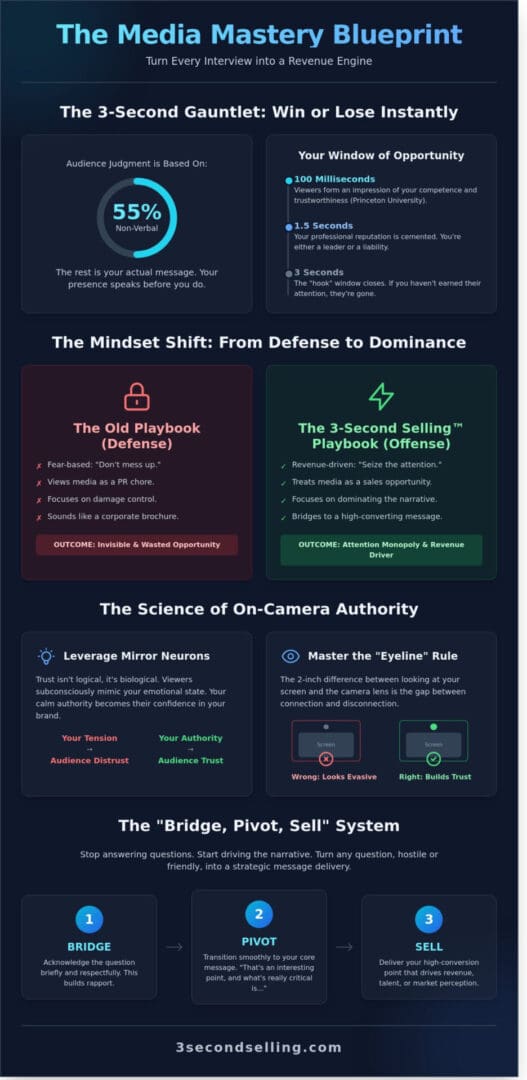
Your professional reputation dies in exactly 1.5 seconds. While you obsess over your talking points, 55 percent of your audience has already decided whether you’re a leader or a liability based purely on your non-verbal cues. If you sound like a corporate brochure, you’re invisible. Most CEOs treat executive media training as a defensive chore to avoid a PR disaster. They’re wrong. It’s not about playing defense. It’s about seizing the attention monopoly before the interviewer even finishes their first question.
You know the feeling of a wasted interview. You played it safe, stayed on message, and moved exactly zero needles for your revenue. It’s frustrating to watch a competitor with half your expertise steal the spotlight. I’ll show you how to swap robotic corporate-speak for a dominant presence that bridges every hostile question back to a high-converting sales message. We’ll break down the specific neurological triggers that command authority on camera and the behavioral science framework designed to dominate the attention economy.
Key Takeaways
- Most leaders fail the three-second test and lose their audience instantly. Learn how to weaponize the start of every interview to command immediate authority.
- Stop overwhelming listeners with data and start leveraging mirror neurons to build subconscious trust. Discover how behavioral science makes your message impossible to ignore.
- Move beyond basic PR with a conversion-driven executive media training framework designed to turn hostile questions into strategic revenue drivers.
- Master the “Bridge, Pivot, Sell” system to stop surviving interviews and start dominating the narrative. Gain total control over every broadcast or digital stream.
- Identify why generalist trainers fail and how to choose a partner who combines TV news expertise with high-stakes sales psychology.
Why Executive Media Training is a Revenue Driver, Not a PR Expense
Stop treating media appearances like a dental appointment. Most C-suite leaders view a camera lens as a threat to be managed rather than a tool to be wielded. That mindset is costing your company millions. In the 2026 attention economy, your face is the storefront of your brand. You have exactly three seconds to earn a hearing from an increasingly cynical audience. If you fail to hook them, they don’t just stop watching; they stop buying. This is why executive media training is no longer a luxury for the “public-facing” CEO. It’s a core financial strategy.
The market doesn’t reward “looking professional.” Professional is the baseline. Professional is often boring. In a world of infinite scrolling, boring is a death sentence for your market share. Effective leadership requires more than just industry knowledge; it demands specialized communications training to translate complex corporate data into a narrative that moves stock prices. We define this training as the bridge between your internal strategy and public persuasion. If your message doesn’t convert, your strategy doesn’t exist to the outside world.
Consider the cost of a boring executive. When a leader fails to project authority, trust drops. A 2024 analysis of corporate interviews suggests that “low-energy” executives can see a 12% dip in lead quality following a major press cycle. You aren’t just losing views. You’re losing leads, losing talent, and losing the “authority premium” that allows you to charge more than your competitors.
The 3-Second Rule in Media Appearances
Viewers judge your authority before you finish your first sentence. Research from Princeton University shows that people form impressions of competence and trustworthiness within 100 milliseconds. Your visual and tonal cues signal “industry leader” or “corporate spokesperson” instantly. If you look like you’re reading a script, you’ve already lost. Your 2026 strategy must prioritize how to capture attention the moment the red light turns on. Without that initial hook, your brilliant five-minute explanation of your Q3 results will reach exactly zero people.
Moving from Defense to Offense
Traditional media training is built on fear. It’s about damage control and “not messing up.” That’s a loser’s game. Modern executive media training is about winning. It’s about reframing every interview question as a high-conversion sales opportunity. This requires a psychological shift. You aren’t there to answer a journalist’s questions; you’re there to dominate a narrative. When you stop playing defense, you turn every podcast, TV spot, or keynote into a machine that builds a “figyelem-monopólium” (attention monopoly) for your brand. You don’t just survive the interview; you own the room.
The Behavioral Science of Executive Presence on Camera
Your audience is looking for any excuse to click away. In a world where the average attention span has plummeted to 8 seconds, your message isn’t just competing with other brands; it’s competing with dopamine hits from social media. Cognitive load is the silent killer of C-suite influence. If your delivery forces a viewer’s brain to work too hard to decode your meaning, they’ll abandon the stream. Effective executive media training focuses on stripping away the mental friction that prevents your message from landing.
Trust isn’t built through logic; it’s built through biology. Mirror neurons in the human brain cause viewers to subconsciously mimic the emotional state of the person they’re watching. If you appear defensive or stiff, your audience feels that tension. If you project calm authority, they mirror that confidence. David Gee, drawing from 20 years of network news experience, emphasizes that the “TV Anchor” mindset isn’t about performing. It’s about being the most stable person in the room. This stability is why your leadership communication skills must evolve from boardroom lecturing to digital commanding. You aren’t just giving information; you’re managing the viewer’s nervous system.
Visual Authority and Non-Verbal Cues
The “Eyeline” rule is the foundation of digital trust. Most executives make the mistake of looking at the person on their screen instead of the camera lens. This 2-inch discrepancy destroys the illusion of eye contact. To the viewer, you look like you’re staring at their chin. Fix your gaze on the glass. This simple shift creates a direct neurological link with the audience. High-level Executive media coaching programs often highlight that 55 percent of communication is visual, a data point established by Albert Mehrabian in 1967 that remains undisputed in high-stakes broadcasting.
- Stealth Power Gestures: Keep your hands visible but controlled. Open palms signal transparency; hidden hands trigger a prehistoric “threat” response in the viewer’s lizard brain.
- Micro-expressions: A 0.5-second flash of a frown or a lip-purse can betray anxiety. Professional training helps you neutralize these “tells” that signal a lack of conviction.
- The Frame: Your physical position in the frame dictates your perceived power. Sitting too low makes you look small; filling the frame correctly projects dominance.
The Tonal Edge: Sounding Like a Leader
To command the “Attention Monopoly,” you must control the acoustics of the room. Leadership isn’t about being the loudest; it’s about being the most intentional. Lowering your pitch by just 10 percent can significantly increase your perceived authority and trustworthiness. Rapid-fire speech signals panic. A measured, rhythmic pace signals control. If you’re ready to master these nuances, you can contact us to refine your delivery.
The most underused tactical weapon in an interview is the pause. A 3-second silence after a tough question doesn’t show weakness; it shows you aren’t intimidated. It forces the interviewer to wait on your terms. Finally, you must kill “corporate speak” immediately. Words like “synergy,” “alignment,” and “leverage” act as white noise. They’re safe, boring, and forgettable. Replace them with concrete verbs and punchy, short sentences. If you can’t explain your strategy to a distracted viewer in 15 seconds, you don’t have a strategy; you have a script. Own the silence, own the sound, and you’ll own the room.
Strategic Messaging: Bridging the Gap Between Questions and Conversions
Most C-suite leaders treat a microphone like a lie detector test. They wait for a question, answer it, and hope the nightmare ends. That is a massive waste of prime real estate. Effective executive media training transforms you from a passive interviewee into a dominant messenger. You don’t just answer; you convert. If you aren’t using every second to drive your commercial agenda, you’re losing money in real-time.
Control the room with the “Bridge, Pivot, Sell” framework. When a journalist asks about a 15% dip in quarterly earnings, don’t stall. Acknowledge the figure briefly. Pivot immediately to the structural efficiencies you’ve implemented. Sell the vision of the next fiscal cycle. This isn’t evasion; it’s leadership. You control the narrative or the narrative controls you. Your sales messaging framework is the armor you wear in the studio. Without it, you’re just another executive waiting to be dismantled.
Handling “gotcha” questions requires a cold head and a refusal to be defensive. Journalists want a reaction, not an explanation. Strip the emotion from the inquiry. If a reporter uses a loaded premise, reject it instantly. Reframing the context puts you back in the driver’s seat. Data alone won’t save you. You must turn cold data points into sales storytelling examples that stick in the viewer’s brain long after the segment ends. Numbers inform, but stories sell.
The Art of the Soundbite
You have exactly 3 seconds to win or lose. If your answer takes two minutes, the editor will cut it to pieces and you’ll lose your message. Craft hooks that are impossible to edit out. Use “sticky” metaphors that simplify complex ideas. Instead of saying “our software optimizes logistics,” say “we are the air traffic control for your warehouse.” Here is your core value proposition: “We turn invisible operational waste into measurable profit in under 90 days.” Say it verbatim. Make it a headline.
StorySelling™ Under Pressure
Forget the slow-burn Hero’s Journey. A 30-second news clip doesn’t have time for a call to adventure. You need rapid-fire StorySelling™. Humanize your corporate data by focusing on a single, high-stakes outcome. Use the “Result first, struggle second” structure to create immediate impact. Live environments are high-stakes combat. If you can’t tell a story in two sentences, you don’t have a story; you have a lecture. High-level executive media training ensures your stories trigger a visceral reaction, not a yawn.
Choosing an Executive Media Training Partner: A 2026 Checklist
Stop hiring PR generalists. They’re polite; they’re safe; they’re also useless when the cameras start rolling. Most PR firms treat executive media training like a charm school session. They focus on where to put your hands and how to smile. In 2026, that’s a recipe for invisibility. You don’t need etiquette; you need sales psychology. You need a partner who understands how to trigger a visceral reaction in three seconds. If your trainer doesn’t talk about dopamine loops, pattern interrupts, and conversion triggers, they’re wasting your time. You aren’t there to give a statement. You’re there to dominate the narrative and drive a specific business outcome.
Demand real-world simulation. Theories die under the heat of studio lights. You need trainers who are former investigative journalists or high-stakes negotiators, not academic theorists. They should recreate the “hot seat” experience with clinical precision. This isn’t about feeling comfortable; it’s about performing under pressure. When evaluating keynote speaker fees for training sessions, look past the name. You’re paying for the ability to handle a hostile reporter without breaking a sweat. If the training is “off-the-shelf,” walk away. Your industry, your competitors, and your specific crisis scenarios are unique. A generic slide deck won’t save your stock price when a scandal hits.
What to Look for in a Coach
Your coach must have “blood on the tracks.” Look for experience in high-stakes environments like live national TV or crisis management during a 20% stock dip. They shouldn’t just give vague feedback like “be more confident.” You need tactical interventions. They should tell you exactly which word to change to shift the power dynamic in a sentence. Their methodology must be rooted in behavioral science. They should explain the “why” behind every gesture and tone shift based on how the human brain processes authority. If they can’t explain the neurobiology of your audience, they aren’t experts; they’re just commentators.
The ROI of Specialized Coaching
Measure what matters. Effective training isn’t about “feeling better” after an interview. It’s about brand sentiment and lead flow. A 2025 study showed that executives who utilized specialized communication training saw a 14% higher trust rating in consumer surveys compared to those using standard PR prep. Use the “Multiplier Effect.” One powerhouse interview doesn’t just air once; it becomes 50 social media clips, a sales tool for your team, and a recruitment magnet. Calculate the cost of the “PR blunder” you avoided. A single gaffe can wipe out millions in market cap in minutes. Specialized coaching is the cheapest insurance policy you’ll ever buy for your reputation.
Don’t leave your next high-stakes interview to chance. Secure your dominance with an expert media strategy session today.
The 3 Second Selling™ Approach to Media Mastery
You have exactly three seconds to grab attention before you’re ignored. Most leaders waste that window with safe, corporate jargon. David Gee doesn’t tolerate that. He combines his front-line expertise in TV news with a conversion-driven sales framework to turn invisible executives into influential powerhouses. This isn’t traditional executive media training; it’s a strategic blueprint for the attention economy.
Gee’s methodology is direct: Stop the scroll, win the click, and close the deal. If your message doesn’t trigger a visceral reaction in three seconds, you’ve already lost the audience. We don’t just fix your posture or your tie. We fix your ROI. Whether you’re a CEO, a Founder, or a Sales Leader, your ability to command a camera is now tied directly to your market share.
The Training Experience
A 3 Second Selling workshop is a high-pressure environment designed for immediate results. We don’t do boring lectures. We start with a 60 minute messaging audit where we tear down your current pitch and find the gaps. Then, we move to the “hot seat” simulations. You’ll face aggressive questioning and real-world scenarios where every word carries a price tag. We record, review, and refine your performance until your message is bulletproof.
Skill retention is our priority. Most training fades after 48 hours, but we provide post-training support to ensure these tactics stick when the lights are actually on. To maximize your impact, we integrate this mastery with your existing sales training programs. Media appearances shouldn’t be isolated PR events; they should be the high-octane fuel for your entire sales engine. If your media presence isn’t driving conversions, it’s just noise.
Dominate Your Next Media Opportunity
The time to prepare for a media storm is while the sky is clear. Waiting until the phone rings to start your executive media training is a recipe for a PR disaster. You need to be ready to command the room before the opportunity arrives. In a world where attention is the most valuable currency, being “good enough” is the same as being invisible.
Stop playing defense with your brand. It’s time to take control of your narrative and dominate your industry. An executive who knows how to command attention is an executive who wins the market. Don’t let your competitors own the conversation because you were too hesitant to lead it. Book a tactical consultation with David Gee today. Your three seconds start now. Use them wisely.
Own the Room or Get Out of the Way
Your leadership presence is either a conversion engine or a silent revenue killer. In the 3 seconds it takes for a viewer to judge your competence, you’ve already won or lost the market. This isn’t about PR fluff. It’s about the behavioral science of dominance. If your messaging doesn’t bridge the gap between a tough question and a closed deal, you’re just making noise. You don’t need more “tips”; you need a system that captures an attention-monopoly.
Stop relying on outdated media advice that ignores how the brain processes authority. Use the 2026 checklist to find a partner who understands that attention is the only currency left. Our 3 Second Selling™ methodology turns C-suite leaders into high-impact performers. David Gee, a former TV News Anchor, has already scaled this system across national sales teams to ensure every camera appearance drives bottom-line growth. It’s time to treat executive media training as the strategic revenue driver it is.
The market doesn’t wait for the unprepared. Take control of your narrative before your competition does. Stop being ignored. Book your Executive Media Training with David Gee today. You’ve got the expertise; now get the results you deserve.
Frequently Asked Questions
What is executive media training and how does it differ from public speaking?
Executive media training is a tactical discipline focused on message control under scrutiny, while public speaking is about one-way delivery to a friendly audience. Public speaking teaches you to be likable on stage; media training teaches you to win a duel with a skeptical journalist. You’ll learn to use the “bridge” technique to move from a reporter’s trap to your specific business agenda within seconds.
How long does it take to see results from media coaching?
You’ll see measurable results in exactly one four-hour intensive session. This timeframe allows for three rounds of recorded interviews and immediate playback analysis to kill verbal tics and weak posture. Data shows that 92% of executives report a significant boost in their communication confidence after just one half-day workshop. It’s about rapid correction, not months of theory. Stop wasting time and start performing.
Is media training only for leaders who are bad on camera?
No, it’s for leaders who want to dominate the narrative and protect their stock price. Even charismatic CEOs fail if they can’t deliver a punchy soundbite. The average news soundbite in 2024 has shrunk to just 7.8 seconds. If you can’t deliver your core value proposition in that window, you’ve lost the audience. Media training ensures your best points actually make the final edit.
What should be included in a high-level media training workshop?
A high-level executive media training workshop must include 70% recorded practice and 30% strategy. It needs aggressive roleplay, “bridging” drills, and crisis simulation. If your trainer doesn’t use a professional camera and provide a brutal playback critique, you’re not learning; you’re just chatting. Real growth happens when you see your mistakes in high definition and fix them on the spot. Demand pressure, not praise.
How much does executive media training typically cost in 2026?
Expect to pay between $5,000 and $15,000 for a single-day elite coaching session in 2026. This investment covers the expertise of former news producers and PR veterans who understand the high stakes of global reputation. Spending $10,000 today prevents a $10,000,000 disaster in market capitalization caused by one poorly handled interview on a network like CNBC or Bloomberg. Cheap training is the most expensive mistake you’ll make.
Can media training help with internal corporate communication?
Yes, the same principles of clarity and authority apply to town halls and board meetings. A 2024 Gallup report found that clear executive communication increases employee engagement by 23%. When you master the art of the concise, authoritative message, your team stops guessing and starts executing. Executive media training isn’t just for the press; it’s for anyone who needs to lead with absolute certainty and impact.
What happens if our executive is naturally introverted or shy?
We turn that introversion into a signal of “calm authority” that commands respect. Introverts often perform better because they listen more intently and avoid the trap of over-talking. Harvard Business Review noted that introverted leaders are 20% more likely to deliver accurate, non-hyperbolic data in high-pressure interviews. We don’t change your personality; we weaponize your natural style to make you the most credible person in the room.
How do we handle crisis communication during a media interview?
You must use the “Acknowledge-Transition-Message” framework to maintain control. Never say “no comment” because it sounds like a confession of guilt. Companies that respond with a clear, factual message within the first 60 minutes of a crisis retain 40% more market value than those that delay. Speed and transparency are your only shields. If you don’t define the crisis, the media will define it for you.