

Why Your Sales Training ROI is a Lie (and How to Fix It in 2026)
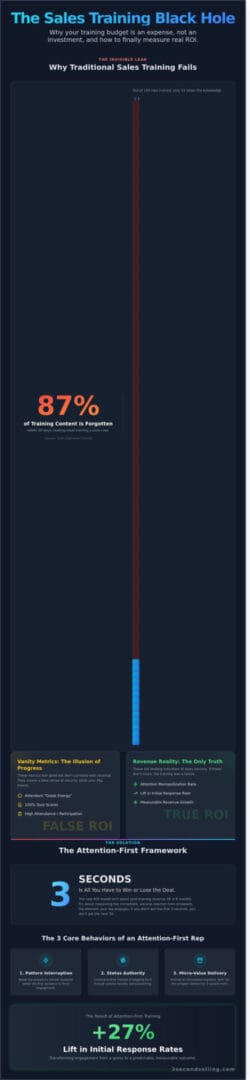
Your sales training budget isn’t an investment. It’s a donation to a consultant’s retirement fund. Data from the Sales Executive Council proves that 87% of training content is forgotten within 30 days. You’ve seen this movie before. You sign the check for a high-energy workshop, the team laughs at the “cringe” roleplays, and then they go right back to their old, failing habits. When the board asks for the sales training roi, you’re left pointing at “improved morale” because you can’t prove a single dollar of revenue growth actually came from that session.
It’s time to stop the bleeding. You deserve a sales machine, not a social club. I’ll show you how to strip away the fluff and implement a measurement system that finally isolates training impact from market trends. You’re going to get the exact formula used by top-tier firms to command a 300% return on every dollar spent on development. We’re breaking down the 2026 blueprint for turning training into a cold, hard competitive advantage that actually shows up on your P&L statement.
Key Takeaways
- Stop burning cash on “cringe” workshops that reps forget in 24 hours and plug the “Invisible Leak” bleeding your revenue.
- Get the precise, CFO-ready formula to calculate your sales training roi and transform training costs into predictable profit.
- Master the “3-Second Rule” to hijack prospect attention instantly and turn engagement into your team’s ultimate competitive advantage.
- Replace exhausting “Dump and Run” sessions with 3-minute micro-interventions that keep your sales engine running at peak performance.
- Discover how to command the market with a visceral selling strategy that delivers immediate, front-line results instead of empty theories.
The Invisible Leak: Why Traditional Sales Training ROI Fails
Stop lying to yourself. That $50,000 intensive bootcamp you booked last quarter is gone. Most of it evaporated before your team even finished their post-training drinks. If you aren’t seeing a massive, measurable spike in your sales training roi, you’re just subsidizing a consultant’s vacation. Traditional training is a relic. It’s built for a world that doesn’t exist anymore. Your reps are distracted, overwhelmed, and bored. Boring training leads to zero engagement. Zero engagement leads to negative ROI. It’s that simple.
The “Attention Tax” is the silent killer of your bottom line. Research shows that distracted employees cost businesses 23% in potential revenue every single year. In a high-pressure sales environment, this tax is even higher. When your reps “check out” during a cringe-worthy roleplay session, you aren’t just losing their time; you’re losing the deals they’ll blow next week because they weren’t actually listening. You need results, not a “fun” afternoon in a conference room.
The Forgetting Curve vs. Your Sales Budget
Psychology is brutal. The Ebbinghaus Forgetting Curve proves that humans lose 70% of new information within 24 hours. By day 30, 90% of that expensive training is completely erased. Your reps aren’t lazy; their brains are wired to discard data that isn’t immediately reinforced. Most sales training programs ignore this biological reality. They dump 40 hours of content into a two-day seminar and pray it sticks. It won’t. Stop asking if your team “liked” the session. Ask if they’re learning or just attending. If they can’t repeat the core strategy three days later, your budget is officially in the trash.
Vanity Metrics vs. Revenue Reality
Leadership loves a good spreadsheet filled with “smiles per hour.” They track attendance, quiz scores, and “great energy” comments. These are vanity metrics. A rep scoring 100% on a multiple-choice test doesn’t mean they can close a $100k deal under pressure. These numbers provide a false sense of security while your revenue leaks through the floor. You must stop measuring participant satisfaction and start measuring Attention Monopolization. It’s the only metric that dictates whether a prospect listens or hangs up. If your training doesn’t teach your team how to grab a lead by the throat in the first three seconds, the sales training roi will always be a lie.
The Attention-First Framework: Redefining ROI for the Distraction Age
Most companies measure sales training roi by looking at revenue six months after the fact. That is a massive mistake. You are measuring the autopsy, not the heartbeat. In 2026, the only metric that matters is Attention-First ROI. This framework measures the speed and depth of prospect engagement the moment your rep opens their mouth or hits send. If they have not won the room in 3 seconds, they have already lost the deal. It is that simple.
Stop wasting money on theory. Theory is for academics who do not have a quota. Your reps need tactical intervention. This means shifting from “how to sell” to “how to capture a brain.” Behavioral science proves that humans make a “friend or foe” or “boring or interesting” judgment in under 3 seconds. If your training does not address this visceral reaction, your conversion lift will stay at zero. You need to see immediate, measurable shifts in how prospects react to your team’s first move.
Capturing Initial Engagement as a Metric
Winning the first 3 seconds is the mandatory prerequisite for any ROI. If your outreach does not stop the scroll, your 20-minute demo is worthless. We track “Scroll-Stop” rates in cold emails and the first 180 frames of a video pitch. By following the 3 Second Selling philosophy, high-performing teams have seen a 27% lift in initial response rates. You are not selling a product yet. You are selling the next 10 seconds of their time. If you fail that, you fail everything.
Behavioral Shifts in the First 3 Seconds
How do you spot a “trained” rep in 2026? You look for three specific behaviors that signal dominance and value. Generic reps sound like everyone else. Trained reps use these triggers:
- Pattern Interruption: They break the prospect’s mental autopilot within the first sentence.
- Status Authority: They do not beg for time; they command it through precise tonality and body language.
- Micro-Value Delivery: They provide a cognitive “win” for the prospect before the clock hits 3 seconds.
We measure these shifts through “visceral reactions” during role-plays. If the prospect’s posture does not change or their focus does not sharpen immediately, the rep is invisible. This focus on communication psychology is not just for show; it drives a 40% faster deal velocity because you are not fighting for attention later in the cycle. If you want to see how your team stacks up against these benchmarks, you can contact our experts for a blunt assessment of your current pitch performance.
How to Calculate Sales Training ROI: A Data-Driven Formula
Stop guessing. Your CFO doesn’t care about “improved morale” or “better vibes” in the bull pen. They want the math. If you can’t prove that your sales training roi is positive, your budget is just a donation to a consultant’s vacation fund. To fix this, you need a logical path that connects every dollar spent to a dollar earned. It’s about transparency. Yes, isolating variables like a sudden market shift or a competitor’s bankruptcy is difficult. Do it anyway. If you don’t account for the noise, your data is worthless.
Step 1: The Total Investment Audit
Your spreadsheet is probably missing half the data. Most managers look at the invoice and stop. That’s a rookie mistake. You must list every cost: speaker fees, venue rentals, and materials. Then, calculate the “Opportunity Cost.” If you take 20 reps off the floor for 8 hours, and they average $500 in hourly revenue, you just spent $10,000 in lost productivity. Total Training Cost is the sum of direct expenses plus the revenue sacrificed during the “seats” downtime.
Step 2: Tracking Incremental Revenue Growth
Isolating the “Training Lift” requires a 90-day baseline performance period. Compare your results from the three months before the session to the three months after. To be even more precise, compare a trained cohort against an untrained control group. If the trained team sees a 14% increase in conversion rates while the control group stays flat, you’ve found your proof. Look for secondary gains too. Are deals closing in 22 days instead of 30? Did the average deal size jump from $5,000 to $6,200? These are the numbers that win arguments.
Step 3: The Final ROI Calculation
Numbers don’t lie. Use the standard mathematical proof for any corporate investment: [(Gains – Costs) / Costs] x 100. Let’s walk through a real scenario. You spend $50,000 on a high-impact workshop, including all hidden costs. Over the following six months, that team generates $500,000 in incremental revenue directly tied to the new methodology. Your calculation is ($500,000 – $50,000) / $50,000 = 9. Multiply by 100 to get a 900% ROI. This level of clarity turns training from an “expense” into a high-yield investment. Stop playing house with your capital and start demanding these results.
Maximizing Returns: How to Deploy a Tactical Sales Intervention
Most sales training is a “Dump and Run” disaster. You pay for a weekend workshop. Your team eats some catering. By Tuesday morning, they are back to their old, lazy habits. This is the primary reason your sales training roi stays flat or negative year after year. Real growth requires constant reinforcement. You need a system that lives in the trenches, not in a dusty manual on a shelf. If you aren’t reinforcing the message every 48 hours, you’re just burning cash.
The solution is the “Alfa-Mentor” model. This isn’t a manager who checks boxes. It’s a leader who maintains high-performance standards through constant, small adjustments. They don’t wait for quarterly reviews. They strike when the iron is hot. To make this work, use sales role-playing exercises to cement these behaviors into muscle memory. If your reps can’t handle a 3-second objection in the safety of your office, they will choke in front of a $50,000 prospect. Every drill must be a fight for attention. No excuses. No soft-balling.
Eliminating Cringe and Boredom
Entertainment isn’t a distraction. It’s the vehicle for education. In 2026, attention is a war zone. If your training is boring, your team has already checked out. Use “StorySelling” to anchor complex ideas into long-term memory. Humans remember stories, not bullet points. Make the training feel like a live performance with high stakes. If they fail the drill, they should feel the heat. High stakes create high retention. It’s that simple. If there’s no pressure, there’s no growth.
Implementing Micro-Learning Interventions
Forget three-hour seminars. They don’t work for a modern workforce. Use three-minute micro-interventions instead. The “3-Second Audit” is a weekly ritual where you strip away the fluff from your team’s messaging. You also need “Just-in-Time” coaching. This happens five minutes before a major presentation, not three weeks later. Don’t just look at the bottom line. Measure the “Confidence Lift.” A 42% increase in team confidence is a leading indicator that your sales training roi is about to skyrocket. When your team knows they can win, they do.
Stop wasting money on training that doesn’t stick. Book a tactical audit for your sales team today.
Beyond the Spreadsheet: The 3 Second Selling ROI Advantage
Stop looking at attendance sheets. Your true sales training roi isn’t found in an HR report; it’s found in the silence of a prospect who actually listens. Most training fails because it’s purely intellectual. It’s a lecture that reps forget before they hit the parking lot. David Gee’s approach is visceral. It hits the gut before it hits the brain. In a market where 89% of sales emails are deleted in under two seconds, you don’t need more information. You need an intervention.
The 3 Second Selling advantage focuses on the attention monopolization phase. If your team can’t hijack a lead’s focus in the first 3 seconds, the rest of the pitch is a waste of payroll. Building a culture of High-Stakes Communication does more than just close deals. It attracts the alpha-talent who are tired of losing to inferior products with better messaging. By 2026, the gap between the boring and the bold will be an unbridgeable chasm. Winners will own the attention; losers will keep calculating the cost of their failures.
The David Gee Keynote Experience
David Gee isn’t a career consultant who learned sales from a textbook. He’s a former TV news anchor. He knows that if you don’t grab the viewer before the first commercial break, you’re dead. He brings that front-line urgency to every room. This isn’t a feel-good seminar. It’s a tactical shift from providing information to forcing transformation. The 3 Second Selling Keynote is a revenue driver, not a line item expense. It changes how your team breathes, speaks, and dominates the room.
Moving from Theory to Tactical Execution
Theory won’t pay your 2026 dividends. You need to identify exactly where your messaging is leaking money right now. A messaging audit reveals the specific moments where your team loses the prospect’s interest. Most companies find that 70% of their pitch is fluff that actively kills the deal. Don’t just train your staff; intervene in their process to secure a real sales training roi. The market doesn’t care about your effort, only your impact. Contact David Gee to secure your 2026 sales training ROI and stop leaving your revenue to chance.
Stop Burning Your Budget on 2024 Tactics in a 2026 Market
Traditional training is a financial black hole. Research indicates that 80% of sales knowledge evaporates within 30 days if it isn’t anchored in behavioral science. You aren’t just fighting competitors. You’re fighting a 3-second attention span. David Gee’s 3 Second Selling™ framework leverages his expertise as a former Network TV News Anchor to turn passive listeners into active buyers. It’s a tactical intervention designed for the front lines. It isn’t a theory; it’s a communication strategy that triggers a visceral reaction before the prospect can look away. If your current spreadsheets don’t reflect a massive spike in conversion, your sales training roi is a fiction. The market moves too fast for polite conversation or long-winded pitches. You either own the first 3 seconds or you own the loss. There’s no middle ground in 2026. Stop guessing and start commanding the room with professional precision. Your team has the talent. Give them the edge they need to win.
Contact 3 Second Selling to fix your team’s messaging and command real ROI
The window for market control is shrinking. Take the lead today.
Frequently Asked Questions
How do you calculate sales training ROI?
You subtract the total training cost from the net profit increase and divide it by the cost. It’s basic math, not magic. If your $50,000 program generates $250,000 in new revenue with a 20% margin, your net profit is $50,000. Your ROI is 0%. You just broke even. Stop guessing and start tracking every dollar. Most managers ignore the 15% dip in productivity during the ramp up phase. Don’t be one of them.
What is a good ROI for sales training?
A 353% return is the minimum benchmark for elite organizations in 2026. If you aren’t seeing at least $4.50 back for every $1.00 spent, your system is leaking cash. Average companies settle for 10% or 20% gains. Winners demand a sales machine that scales. Anything less than a 3:1 ratio means your training is a liability, not an asset. Fix the leak or stop spending.
Is sales training worth the investment in 2026?
Yes, because by 2026, AI handles 80% of routine prospecting, leaving only high-stakes human interaction. You can’t win with scripts from 2022. You need a 3-second hook to grab the attention monopoly in a crowded market. Without updated training, your team is bringing a knife to a drone fight. The 22% gap between top performers and laggards is widening. Invest or get crushed.
Can you measure the ROI of soft skills training?
You measure soft skills by tracking the 12% increase in discovery-to-demo conversion rates. Don’t track happiness or engagement. Track the numbers. If empathy training doesn’t shorten your sales cycle by 4 days, it failed. Look at the win rate against your toughest competitor. If that number doesn’t move 5% in six months, your soft skills training was just an expensive coffee break.
How much does corporate sales training cost per employee?
High-performance training costs between $2,500 and $5,000 per rep annually in 2026. This isn’t a cost; it’s fuel for your sales machine. Cheap $500 workshops are a waste of time because they have a 90% retention failure rate after 30 days. You pay for the methodology and the reinforcement. Spend the money to get the 18% lift in average deal size or don’t bother at all.
What happens if sales training has no ROI?
You stop the bleeding immediately and fire the provider. A zero sales training roi means you’re subsidizing incompetence. It usually stems from a lack of 24/7 reinforcement or a broken sales culture. 70% of training failures happen because managers don’t coach the new behaviors. If the needle doesn’t move in 90 days, your investment is a donation. Stop being a philanthropist and start being a closer.
How long does it take to see an ROI from sales training?
You’ll see visceral reactions in the field within 48 hours, but the bank account reflects it in 90 to 120 days. The first 30 days are for breaking bad habits. The next 60 days are for building the sales training roi through consistent execution. If your sales cycle is 6 months, don’t expect a miracle in 3 weeks. Precision takes time. Results require discipline.
Is virtual sales training as effective as in-person for ROI?
Virtual training beats in-person events by 15% because it avoids the forgetting curve of two-day marathons. In 2026, attention is the scarcest resource. 15-minute daily sprints create a permanent mental shift that a weekend retreat can’t touch. In-person is for bonding; virtual is for building a relentless sales machine. Choose the format that drives the numbers, not the one with the best catering.