

B2B Sales Techniques for the 2026 Attention Economy: Why 3 Seconds is All You Get
Your prospect’s brain decides to ignore you in exactly 2.6 seconds. If you haven’t triggered visceral curiosity by then, you’ve already lost the deal. It’s a brutal reality where traditional b2b sales techniques have become white noise that the modern executive’s brain is biologically wired to filter out. You’re likely watching your response rates crater toward 0.02% while your sales cycle stretches past the 180 day mark despite your expensive tech stack.
You know the status quo is broken. You feel the frustration of a sales team that sounds like every other generic pitch in the inbox. This article promises to give you the behavioral science tools to hijack attention and close deals in a zero-patience world. You’ll master the exact communication triggers that command instant authority and stop the scroll of a distracted buyer. We’re diving into the psychological mechanics of the 2026 attention economy to ensure your first touch isn’t your last.
Key Takeaways
- Overhaul your b2b sales techniques to bypass the “ignore by default” filter and survive the brutal 2026 attention economy.
- Master the “Pattern Interrupt” to seize the critical 3-second cognitive window before your prospect decides to delete your message.
- Replace forgettable pitches with the StorySelling™ framework to turn boring case studies into high-stakes narratives that force engagement.
- Deploy the “Visual Stop” and “Verbal Lead” tactics to command immediate authority across every digital touchpoint and interaction.
- Build a high-performance sales culture by integrating behavioral science into your daily execution instead of relying on outdated, theoretical training.
The Death of Traditional B2B Sales: Survival in the 2026 Attention Economy
Traditional B2B sales is dead. It didn’t die a quiet death; it was suffocated by a billion automated emails and “AI-optimized” LinkedIn pitches. By 2026, the average executive receives over 120 cold pitches every single day. Their brain has evolved a biological spam filter that deletes your “personalized” outreach before they even process your name. If you’re still relying on 2022 b2b sales techniques, you’re invisible. You aren’t just competing with your direct rivals anymore. You’re competing with TikTok, internal corporate crises, and the sheer mental exhaustion of a saturated attention economy.
Personalization has become the new spam. Adding a “P.S. I saw you went to University of Michigan” doesn’t build rapport. It signals that you’re using a bot to scrape data. It’s lazy. It’s transparent. Prospects smell the desperation. Information-based selling, where you explain what your product does, is a relic. In a world where every feature can be compared on a G2 grid in thirty seconds, information has zero value. You must shift to attention-monopoly selling. If you don’t own their mind in the first three seconds, you don’t own the deal.
Stop being polite. “Polite” sales reps are the ones who get ghosted. Being “nice” is a mask for a lack of conviction. When you’re too afraid to challenge a prospect’s broken process because you want to be “liked,” you’re killing your conversion rates. Authority sells. Politeness begs. Choose one.
The Attention Deficit Bottleneck
The numbers are brutal. Response rates for standard B2B sequences plummeted to 0.5% in early 2024, and the decline is accelerating as we move toward 2026. The “scroll culture” has officially migrated from social media to the C-Suite. Your prospects no longer read emails; they scan for threats or immediate gains. If your pitch doesn’t punch them in the gut within the first 20 seconds, your 20-minute demo is a fantasy. You’re fighting for a micro-monopoly of their focus. Every word that doesn’t scream “value” or “danger” is a reason for them to click ‘Delete’.
The Myth of the “Rational” B2B Buyer
We like to pretend B2B buyers are logical robots driven by spreadsheets. They aren’t. Harvard Professor Gerald Zaltman proved that 95% of purchase decisions occur in the subconscious mind. The lizard brain (the amygdala) decides based on survival, status, and fear long before the executive brain (the neocortex) starts looking for ROI data to justify the choice. Most b2b sales techniques fail because they talk to the neocortex first. That’s a billion-dollar mistake. Features and benefits are secondary to biological triggers. You must reframe “Professionalism” as “Impactful Authority.” Don’t be the vendor who asks for “five minutes of your time.” Be the expert who identifies the $500,000 hole in their strategy and offers the only way to plug it. That isn’t being rude; it’s being essential.
The Behavioral Science of the 3-Second Rule: Why Prospects Ghost You
You have three seconds. That’s the entire window. In those 3,000 milliseconds, your prospect’s brain performs a high-speed execution of your relevance. They aren’t reading your pitch; they’re scanning for a reason to delete you. This is the 3-Second Rule. It’s the cognitive threshold where a decision-maker determines if you’re a valuable partner or a digital parasite. If you fail this test, no amount of data or storytelling will save the deal. You’ve already been ghosted; they just haven’t told you yet.
Most b2b sales techniques fail because they ignore the biology of rejection. When you open a call with “How are you doing today?”, you trigger an automatic “No” response. You’ve identified yourself as a salesperson, not a peer. To win, you must execute a “Pattern Interrupt.” This is a psychological maneuver that breaks the prospect’s autopilot mode. It forces the brain to switch from a passive, defensive state to an active, curious one. You don’t want a polite conversation; you want an attention monopoly.
The Cognitive Filter: How Buyers Protect Their Time
The Reticular Activating System (RAS) is the gatekeeper of B2B attention, acting as a neural filter that blocks out 99% of sensory data to prevent cognitive overload. Discovered by Moruzzi and Magoun in 1949, this bundle of nerves at the brainstem decides what gets through to the conscious mind. In a buyer-empowered world, where 57% of the purchasing process is completed before a rep is ever contacted, the RAS is hyper-sensitized to “sales breath.”
Common triggers that cause an immediate shutdown include generic LinkedIn connection requests or scripts that start with “I’ve been following your company.” These are low-value signals. When the RAS detects a pattern it has seen 1,000 times before, it classifies you as noise. To bypass this filter, your opening must be sharp, unexpected, and centered on a specific pain point that hurts right now. If you can’t articulate a problem better than they can, you’re invisible.
Mastering the Pattern Interrupt
Tactical dominance requires stopping the scroll before the prospect’s thumb hits the delete key. In a cold email, your subject line shouldn’t summarize the email; it should provoke a visceral reaction. Use something like “Friday’s mistake” or “The [Competitor] shift.” These aren’t clickbait; they’re relevance. On a Zoom call, use “The Hook” within the first 3 seconds. Instead of the standard “Can you see my screen?”, try starting mid-sentence about a specific 12% drop in their industry’s efficiency. You must be the one setting the pace.
The “TV News Anchor” secret is your weapon for commanding a room. News anchors don’t ask for permission to speak; they use a downward inflection and controlled breathing to signal authority. Your visual cues on camera must match this. Sit up. Look into the lens, not the screen. If your background is messy or your lighting is dim, you’ve lost the “Anchor” effect. Psychology shows that “The Anchor” sets the tone of the meeting instantly; if you start as a subordinate, you’ll never close as a consultant. You can master these high-stakes moments by adopting advanced persuasion frameworks that prioritize speed over fluff.
High-performance b2b sales techniques rely on this immediate psychological control. You aren’t there to be liked; you’re there to be the solution they can’t afford to ignore. Every second you spend being “nice” is a second they spend looking for the exit. Stop being a vendor and start being a necessity. The clock is ticking.
StorySelling™ Over Pitching: The Framework for High-Stakes B2B Communication
Most B2B case studies are a waste of digital ink. They are boring, self-indulgent, and read like a technical manual for a product nobody asked for. If you want to master modern b2b sales techniques, you must stop pitching and start StorySelling™. Your prospects do not care about your company history or your 5,000 square foot warehouse. They care about their own survival. When you are competing in a crowded playing field, your only weapon is the narrative you build around their pain.
Ditching the Feature-Dump
Facts tell, but stories sell. This is not just a catchy phrase; it is neurobiology. In a 2014 study by Dr. Paul Zak, researchers found that character-driven stories cause the brain to synthesize oxytocin. This chemical enhances empathy and builds immediate trust. Conversely, a data-heavy “feature-dump” triggers cortisol. This stress hormone makes your prospect feel overwhelmed and defensive. They want to escape the meeting, not sign the contract.
Audit your current pitch deck. If 80% of your slides focus on your product’s specifications, your deck is broken. A winning deck focuses on emotional milestones. Do not just list “99.9% server uptime” as a bullet point. Transform that data. Talk about the IT Director who finally slept through the night on Black Friday because the system did not crash. Move the conversation from “What we do” to “What happens to you.” If your solution does not change the buyer’s life, it is just an expense, not an investment.
The 3-part StorySelling™ architecture is your roadmap to dominance:
- Challenge: The specific monster your client is fighting right now.
- Conflict: The internal and external barriers preventing them from winning.
- Conversion: The transformed state where your solution has slain the monster.
The High-Stakes Communication Audit
Authority is eroded by weak words. If your sales team uses phrases like “we try to,” “we hope to,” or “perhaps we could,” they are bleeding credibility. These are “leakage words” that signal uncertainty. In high-stakes B2B environments, uncertainty is a deal-killer. You must speak with the “Alpha-mentor” authority that suggests you have already solved this problem 100 times before. Because you have.
Every case study you share needs a “3-Second Hook.” If the first sentence is “Company X was founded in 1998,” you have already lost the attention monopoly. Start with the crisis. Start with the $450,000 loss they faced before they called you. Use visceral language. Did they have a “problem,” or was their “revenue hemorrhaging”? The latter demands an immediate solution. For teams struggling to bridge this gap, the StorySelling™ Workshop provides the intensive training needed to rewire your communication for maximum conversion.
Finally, remember your role. You are the Guide, not the Hero. In the B2B narrative, your client is Luke Skywalker. You are Yoda. If you try to be the Hero, you are competing with your client’s ego. That is a battle you will lose 100% of the time. Position yourself as the expert Guide with the plan, and you will find that prospects stop “thinking about it” and start buying. This shift in b2b sales techniques is the difference between being a vendor and being a strategic partner.
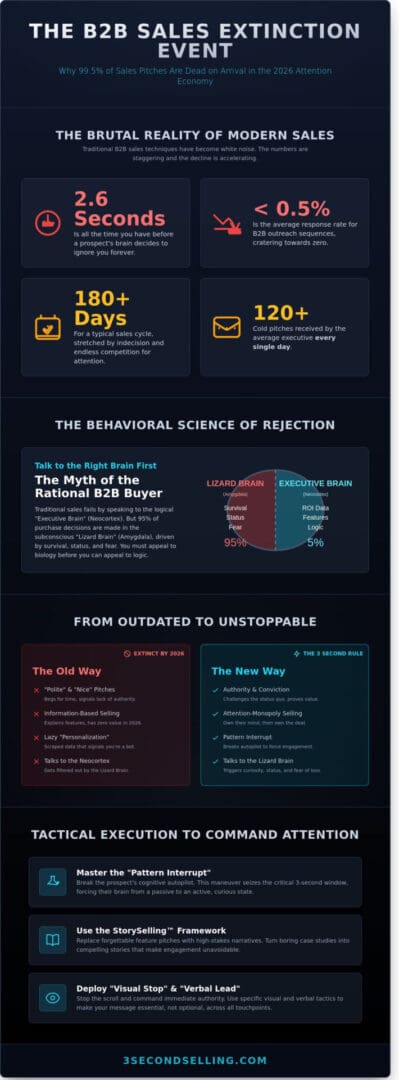
Tactical Execution: How to Capture and Command Attention Across Every Touchpoint
Stop boring your prospects with slow introductions. Most b2b sales techniques fail because they’re too polite and too slow. You have three seconds to win or lose. If you miss that window, you’re invisible. Success starts with the “Visual Stop.” Research from the Missouri University of Science and Technology shows it takes exactly 0.05 seconds for a user to form a first impression of your digital presence. If your LinkedIn profile or landing page looks like a 2005 tax document, the sale ends before you speak a word.
Once you win the eyes, you must win the ears with the “Verbal Lead.” This is your first sentence. Forget your name or your company history. Start with a specific problem or a shocking result. This leads directly to the “Value Pivot.” You have 10 seconds to move from mere attention to genuine interest. You do this by connecting your opening hook to a concrete business outcome. If you can’t prove value in two sentences, you’re just noise.
The final step is the “Micro-Commitment.” Don’t ask for a three-month contract or a deep-dive demo immediately. Ask for the next three minutes. Secure small wins to build momentum. A prospect who agrees to a three-minute screen share is 70% more likely to agree to a full discovery call later. Control the clock, or the clock will control you.
The 3-Second Email Mastery
Opening an email with “I hope this finds you well” is a professional death sentence. It signals that you have nothing urgent to say. Delete it. Your subject line must demand a click by using a “Pattern Interrupt.” Instead of “Quick Question,” use “Your 14% churn rate” or “The [Competitor] Gap.” According to OptinMonster, 47% of recipients open emails based on the subject line alone. Follow the “One Screen Rule.” If your message requires scrolling on an iPhone 15, it’s too long. Put the “Value Pivot” in the first two lines or lose the lead forever.
Commanding the Virtual Stage
Virtual selling is a performance, not a chat. Position your camera at eye level; looking down at your laptop makes you look weak and unprepared. Use “The Frame” by keeping your head in the top third of the screen, just like a professional news anchor. During the first 3 seconds of a discovery call, skip the weather talk. State your purpose immediately to build instant trust. Use the “Power Silence.” When you deliver a price or a hard truth, stop talking. A three-second pause forces the prospect to process the information and signals that you are in total control of the room. This is how modern b2b sales techniques create dominance in a crowded market.
Ready to stop being ignored and start dominating your market? Master the art of the rapid close.
Building an Unstoppable Sales Culture: From Browsers to Buyers in Seconds
Most sales training is a total waste of money. You spend thousands on “proven” systems, yet 80% of the information evaporates from your team’s memory within 90 days. Why? Because traditional b2b sales techniques focus on the wrong end of the transaction. They teach people how to close a deal that hasn’t even been opened. If your team cannot capture a prospect’s lizard brain in the first 3 seconds, the most sophisticated closing script in the world is just noise. Stop paying for theory; start investing in biological reality.
Integrating behavioral science into your daily sales stand-ups is the only way to stay relevant. Forget the standard “what’s in your pipeline” updates. Those are autopsy reports. Instead, ask your team how they triggered the Reticular Activating System (RAS) in their last five calls. Did they sound like every other boring vendor, or did they command a “figural” position in the prospect’s mind? If you aren’t training your people to bypass the brain’s “ignore” filter, you are effectively training them to fail. You need a culture where every second of interaction is treated as a high-stakes auction for attention.
Shift your focus from traditional metrics to “Attention ROI.” It’s a simple calculation. How much mental energy did the prospect invest compared to the value you delivered? If a salesperson spends 20 minutes on a demo but the prospect can’t repeat the core hook 3 seconds after hanging up, your ROI is zero. High-impact communicators don’t just “talk” to prospects. They engineer visceral reactions. They move away from being “closers” who beg for a signature and become authorities who prospects feel they cannot afford to ignore. This isn’t just sales; it’s a battle for dominance in a crowded market.
The ROI of Attention-Based Training
The 3 Second Selling™ methodology transforms your team from invisible background noise into a primary focus. When your sales force masters the art of the immediate hook, your lead-to-opportunity conversion rate doesn’t just crawl up; it explodes. We have seen teams move from being ignored in the inbox to becoming indispensable partners simply by changing how they open a conversation. Team-wide communication alignment reduces sales cycle length by ensuring every touchpoint reinforces a single, high-impact message that bypasses the prospect’s mental filters. By cutting the fluff, you stop wasting time on “polite” prospects who were never going to buy and start accelerating the ones who will.
Next Steps: Command the Room with David Gee
Your next event doesn’t need another “speech” about quotas and hustle. It needs a catalyst. Bringing the 3 Second Selling™ Keynote Experience to your stage is about more than just information; it’s about a fundamental shift in how your organization speaks to the world. David Gee doesn’t deliver a lecture. He delivers an experience that forces your team to confront their own communication failures and gives them the tools to fix them on the spot. A speech is something you hear; an experience is something that changes your behavior the moment you walk out the door. If you are ready to stop the “browsing” and start the buying, it’s time to change the game. Book David Gee for your next sales keynote and watch your team turn every 3-second window into a closed deal.
Command the Clock or Lose the Deal
The 2026 market won’t wait for your 20-minute slide deck. You have 3 seconds to trigger a visceral reaction or you’re invisible. Former TV news anchor David Gee developed this framework using communication psychology to ensure you never get ghosted again. Stop pitching. Start StorySelling™. This shift bypasses the logical brain and hits the prospect where they actually make decisions. These b2b sales techniques are the only way to win when attention is the world’s most expensive currency.
National sales organizations and leadership summits already use these behavioral science protocols to turn browsers into buyers. Your competition is already shortening their cycle. Don’t let your revenue stall because of a slow start. You can master the 3-second hook and build an unstoppable sales culture right now. Success belongs to the fast. Go out there and take the market share you deserve.
Bring the 3 Second Selling™ Keynote Experience to your next event
Frequently Asked Questions
What are the most effective B2B sales techniques for 2026?
The most effective b2b sales techniques for 2026 center on hyper-personalization driven by predictive AI and behavioral science. Gartner predicts that 75% of B2B sales organizations will replace traditional playbooks with AI-guided selling strategies by next year. You can’t rely on generic templates anymore. Success requires using real-time data to engage prospects exactly when they hit the 70% mark of their buyer journey.
How do you capture a B2B prospect’s attention in under 3 seconds?
You capture attention by triggering a visceral reaction through a radical pattern interrupt. Research from Microsoft shows human attention spans have dropped significantly, leaving you with a 3,000-millisecond window to prove your relevance. If your opening doesn’t challenge the status quo or highlight a specific, painful cost of inaction, the prospect will delete your message. Win the fight for focus or remain invisible.
Why is storytelling important in B2B sales?
Storytelling is vital because the human brain is hardwired to retain narratives much better than raw data. A famous study by Jennifer Aaker at Stanford University found that stories are 22 times more memorable than facts alone. Data provides the logical justification, but stories provide the emotional hook that drives the decision. If you want a prospect to remember your solution, give them a narrative they can retell to their board.
What is the “Attention Economy” and how does it affect sales?
The Attention Economy is a marketplace where human focus is the most scarce and valuable commodity available. Nobel Laureate Herbert Simon defined this concept in 1971, stating that a wealth of information creates a poverty of attention. In sales, this means your true competition isn’t just another vendor. It’s every notification, email, and meeting distracting your prospect. You must dominate their mental space instantly or you lose.
How can I improve my cold email response rate in 2026?
Improve your response rate by replacing vague “coffee chats” with specific, low-friction value propositions. Data from Woodpecker indicates that personalized subject lines can increase open rates by 26% compared to generic ones. Keep your body copy under 50 words and focus on one singular, urgent problem. If you don’t mention a specific challenge their company faced in the last 90 days, your email is just digital noise.
What is StorySelling™ and how does it differ from a regular pitch?
StorySelling™ is the strategic fusion of narrative structure and conversion psychology designed to bypass logical resistance. While a regular pitch bores the audience with a list of features, StorySelling™ casts the prospect as the hero and your product as the essential tool to defeat their villain. It creates an attention monopoly. This method transforms a standard sales presentation into an irresistible journey that leads to a signed contract.
How do I train my sales team in behavioral science?
Train your team by focusing on the 188 known cognitive biases that dictate every human decision. Start with Loss Aversion; Daniel Kahneman proved that the pain of losing is twice as powerful as the joy of gaining. Your team must stop selling “benefits” and start highlighting the specific costs of staying the same. Use weekly role-play sessions to turn these psychological theories into tactical, high-pressure execution habits.
What does a sales keynote speaker actually do for a team?
A sales keynote speaker provides a high-impact mental reset and a proven framework for immediate revenue growth. They don’t just deliver a speech; they install a new operating system for your entire sales engine. According to the Sales Management Association, targeted training can increase individual performance by 20%. A professional speaker brings front-line experience that forces your team to stop playing it safe and start winning bigger deals.