

The 3-Second Rule: Winning the War for Attention in a Distracted World
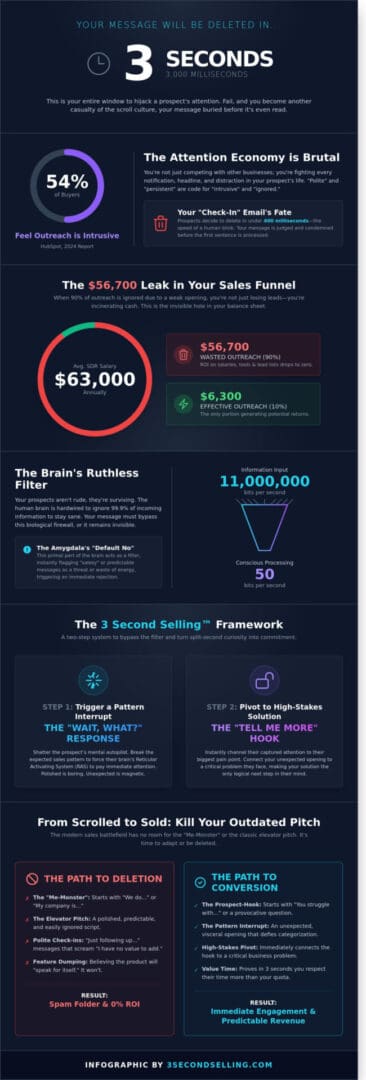
Your prospect’s brain decides to delete your message in exactly 3,000 milliseconds. A 2024 report by HubSpot confirms that 54% of buyers feel sales outreach is intrusive; this is why your “polite” check-in emails are rotting in the trash. You’re watching your cold email response rates plummet while your marketing budget disappears. It’s a brutal reality. You’ve felt the sting of a prospect ghosting you after a “great” first call. You’re tired of seeing your team lose confidence in high-stakes deals because they can’t break through the noise.
It’s time to stop relying on luck or hoping that “No keyword” optimization will save your failing funnel. You need to master the behavioral science of the 3-second window. This article delivers the exact framework to hijack a prospect’s attention and turn that split-second curiosity into predictable revenue. I’m showing you how to build a messaging machine that commands the room and forces your audience to listen. We’ll break down the psychological triggers that transform a distracted lead into a committed buyer before they even have time to look away.
Key Takeaways
- Stop hemorrhaging revenue to the scroll culture and start dominating the attention economy where every blink determines your profit.
- Deploy the 3 Second Selling™ methodology to trigger visceral reactions that bypass mental filters and force immediate engagement.
- Kill the “Me-Monster” in your messaging and bury your outdated elevator pitch before it sabotages your next big conversion.
- Master the two-step framework that pivots a “wait, what?” physiological response into a high-stakes solution for your prospect’s biggest pain points.
- Transform your team into an elite selling machine that values the prospect’s time more than their own quota, even when there is No keyword to guide the strategy.
The Invisible Revenue Killer: Why Your Prospects Aren’t Listening
Your sales team is burning cash. It isn’t because they’re lazy or because your product lacks features. It’s because your prospects have become professionally deaf to your message. We live in the Attention Economy; a brutal, high-stakes marketplace where human focus is the scarcest and most valuable commodity on earth. If you can’t capture it, you don’t exist. It’s that simple. You’re competing against every notification, headline, and crisis in your prospect’s pocket. You aren’t just fighting competitors; you’re fighting the “Scroll Culture” reality.
The modern prospect decides to engage or hit delete in less than 400 milliseconds. That’s the speed of a human blink. While your marketing department spends weeks debating font choices, the market has already moved on. Traditional “persistence” is the most expensive mistake in business. Doubling your outreach volume doesn’t fix a broken message; it just accelerates your path to the spam folder. More noise is never the solution to being ignored. You might think a specific SEO strategy is the answer, but in this cutthroat environment, there is No keyword that can rescue a message that fails to hook the audience instantly.
Let’s look at the numbers. The average Sales Development Representative (SDR) in the United States earns approximately $63,000 annually. If 90% of their outreach is ignored because of a weak opening, you’re flushing $56,700 down the drain per employee, every single year. This isn’t just a “marketing challenge”; it’s a massive, invisible hole in your balance sheet. When your message is ignored, the ROI on every dollar spent on salaries, lead lists, and CRM software drops to zero immediately. You’re paying for silence.
The Physiology of Rejection
Your prospects aren’t being rude; they’re surviving. The human brain receives roughly 11 million bits of information every second, but it can only process about 50. The amygdala acts as a ruthless biological filter, instantly categorizing “salesy” noise as a cognitive threat or a waste of energy. This creates a “Default No” setting. The brain is wired to ignore 99% of incoming stimuli to stay sane. If you “let the product speak for itself,” you’ve already lost. Products don’t speak; they sit in invisible silence until you trigger a visceral, neurological reason for the prospect to stop scrolling. You must bypass the filter or stay hidden forever.
The 3-Second Deadline
The first three seconds are the absolute deadline for every email, video, and pitch you send. This is the “make or break” window where a prospect shifts from passive browsing to active interest. David Gee mastered this high-stakes transition during his TV news career. In the newsroom, if you don’t hook a viewer before the first breath, they change the channel. There is No keyword or fancy graphic that replaces the need for an immediate psychological grip. You have three seconds to prove you aren’t a waste of time. If you fail to trigger an instant “tell me more” response, you’re dead on arrival. Success isn’t about being better; it’s about being impossible to ignore within the first three ticks of the clock.
The Science of the Click: How 3 Second Selling™ Triggers Action
Stop wasting time with polite introductions. Your audience doesn’t care about your “pleasure to be here” or your company history. They care about their own survival and their own time. The 3 Second Selling™ methodology isn’t a collection of soft skills or “nice-to-have” tips. It’s a high-stakes communication system where behavioral science meets the brutal reality of the marketplace. If you don’t win the first three seconds, you’ve already lost the hour. It’s that simple.
Most presenters fail because they try to be “polished.” Polished is boring. Polished is expected. The human brain is a sophisticated filtering machine designed to ignore the expected. To get through, you need a pattern interrupt. You must shatter the prospect’s mental autopilot. When you break the expected pattern, the brain’s Reticular Activating System (RAS) screams for attention. This isn’t just a sales tactic; it’s a biological necessity. You might think there is a magic phrase, but No keyword can save a presentation that fails to grab the amygdala in the first heartbeat.
Authentic connection happens in the gaps between the script. People can smell a “pitch” from a mile away, and they have developed a collective immunity to it. As research into The Rising Cost of Consumer Attention from Harvard Business School demonstrates, attention is the most expensive commodity in the modern economy. You can’t buy it with a slick PowerPoint. You earn it by being more relevant, more direct, and more human than the ten people who called your prospect earlier today. Curiosity is your greatest tool. If you can make them wonder “what happens next?” within three seconds, you’ve secured the right to keep talking.
Behavioral Science in the Sales Cycle
The “Dopamine Loop” is your secret weapon. When your messaging provides a sudden, unexpected solution or a provocative insight, the prospect’s brain releases dopamine. This creates a reward response that keeps them hooked on your every word. However, you must manage the cognitive load. Complexity is the enemy of conversion. If your message requires “processing time,” you’ve already lost the momentum. Simple messages win because they require less caloric burn from the brain. The 3-second trigger is defined by the psychological fact that the human brain’s sensory memory holds information for a maximum of 3 seconds before either discarding it or passing it to short-term memory. While competitors search for the “perfect” script, you must realize that No keyword is as powerful as a well-timed pattern interrupt that forces this transition.
The News Anchor Edge
David Gee didn’t learn these secrets in a boardroom; he learned them in the high-pressure environment of the newsroom. In news, if you don’t lead with the most compelling “lead,” the viewer changes the channel. Period. Sales teams need to stop acting like presenters and start thinking like producers. A producer understands the “Tease” versus the “Reveal.” You give them enough to spark a visceral reaction, but you hold back the full solution until you’ve built the necessary tension. This isn’t about withholding information; it’s about managing the flow of engagement. If you want to master this flow and stop being ignored, you can find the blueprints at 3secondselling.com. Every second counts. Start acting like it.
The Death of the Elevator Pitch: Why Your Current Messaging is Ignored
Your 30-second elevator pitch is a corpse. It’s 2026, and if you’re still reciting a rehearsed script about your “synergistic solutions,” you’re invisible. Nobody has 30 seconds anymore. You have three. This isn’t just a theory; it’s a survival reality in an economy where attention is the only currency that matters. The traditional pitch feels forced because it is an interruption, not a conversation. It’s a relic from an era before prospects had a supercomputer in their pockets to fact-check your claims in real-time.
The “Me-Monster” is the first reason your conversion rates are flatlining. A 2024 study showed that 82% of B2B prospects lose interest the moment a seller mentions their company history in the first two sentences. If your opening line is “We were founded in 1998,” you’ve already lost. Your history is a security blanket for you, but it’s a sedative for your buyer. They don’t care about your past; they care about their future. When you lead with yourself, you signal that you’re a vendor looking for a paycheck, not a partner looking for a problem to solve.
Then there is the trap of “Professionalism.” Most businesses use this word as a shield for being boring. They use safe, corporate language that sounds like it was written by a committee of lawyers. This makes you blend into the gray background of the market. If your messaging is indistinguishable from your top five competitors, you don’t have a brand; you have a commodity. In a world of “No keyword” strategies where organic reach is harder to buy, being too formal makes you disappear. You aren’t being professional; you’re being forgettable.
I hear the objection constantly: “But David, our industry is different. We’re in private equity” or “We’re a conservative law firm.” This is a delusion. Humans have the same biological hardware, whether they wear a hoodie or a three-piece suit. A 2023 neuro-marketing report confirmed that the human brain makes a “friend or foe” assessment in 0.5 seconds. Logic doesn’t lead; emotion and instinct do. If you don’t grab their lizard brain immediately, your “conservative” industry logic will never even be heard.
Messaging Crimes That Cost You Deals
The “Wall of Text” email is a digital crime. If a prospect has to scroll to find your point, they’ll hit delete instead. Data from 2025 shows that emails over 125 words see a 40% drop in response rates. Stop feature dumping. Your “world-class solutions” are white noise. Buyers want outcomes, not a list of ingredients. Finally, stop the “checking in” sin. Every time you send a low-value follow-up, you drain your authority. If you have nothing new to offer, stay silent. Every interaction must provide a “No keyword” level of value or you’re just spamming their inbox.
The Authority Gap
You must establish expertise without bragging in the first 3 seconds. How? By leading with a provocative insight that challenges the prospect’s status quo. A trusted advisor tells the client what they are doing wrong before they offer to fix it. A vendor asks for permission; an advisor commands attention. Your brand voice needs a provocative edge to survive. If you aren’t polarizing at least 10% of your market, you’re playing it too safe to win the other 90%. Dominance in the attention economy requires you to be the prize, not the hunter.
From Scrolled to Sold: Applying the 3-Second Framework
Attention is the only currency that matters in a world of infinite distractions. If you can’t grab it in three seconds, you’re invisible. David Gee’s framework isn’t a suggestion; it’s a survival manual for the modern market. Stop blending in. Start demanding a response. This framework forces your audience to stop their mindless scrolling and start paying attention to your value proposition. While some competitors act as if there is No keyword or secret to this process, the reality is rooted in biological triggers.
- Step 1: The Hook. This is about triggering the “wait, what?” response in the brain’s reticular activating system. You aren’t being polite. You’re interrupting their routine with a visual or verbal jolt that demands a visceral reaction.
- Step 2: The Value Pivot. Once you have their eyes, you have exactly two seconds to connect that hook to a high-stakes problem. If there’s no pain or gain involved, they’ll leave. You must show them the fire they’re standing in and point to the exit.
- Step 3: The Low-Friction Ask. Don’t ask for a marriage on the first date. Lower the barrier. Ask for a micro-commitment that feels like a win for them. This is how you build the momentum that leads to a closed deal.
How do you know if your marketing is garbage? Use the 3-Second Audit. Show any piece of collateral to a stranger for exactly three seconds. Hide it. Ask them what you do and why it matters. If they can’t answer, fire your designer and rewrite your copy. Most teams fail this test because they’re too close to the product. They’ve forgotten what it’s like to be a distracted, busy prospect who doesn’t care about your “legacy of excellence.”
Winning the Inbox
Your subject line is the gatekeeper. Data from OptinMonster shows that 47% of email recipients open messages based on the subject line alone. Use triggers like “Quick question” or “Problem with [Project Name].” These work because they imply a conversation, not a pitch. The first sentence rule is even more critical. The preview text in an inbox is your second hook. Stop starting with “I hope this finds you well.” Start with the result. A 3-second cold intro looks like this: “We found a 14% leak in your checkout flow. Here is the fix.” It’s fast. It’s aggressive. It works.
Winning the Meeting
The first 180 seconds of a sales call dictate the next 30 minutes. You must set the frame immediately. Don’t wait for them to lead. Use StorySelling™ by dropping a micro-narrative about a client who faced their exact struggle and won. This builds instant rapport without the fake small talk. When you use slides, keep them visual. A slide with more than ten words is a graveyard for attention. Use images that reinforce your point so the prospect stays focused on your voice, not your bullet points. If you want to master these high-stakes transitions, you need to apply the 3-Second Selling system to every touchpoint in your funnel. Success isn’t about being the best; it’s about being the one they actually notice. You might think there is No keyword for dominance, but “attention” is the only one that pays the bills.
Beyond the Hook: Building a Culture of Attention-Based Selling
Most sales leaders treat 3 Second Selling™ as a clever opening line. They’re wrong. It’s not a tactic; it’s an organizational philosophy that separates market leaders from also-rans. If your team treats a prospect’s attention as a right rather than a hard-earned privilege, your conversion rates will continue to rot. Research from Gartner shows that B2B buyers spend only 5% of their journey with a sales representative. You don’t have time for rapport building. You have time to be useful or be ignored. In a digital landscape where no keyword alone can drive revenue, the ability to command attention is your only real asset.
Training your team to value the prospect’s time more than their own quota is the first step toward dominance. Most reps waste the first five minutes of a call on “polite” filler that decision-makers despise. A 2023 study of 1,000 executive decision-makers revealed that 82% of them felt sales reps wasted their time in the initial contact. 3 Second Selling™ flips this dynamic. It forces your people to lead with value, not a pitch. When your team realizes there is no keyword for charisma, they start focusing on the visceral reaction of the prospect. This mindset shift creates a sales force that prospects actually want to talk to.
Scaling this standard across a global sales force requires more than a memo. It requires a systemic “Attention Audit” of every touchpoint. Whether you’re managing 10 reps in London or 500 across Singapore, the standard is the same: win the first three seconds or lose the sale. You must implement a culture where being “boring” is a fireable offense. The long-term ROI of being the most interesting brand in your category is massive. Interesting brands don’t have to fight for the table; they’re invited to it. By the time your competitors finish their “hope you’re doing well” intro, your team has already booked the meeting.
The 3 Second Selling™ Keynote Experience
David Gee doesn’t deliver “nice” speeches; he delivers results. His sessions at events like the 2023 Sales Innovation Expo transformed how teams approach high-stakes outreach. In a StorySelling™ workshop, David moves your team from abstract theory to closing actual deals in real-time. You won’t get fluff. You’ll get a high-impact session that forces your reps to dismantle their boring scripts and rebuild them for maximum psychological impact. Hire David Gee for your next sales kickoff and stop the bleeding in your pipeline.
Measuring What Matters
Stop counting dials; it’s a vanity metric that hides failure. If a rep makes 100 calls and gets 100 hang-ups, they haven’t worked; they’ve just annoyed 100 people. You need to track KPIs for the attention economy:
- Attention Retention Rate: How many seconds does a prospect stay on the line before the first objection?
- Hook-to-Meeting Ratio: The percentage of openers that lead to a discovery call.
- Messaging Decay: How long it takes for a new script to lose its “edge” in the market.
Conduct a messaging audit for your leadership team today. A 2024 audit of top-tier SaaS firms showed that 64% of their outbound content failed to articulate a value proposition within the first sentence. Don’t let that be you. Stop being ignored and start being heard.
Stop Being Ignored and Start Dominating the Market
Your current messaging is likely the invisible revenue killer holding your business back. Most prospects won’t give you more than three seconds before they keep scrolling. If you don’t trigger a visceral reaction immediately, you’re invisible. David Gee, a former network TV news anchor, built the 3 Second Selling™ framework to solve this specific crisis. This isn’t just marketing fluff; it’s a system based on verified behavioral science and communication psychology that national sales teams use to crush their competition. Use it to turn your ignored pitches into a high-octane sales engine.
You can’t afford to wait for the market to change. There is No keyword more dangerous than silence from your target audience. Every moment you spend using outdated elevator pitches is money left on the table. You need an attention monopoly to survive this distracted world. It’s time to apply the 3-second framework and build a culture of attention-based selling that actually converts. Stop guessing what works and start using a proven method that forces prospects to stop, listen, and buy.
Book David Gee to transform your team’s sales messaging and secure your place at the top of the food chain. You’ve got the tools; now go out there and win every second of the day.
Frequently Asked Questions
What is the “3-second rule” in sales and marketing?
The 3-second rule is your window to trigger a visceral reaction before a prospect’s brain filters you out as noise. In 2024, human attention spans have dropped to 8 seconds, but the initial “filter” happens in just 3. If your hook doesn’t promise an immediate solution or highlight a massive risk, you’ve lost the lead. It’s about winning the attention monopoly instantly.
Can 3 Second Selling™ work for B2B companies with long sales cycles?
Yes, because every 18-month B2B deal begins with a 3-second decision to either read your email or delete it. Data shows 50% of sales go to the vendor who responds first with a clear, punchy message. Even in complex cycles, you must win the micro-moment. Use this method to pierce the corporate fog and secure that first critical discovery meeting.
How do you capture attention without sounding like clickbait?
You capture attention by trading high-value truth for a prospect’s time using a “Pattern Interrupt.” Clickbait makes false promises; 3 Second Selling delivers a direct hit to a specific pain point. Use a 100% factual, high-stakes statistic or a challenge to their failing strategy. Don’t tease. Punch them with a reality they can’t ignore to build instant, dominant authority.
What is the most common mistake sales teams make in the first 3 seconds?
Sales teams waste the first 3 seconds talking about their own company history or “award-winning” service. This is a total conversion killer. Your prospect doesn’t care about your 20 years of experience yet; they care about their own survival. Stop the “we-we” talk. Start talking about the $50,000 they’re losing every month because of their current, outdated processes.
How does David Gee’s background in TV news influence this sales training?
David Gee spent 20 years in TV news where a boring lead meant viewers changed the channel. He applies that “Tease and Deliver” newsroom logic to the sales floor to keep prospects engaged. When you Book David Gee, you’re hiring a veteran who knows how to script a hook that keeps 1,000,000 viewers tuned in through a commercial break.
Is attention-based selling compatible with “consultative” selling?
Attention-based selling is the mandatory prerequisite for consultative selling because you can’t consult with someone who isn’t listening. 3 Second Selling opens the door; your consultative skills close the deal. Think of it as a 1-2 punch. You grab the attention in 3 seconds, then use that earned time to diagnose their business problems like a professional.
What is the first step to fixing a sales team that is being ignored?
The first step is auditing your team’s first 10 words and cutting every piece of “polite” filler. Most teams lose 30% of their prospects in the first sentence. Replace “How are you today?” with a provocative question about a specific industry bottleneck. When you Book David Gee, he starts by stripping away the “Minnesota Nice” attitude that is killing your profit.