

The Attention Economy is Killing Your Sales: How to Win the 3-Second War in 2026
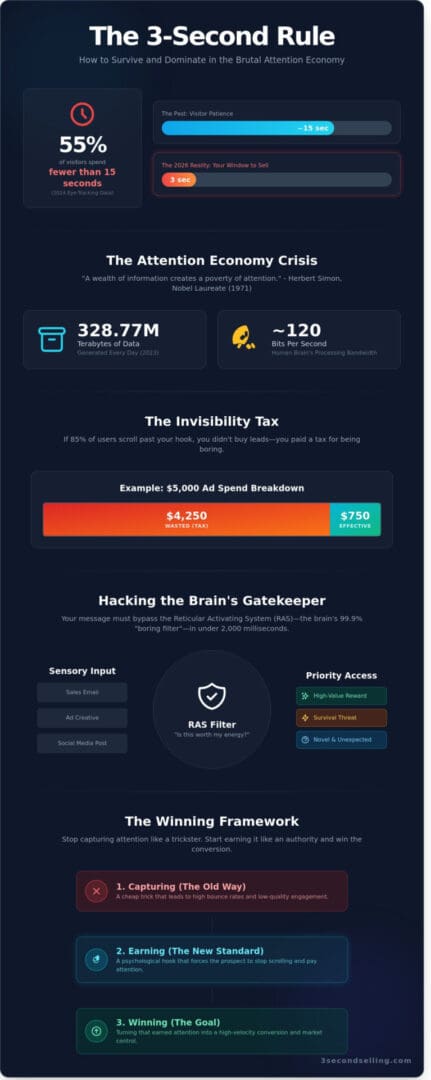
Your prospect’s brain has already decided to ignore you before you’ve even finished your first sentence. Data from 2024 eye-tracking studies shows that 55% of visitors spend fewer than 15 seconds on a page. In the hyper-saturated attention economy of 2026, the window to secure a sale has shrunk to a mere 3 seconds. If you aren’t triggering a visceral, survival-based reaction instantly, your revenue is simply evaporating into the digital noise of social media and internal distractions.
You’ve noticed your response rates are hitting rock bottom while your cost per acquisition climbs. It’s a losing game to play by the old rules of polite, long-winded pitches when your audience has zero patience left. I’ll give you the exact behavioral science framework to hijack the amygdala and force a “stop the scroll” reaction every single time. We’re going to break down the neuro-triggers that bypass the logical brain to secure an immediate, dominant position in your prospect’s mind and establish your authority in the niche.
Key Takeaways
- Stop wasting money on dead advertising models. Learn why the attention economy has made human focus the only currency that matters for your business survival.
- Crack the code of the brain’s “Boring Filter.” Force your prospect’s mental gatekeeper to flag your message as a priority instead of background noise.
- Complexity is a sales killer. Replace the “information dump” with a 3-second strike that interrupts their mental state and demands immediate engagement.
- Master the 3 Second Selling™ Framework. Deploy visceral hooks that hijack attention and pivot instantly to benefits your prospects can actually feel.
- Turn your team into an attention-grabbing machine. Build a high-velocity sales engine that secures market control while your competitors are still being ignored.
What is the Attention Economy? Why Your Business is Currently Bankrupt
Your bank account is a lagging indicator. Your attention account is the leading one. If nobody is looking, nobody is buying. It’s that simple. Most business owners are currently operating in a state of “Attention Bankruptcy” without even realizing it. They spend thousands on “quality content” that nobody consumes. They hire expensive agencies to “build a brand” that nobody notices. If your prospect doesn’t acknowledge your existence within the first 180 frames of a video, you don’t exist. You’re not just losing; you’re invisible.
The rules of the game changed decades ago, but most of you are still playing by the 1995 handbook. Nobel laureate Herbert Simon predicted this crisis in 1971. He observed that a wealth of information creates a poverty of attention. He knew that when information becomes infinite, the human brain becomes the bottleneck. To survive, you must understand What is the Attention Economy? and why it’s the only market that matters. It’s a system where human focus is the scarcest, most valuable resource on the planet. If you can’t monopolize that focus, you’re broke.
The Shift from Information to Focus
The internet flipped the script on scarcity. In 1990, information was hard to find. Today, it’s a flood. According to Statista, users generated 328.77 million terabytes of data every single day in 2023. We’ve moved from a world of data droughts to a world of data drowning. Your “more content” strategy is actually killing your sales. Why? Because the human brain hasn’t upgraded its hardware in 50,000 years. We still have a limited bandwidth of roughly 120 bits per second, as noted by psychologist Mihaly Csikszentmihalyi. When you pump more content into a fixed-capacity brain, the brain simply shuts the door.
This creates a massive “Invisibility Tax” on your revenue. Calculate it yourself. If you spend $5,000 on ads and 85% of users scroll past your hook in under two seconds, you didn’t pay for 1,000 leads. You paid a $4,250 tax for being boring. You’re subsidizing the platforms while your competitors steal your audience. You don’t need more “reach”; you need a attention monopoly over the few seconds your prospect gives you.
The 3-Second Rule for Modern Business
Why 3 seconds? It’s not a marketing gimmick; it’s biology. The “orienting response,” first identified by Ivan Pavlov, is a visceral reaction to new stimuli. Your brain takes less than 2,000 milliseconds to decide if something is a threat, a reward, or junk. If you don’t trigger a “reward” or “threat” response instantly, the brain filters you out to save energy. This is the attention economy in its rawest form. You have a 3-second window to prove you’re worth the metabolic cost of thinking.
David Gee, a former TV anchor, mastered this in the high-stakes world of broadcast news. He knew that if the first 3 seconds of a segment didn’t grab the viewer, they’d flip the channel. Modern business is no different. Every scroll is a channel flip. You must stop trying to “capture” attention like a hunter and start “earning” it like an authority.
- Capturing is a cheap trick that leads to high bounce rates.
- Earning is a psychological hook that forces the prospect to stop.
- Winning is turning that stop into a conversion.
If you can’t win the first 3 seconds, you’ll never get the 3 minutes you need to close the sale. Stop being polite. Start being impossible to ignore.
The Science of Selective Attention: Why Your Prospects Are Programmed to Ignore You
Your prospect’s brain has a bouncer. It is called the Reticular Activating System (RAS). This bundle of nerves in the brainstem acts as a high-security gatekeeper, filtering out 99.9% of the sensory data hitting the mind every second. If your message does not immediately signal survival, a high-value opportunity, or a novel threat, the RAS kills it. You do not just lose the sale; you never even existed in their conscious mind. In the modern attention economy, you are not fighting your competitors. You are fighting a biological defense mechanism designed to keep the brain from overheating.
The brain categorizes nearly every sales email and LinkedIn message as background noise. It is the “Boring Filter” in action. When a prospect sees a standard subject line, their brain registers it with the same level of interest as the hum of an office air conditioner. It is a low-value stimulus. To the brain, “checking emails” is a chore that consumes precious glucose. If your pitch looks like work, the prospect’s thumb will hit the delete button before they even realize they have done it. This is a reflexive, lizard-brain response that logic cannot fix.
Cognitive load is the total amount of mental effort required to process information, and by 2026, digital fatigue is projected to cause 65% of B2B buyers to instinctively abandon any digital interaction that requires more than five seconds of intense focus. If your pitch is a wall of text, you are triggering an immediate “No” response. The brain is a miserly organ. It wants to conserve energy. When you present a complex solution without a clear, simple entry point, you are asking the prospect to spend more “brain gold” than they are willing to part with. They will choose the path of least resistance every single time.
You are also competing with the most sophisticated dopamine delivery systems in human history. Every time your prospect opens their phone, they are one tap away from a TikTok feed designed by thousands of engineers to hijack their brain chemistry. Your business proposal is competing with a 15-second shot of pure neurochemical reward. To survive, your marketing and branding strategies must provide an immediate mental “payoff” that rivals the addictive nature of the scroll. If you aren’t more interesting than a cat video, you’re bankrupt.
The Psychology of Pattern Interruption
A pattern interrupt is a deliberate shock to the system that breaks a prospect out of their hypnotic, autopilot state. It is the only way to force the RAS to pay attention. Most professionals use “sleep signals” that tell the brain it can safely ignore the message. If you want to stop the scroll, you must eliminate the predictable. Stop acting like a salesperson and start acting like a disruptor.
Common corporate jargon acts as a sedative. Avoid these “sleep signals” at all costs:
- “I’d love to hop on a quick call to discuss…”
- “We provide a holistic, end-to-end solution for…”
- “I’m reaching out to see if you’re the right person to talk to about…”
- “In today’s fast-paced business environment, synergy is key…”
Visual and Auditory Hooks in Sales
The brain judges your credibility in exactly 50 milliseconds. That is 0.05 seconds. Your profile picture, the layout of your landing page, and the very first word of your sentence are judged by the amygdala before the prefrontal cortex can even read. If you look like a generic vendor, you are treated like one. A professional, high-authority visual presence is not about vanity; it is about bypassing the brain’s “scam” filters.
Empathy is your secret weapon for bypassing these defense mechanisms. When you lead with a visceral understanding of their specific, daily pain, the brain stops seeing you as a predator. It starts seeing you as a solution. You must prove you know their problem better than they do within the first three seconds. If you fail to hook them visually and emotionally in that window, you have lost the right to speak. Master the 3-second rule today or continue to be ignored by the people who need you most.
Complexity is the Enemy: Why ‘Features and Benefits’ Fail in a 3-Second World
Stop acting like a college professor. Your prospects are drowning in a sea of noise; your 12-point bullet list of technical specifications is the anchor pulling them under. In the attention economy, clarity beats cleverness every single time. If you spend the first three seconds explaining how your product works instead of what it solves, you’ve already lost the sale. The market doesn’t care about your “proprietary algorithm” or your “24/7 cloud-native architecture” until they know you can stop their pain.
Experts are often the worst at selling. This is the “Curse of Knowledge.” You know your product so well that you’ve forgotten what it’s like to be clueless. You assume your prospect wants to learn. They don’t. They want to solve a problem and return to their lives. Research from the Berkeley Economic Review defines attention as a scarce resource, which means every extra second you force a prospect to think is a tax they won’t pay. You’re not just competing with your rivals; you’re competing with TikTok, urgent emails, and the desire to be anywhere else.
You might argue that your product is “too complex” for a short pitch. That’s a lie you tell yourself to avoid the hard work of editing. If you can’t explain the value of a nuclear reactor or a high-frequency trading bot in three seconds, you don’t understand your customer’s primary pain point well enough. Complexity is a mask for a weak value proposition. Real authority is the ability to strip away the jargon until only the raw, undeniable result remains.
Old Sales vs. Attention-Based Selling
The old way of selling relied on the “Information Dump.” You’d build rapport for twenty minutes, then show a slide deck full of features. That’s dead. Modern selling requires a narrative-driven hook that creates an immediate “Curiosity Gap.” Instead of listing features, you lead with a provocative result. The old way is a slow burn; the attention economy way is an immediate explosion of value. If you don’t trigger a visceral “I need that” reaction in the first three seconds, no amount of follow-up will save the deal. You aren’t building a relationship yet; you’re winning a battle for mental real estate.
The ROI of Simplicity
Simplicity isn’t just a design choice; it’s a massive profit driver. A landmark 2012 study published in the Harvard Business Review found that “decision simplicity” makes consumers 86% more likely to purchase a product. Even more striking, these customers are 115% more likely to recommend the brand to others. When you reduce message friction, you don’t just get more clicks; you get a cleaner path to the bank. I’ve seen messaging audits take a failing SaaS landing page and generate a 300% lift in conversions simply by deleting 70% of the copy and focusing on one single, aggressive promise.
- The Mom Test: If you explain your pitch to your mother and she doesn’t understand the benefit in 3 seconds, your prospect won’t either.
- Friction Killers: Remove every “if,” “perhaps,” and “we aim to.” Use “we do” and “you get.”
- The Result First Rule: Put the outcome in the headline. Save the methodology for the fine print.
Your goal is to be the signal in the noise. Every word that doesn’t actively convert is working against you. Cut the fluff, kill the jargon, and start winning the 3-second war.
The 3 Second Selling™ Framework: How to Capture and Keep Attention
Stop pretending your audience cares about your “mission statement” or your “years of experience.” They don’t. In the attention economy, you have exactly 1.7 seconds to stop a mobile user from scrolling past your existence. This isn’t a suggestion; it’s a physiological reality confirmed by 2024 social media engagement data. If you don’t interrupt their mental autopilot immediately, you’re invisible. Dead. Gone.
The 3 Second Selling™ Framework is your weapon for total market dominance. It’s a three-step execution plan designed to seize control of the prospect’s brain and refuse to let go. It starts with the Hook. You must trigger a visceral reaction that forces a “stop” response in the prefrontal cortex. Don’t be polite. Be disruptive. Use a pattern interrupt that makes it impossible to look away.
Once you’ve stopped them, you pivot instantly to the Value. This isn’t about features. It’s about a specific, tangible benefit that solves a burning problem. If you can’t articulate how you’ll save them $5,000 or 20 hours of frustration in ten words or less, you’ve already lost. Finally, you deploy a frictionless Call to Action. One path. One click. Zero confusion. A 2023 study by Salsify showed that 46% of consumers abandon a purchase if the next step feels even slightly complicated. Don’t be that statistic.
To sustain this focus, we use StorySelling. These are micro-narratives, small loops of tension that keep the reader’s dopamine firing. You aren’t just giving information; you’re building a bridge from their current pain to a future victory. It’s fast. It’s aggressive. It works.
Crafting the Perfect Hook
Stop the scroll or die. In 2026, only three types of hooks actually convert: the Counter-Intuitive Truth, the Specific Threat, and the Radical Transparency. You must use “Negative Stakes” to create urgency. Nobel Prize winner Daniel Kahneman proved that humans are twice as motivated to avoid a loss as they are to achieve a gain. Tell them what they’re losing right now. Is it $400 a day in wasted ad spend? Say it. Be specific. Numbers cut through the noise. Ready to master this? Check out our StorySelling™ Workshop to build hooks that demand a response.
Sustaining Attention After the Hook
You caught them. Now, how do you keep them? Use the “Open Loop” method. This is based on the Zeigarnik effect, a psychological phenomenon discovered in 1927 stating that people remember uncompleted tasks better than completed ones. Start a story in paragraph one, but don’t give the resolution until the end. It creates a mental itch that only more reading can scratch.
The secret to the attention economy isn’t just talking louder; it’s active listening. Data from 2025 consumer surveys indicates that 72% of buyers only engage with brands that demonstrate a deep understanding of their specific industry jargon and pain points. If you don’t listen to the data, you can’t speak the truth. For leaders who need to sharpen this edge, Level Up Your Listening is your next move.
Winning isn’t about being the best; it’s about being the most noticed. Every second you waste on “professional” fluff is a second your competitor spends stealing your market share. Apply the framework. Lock in the attention. Close the deal. Do it now.
Take control of your growth today: Download the 3 Second Selling Blueprint
From Distraction to Action: Scaling Your Attention-Based Sales Engine
Your business is bleeding revenue. It happens every time a prospect glances at your ad and scrolls past. It happens every time your sales rep starts a pitch with a “How are you doing today?” fluff piece. Stop it. In the attention economy, you don’t earn interest; you seize it. If your team doesn’t speak “Attention” as their native tongue, they’re invisible. You aren’t competing with your rivals anymore. You are competing with dopamine hits, news alerts, and the infinite scroll. Winning requires a total shift in how you scale your communication.
Training a team to speak “Attention” means killing the preamble. Every email, every cold call, and every presentation must hit a target in under three seconds. This isn’t just a tactic; it is a survival mechanism. Companies that master this move from being “just another option” to holding an attention monopoly. When your team can trigger a visceral reaction before the prospect even has time to think, you’ve already won the battle. Most companies waste 90 percent of their marketing budget because they fail to pass this initial filter. Don’t be one of them.
Leadership in the Age of Distraction
Leadership isn’t about long meetings; it’s about clarity and speed. Internal distraction is the hidden productivity killer. A 2023 study by University of California researchers revealed it takes an average of 23 minutes to return to a task after an interruption. If your internal communication is cluttered, your team is paralyzed. You must set the pace. Command the room in under 3 seconds or lose the floor. Executive presence isn’t a mystery; it is the ability to project authority and value instantly. Start with a 3-second audit of your company’s digital footprint. If your homepage doesn’t tell a visitor exactly why they should stay in under 3 seconds, you are losing 55 percent of your traffic according to Chartbeat data. Fix the lead, or the rest doesn’t matter.
Transforming Your Sales Force
Most sales training is fundamentally broken. It focuses on the “close” while ignoring the “hook.” If you can’t win the first 3 seconds, the close never happens. You need a sales machine that triggers immediate engagement. This requires a shift from passive explaining to active dominance. When your sales force understands that attention is the ultimate competitive advantage, they stop begging for time and start providing value that demands it. They become the signal in a world of static.
The impact of David Gee’s Keynote Experience on corporate culture is transformative. It replaces hesitation with precision. It turns a timid sales department into a lethal growth engine. In a market where 99 percent of messages are ignored, being the 1 percent that gets through is the only way to scale. Don’t let your revenue die in the noise of a crowded market. Secure your dominance now. Every second you wait is a second your competitor uses to steal your customer’s focus. The choice is yours: be the distraction or be the action.
Stop being ignored. Stop losing to the noise.
- Kill the fluff and lead with value.
- Audit your messaging for the 3-second rule.
- Scale your attention-based sales engine today.
Book David Gee for your next Sales Summit and start winning the attention economy.
Stop Losing the Battle for the Clock
The attention economy isn’t coming; it’s already here, and it’s ruthless. By 2026, your prospects will have developed an even more sophisticated biological filter for your features and benefits fluff. You’ve seen the data. Complexity kills conversions. If you don’t capture interest within the first 3 seconds, you’re invisible. It’s that simple. You need a communication engine built for the front lines, not a textbook. Former network TV anchor David Gee spent years mastering the art of the hook. He took those high-stakes lessons from the newsroom and fused them with behavioral science to create the 3 Second Selling™ framework. This isn’t theory. It’s a proven system that delivers immediate ROI at national sales meetings and leadership summits across the country. You can continue shouting into the void, or you can learn to dominate the noise. Your competition is already moving. Don’t get left behind in the static. You have the tools to win now.
Win the War for Attention: Book the 3 Second Selling™ Keynote Experience
Frequently Asked Questions
What exactly is the attention economy in simple terms?
The attention economy is a brutal marketplace where human focus is the primary currency. In 2024, Microsoft research revealed that the average human attention span dropped to eight seconds. If you can’t seize focus in three seconds, you’ve lost the sale. It’s not about information. It’s about the psychological battle to stop someone from clicking away.
How has the attention economy changed sales in 2026?
By 2026, Gartner predicts that 80% of B2B sales interactions will happen in digital channels. Sales teams no longer compete with industry rivals; they compete with Netflix and social feeds. Traditional outreach fails because buyers filter out 95% of cold interruptions. You must use hyper-personalized hooks that trigger a visceral reaction within three seconds to survive this saturated environment.
Is the 3-second rule really enough for B2B sales?
Three seconds isn’t the whole sale, but it’s the only gateway. A study from the Missouri University of Science and Technology shows it takes 0.05 seconds for users to form an opinion. In B2B, if your opening line doesn’t promise immediate value, the executive has already checked out. You don’t close the deal in three seconds. You win the right to spend the next thirty seconds talking.
What are the biggest mistakes sales teams make in the attention economy?
Most teams waste their golden window on useless pleasantries. They start emails with “I hope this finds you well,” which signals low value. Data from Gong shows that successful cold calls lead with a specific reason for the call rather than an ask. Stop being polite. Start being relevant. If you aren’t solving a problem in the first sentence, you’re just noise.
Can you really teach someone to have ‘executive presence’?
Yes, because executive presence is a set of observable behaviors, not a birthright. It involves mastering vocal tonality and the economy of words. In our 3 Second Selling framework, we train reps to use power pauses and high-status body language. When you speak with conviction and strip away filler words, you command the room. It’s about projected authority that demands focus.
How do I measure the ROI of attention-based sales training?
Track your Stop Rate and Hook Rate metrics. If your cold email open rates jump from 15% to 45% after implementing attention economy tactics, that’s your ROI. You should also measure the Time to First Value in your sales calls. Teams using these methods typically see a 20% reduction in sales cycle length. They stop wasting time on prospects who aren’t paying attention.
What is the difference between capturing attention and being clickbaity?
Capturing attention is a promise you keep; clickbait is a lie. If your headline promises a solution to a 10% revenue leak and your content delivers it, you’ve earned trust. Clickbait burns your brand’s reputation for a one-time view. Professional sellers use pattern interrupts to wake up the brain, but they always back it up with hard data and real solutions.
What does a former TV news anchor know about sales?
A news anchor lives or dies by the Tease and the Lead. They know that if the first five seconds of a broadcast are boring, viewers switch channels. This is the exact same pressure as a modern sales environment. They bring a mastery of The Hook, teaching reps how to structure information so it’s impossible to ignore. Every syllable counts.