

Virtual Keynote Speaker for Sales Teams: Winning the 3-Second War for Attention
Your sales team isn’t listening to you. While you present your strategy, 92% of your reps are likely scrolling Slack or checking emails. This isn’t a guess; a 2023 Vyopta study confirms that digital fatigue is actively killing engagement. You’ve seen the blank stares through the webcam. You’ve paid for a virtual keynote speaker for sales teams before and seen zero ROI. It’s a waste of time. You’re tired of “Zoom snooze-fests” that leave your team drained instead of driven.
Stop settling for mediocrity. You’re about to discover how to weaponize the science of the Attention Economy to turn your next meeting into a high-impact revenue driver. We’ll show you how to win the 3-second war for focus and command total authority on screen. This guide breaks down the psychological triggers that stop the scroll and provides the tactical tools your reps need to close deals in a distracted world. Get ready to transform your next event into a memorable catalyst for growth.
Key Takeaways
- Stop the “Zoom snooze-fest” by mastering the 3-second rule that dictates whether your reps stay focused or instantly check their emails.
- Bridge the digital divide using proven behavioral science to maintain mental presence in a medium that the human brain processes differently than face-to-face meetings.
- Stop wasting budget on temporary “rah-rah” hype and learn how to hire a virtual keynote speaker for sales teams who delivers permanent attention-grabbing skills.
- Audit your next speaker’s production value and intro hook to ensure they can dominate a 13-inch laptop screen before the first minute ends.
- Transform your next virtual meeting into a high-impact revenue driver by deploying tactical strategies specifically engineered for the age of distraction.
Why Your Last Virtual Sales Meeting Failed (And How to Fix It in 3 Seconds)
Your last virtual sales kickoff didn’t fail because of a weak internet connection. It failed because you treated a digital broadcast like a physical stage. Most leaders make the fatal mistake of thinking a virtual event is just a remote version of a live meeting. It isn’t. It’s a completely different medium with different rules, higher stakes, and a much shorter fuse. If you don’t respect the medium, your team won’t respect the message.
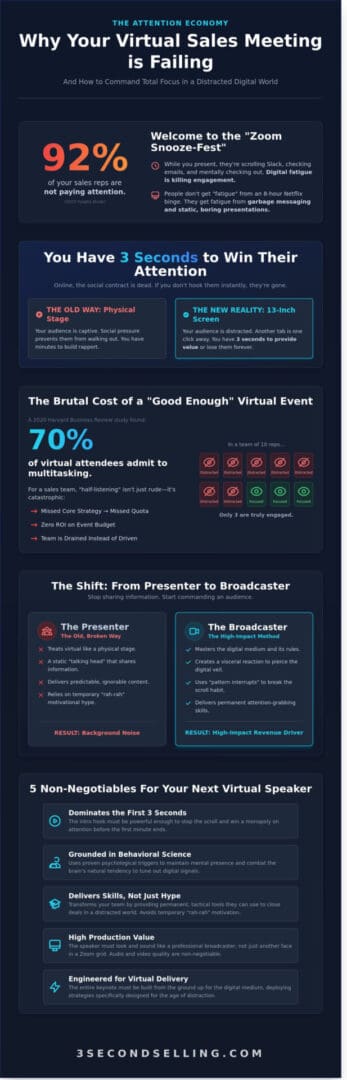
Enter the 3-second rule. In a physical ballroom, your audience is a captive one. They won’t walk out mid-sentence because it’s socially awkward. Online, that social contract is dead. If a virtual keynote speaker for sales teams doesn’t hook a rep within the first three seconds, that rep has already opened a new tab. They’re checking Slack. They’re responding to a prospect. They’re gone. You have exactly three seconds to win a monopoly on their attention or you lose them for the entire hour.
People love to blame “Zoom fatigue” for low engagement. That’s a convenient lie. The truth is that “Zoom fatigue” is just a symptom of garbage messaging and a total lack of visceral engagement. People don’t get “fatigue” from binge-watching eight hours of a high-stakes thriller on Netflix. They get tired of staring at a static head talking about “synergy” and “Q4 goals” without any emotional payoff. Traditional motivational speeches fall flat when the audience has the entire world of digital distraction at their fingertips. A standard keynote speech designed for a stage will die a slow, painful death on a 13-inch laptop screen.
The Crisis of the Distracted Sales Rep
The numbers are brutal. Data from a 2020 Harvard Business Review study indicates that 70% of participants admit to multitasking during virtual presentations. In a sales organization, “half-listening” isn’t just rude; it’s expensive. If your reps miss the core strategy because they were checking email, your missed quota is the direct result. A “good enough” speaker is a massive liability. They provide a safe space for your team to tune out, effectively flushing your event ROI down the toilet. You aren’t just competing with other meetings; you’re competing with the dopamine hit of a new notification.
Breaking the ‘Scroll’ Habit
Why do we look away? Psychology shows our brains are wired to ignore static, predictable stimuli. To keep a sales rep engaged, you need a “pattern interrupt” every few minutes. This starts in the first three seconds. You must move from being a “presenter” to being a “broadcaster.” A presenter shares information. A broadcaster commands an audience. Choosing a virtual keynote speaker for sales teams who understands this shift is the difference between a motivated force and a distracted crowd.
This shift requires a total rejection of the “talking head” format. You need someone who can create a visceral reaction through a screen. If the speaker isn’t using the camera as a weapon to pierce the digital veil, they’re just background noise. Stop talking at your reps. Start grabbing them by the throat with content that moves faster than their urge to scroll.
The Behavioral Science of Virtual Engagement: More Than Just a Camera
Virtual engagement isn’t a technical setting on your Zoom dashboard. It’s a psychological war for the limited cognitive resources of your prospect. Most sales leaders think a high-definition webcam solves the problem. They’re wrong. Virtual engagement is the strategic use of communication psychology to maintain mental presence in a digital environment. If your team isn’t winning the battle for focus, they’re losing the deal. It’s that simple.
The human brain processes digital signals with a massive handicap. In a physical room, we decode thousands of micro-expressions and spatial cues effortlessly. Behind a lens, these signals are compressed or lost. This creates “Zoom Fatigue,” which a 2023 Stanford University study confirmed results from the intense cognitive load of staring at a grid of faces. By 2026, the “Attention Economy” will be the only currency that matters. Your sales reps aren’t just competing with other vendors. They’re competing with Netflix, Slack notifications, and the laundry. To win, you need a virtual keynote speaker for sales teams who understands that the screen is a barrier to be smashed, not a window to look through.
Behavioral science is the bedrock of the 3 Second Selling™ methodology. We don’t guess what works. We use proven triggers to force a visceral response. If you don’t trigger the brain’s survival or reward centers within the first few moments, the prospect’s mind checks out. High-level virtual sales meeting engagement requires a speaker who can teach your team to hijack the buyer’s focus before they have a chance to click away.
Neuromarketing in Your Keynote
Dopamine is the engine of sales. We leverage dopamine loops to keep the audience in a state of constant anticipation. Every slide and every story must pose a question that the brain feels an itch to answer. This isn’t just “telling stories.” It’s StorySelling™. This technique bypasses the logical, skeptical prefrontal cortex and hits the visceral decision-making centers of the brain. When a virtual keynote speaker for sales teams uses this, they activate “Mirror Neurons.” The audience doesn’t just watch the speaker; they experience the speaker’s confidence and success as if it were their own. This creates an authentic connection that a standard PowerPoint deck can never achieve.
Attention-Based Selling Mechanics
Your reps have exactly 3 seconds to win a cold call or an email open. If they fail there, the rest of the pitch is a waste of breath. We teach the “Attention-Monopoly” framework. This isn’t about being loud. It’s about being the only thing your prospect cares about in that moment. Stop delivering information. Nobody wants more information. They want an experience. In 2024, data from Gong showed that top-performing reps speak for only 46% of a discovery call, but they make every second of that time count by using provocative questions that demand mental presence. You can master these psychological triggers to transform your team from passive presenters into dominant deal-closers. Move away from “delivery” and toward “creation.” If the prospect isn’t feeling something, they aren’t buying anything. Control the attention, and you control the market.
Motivational Hype vs. Attention Strategy: Choosing the Right Keynote for 2026
Stop paying for temporary adrenaline. Your sales team doesn’t need a “rah-rah” speech that evaporates before the Zoom call ends. In 2026, the market is too crowded for fluff. You need a virtual keynote speaker for sales teams who builds frameworks, not just feelings. Motivation provides a 24-hour peak. Attention strategy provides a permanent competitive advantage. If your speaker’s primary goal is to make people “feel good,” you’re burning your budget. You need them to “act differently.”
The Problem with ‘Old School’ Keynotes
Strategic Communication as a Competitive Edge
Inspiration is a ghost; you can’t track it. Attention metrics are hard data. We look at engagement rates, retention of core frameworks, and immediate pipeline velocity. According to Gartner, 80% of B2B sales interactions will occur in digital channels by 2025. This makes “virtual presence” a survival skill, not an elective. If you can’t measure the shift in how your team communicates after the keynote, the speaker failed. You aren’t looking for a cheerleader; you’re looking for a mechanic who can tune your sales engine for a digital-first world.
Stories are for campfires. Frameworks are for boardrooms. An “inspiring story” about climbing a mountain won’t help your rep handle a price objection at 4:00 PM on a Friday. A conversion-driven framework gives them the exact syntax to dominate the conversation. The difference is clear:
- Motivation: “Believe in yourself and the numbers will come.”
- Strategy: “Use this specific hook in the first 3 seconds to stop the prospect from hanging up the phone.”
- Motivation: “Visualize the win to stay focused.”
- Strategy: “Apply this 4-step psychological trigger to move the deal to the next stage of the funnel.”
- Motivation: “Stay hungry and keep grinding.”
- Strategy: “Audit your LinkedIn outreach using this 3-point checklist to increase response rates by 22%.”
The “high” of a motivational speech has a half-life of about 48 hours. By Tuesday morning, your reps are back to their old, ineffective habits. A strategy-based keynote installs new habits. It changes the way they write emails, the way they open calls, and the way they present value. You aren’t buying a speech. You’re buying a shift in your company’s conversion rate. If the speaker doesn’t challenge your team’s current failures, they aren’t helping them grow. Demand a strategist who focuses on the psychology of the click and the chemistry of the close.
5 Non-Negotiable Criteria for Your Next Virtual Sales Keynote
Stop hiring speakers who treat a virtual stage like a downgraded version of a ballroom. If your chosen virtual keynote speaker for sales teams looks like they are calling from a basement, your reps will tune out before the first slide. You are competing with Netflix, TikTok, and the “urgent” Slack notification. You need a pro who understands the physics of digital attention. Follow these five steps to ensure you aren’t wasting your budget on a glorified Zoom call.
- Step 1: Audit their ‘Hook’ – Watch their intro video. Do they grab your throat in the first three seconds? If they start with “Hello, I’m so happy to be here today,” they have already lost the room. A professional must trigger a visceral reaction immediately.
- Step 2: Evaluate Production Value – High-definition is the floor, not the ceiling. If they aren’t using a professional broadcast studio with multi-cam setups, they aren’t serious. A bedroom webcam signals “low value” to your high-performing reps.
- Step 3: Check for Behavioral Science – Motivation is a temporary chemical spike. You need communication psychology. Ask if their content is built on proven triggers like the “attention-monopoly” or dopamine-loop feedback. If it’s just “feelings,” it won’t convert.
- Step 4: Demand Tactical Takeaways – Your reps should have a new, usable skill exactly 60 minutes later. Can they apply a specific framework to their next call? If the speaker cannot name the specific outcome, the session is just expensive entertainment.
- Step 5: Assess High-Stakes Experience – Have they performed where every second counts? You want a speaker who has operated in the trenches of direct sales. Theory is for academics; you need a veteran who knows how to handle a skeptical audience in a high-pressure environment.
The Broadcast Quality Standard
Audio and video quality are the entry fee for credibility in 2026. A 2021 study by the University of Southern California proved that people find the same information less credible when audio quality is poor. If there is a lag or echo, your message dies. Professional framing and lighting aren’t luxuries. They are psychological signals of authority. If your virtual keynote speaker for sales teams uses a $29 webcam, they are telling your team their ideas are cheap. Demand the “TV News” standard to maintain the professional dominance your brand requires.
Action-Oriented Outcomes
Motivation wears off by Monday morning. You must avoid the “That was great, now what?” syndrome. A top-tier speaker provides a rigid framework like 3 Second Selling™ that teams can use immediately. The presentation must follow a staccato rhythm. This means fast, punchy segments that reset the “attention clock” every six minutes. Research shows that 70% of corporate training ROI is lost because of mental drift. A structured, rhythmic delivery prevents this drift and forces the audience into a state of active learning. Every word must serve the conversion.
Don’t settle for another boring webinar that your team watches on mute. You need a speaker who dominates the screen and delivers results that show up in your CRM by next week. If you want to see how a professional captures the attention-monopoly, book a high-impact session for your sales team here.
The 3 Second Selling™ Virtual Keynote: Transforming Distracted Reps into Focused Closers
Your sales team is losing the war for attention. It’s not a lack of talent; it’s a lack of timing. Most prospects decide to tune out within the first few moments of a call or video meeting. If your reps don’t own that window, they’ve already lost the deal. This is why hiring a virtual keynote speaker for sales teams requires more than just finding a “good talker.” You need a specialist who understands the high-stakes pressure of live communication and the biology of a split-second decision.
David Gee isn’t your average corporate trainer. He’s a former TV news anchor who mastered the art of the 3-second hook under the glare of studio lights. In the newsroom, if you don’t grab the audience before the first headline ends, they’re gone. He brings that same “stop-the-scroll” intensity to the sales floor. His signature experience, “Winning in the Attention Economy,” is a direct response to the 47 percent of employees who admit to being distracted during virtual meetings. We don’t just deliver a speech. We conduct customized messaging audits to identify exactly where your team’s communication is failing. We find the dead air in your scripts and replace it with high-impact hooks that demand a response.
- Real-world stakes: Lessons from the anchor desk applied to cold calls and Zoom demos.
- Messaging Audits: We analyze your current outreach and fix the broken links before the event.
- Master of Attention: David elevates the entire event flow, ensuring your audience stays locked in from the introduction to the final call to action.
The David Gee Advantage
David Gee operates as an Alfa-Mentor. This isn’t a hand-holding session. It’s a provocative, results-obsessed intervention for teams that are tired of hitting plateaus. He uses the 3 Second Selling™ framework to teach reps how to trigger a positive visceral reaction in prospects immediately. This isn’t theory from a decade ago. It’s the most practical tool for the 2026 sales landscape, where digital noise has increased by 300 percent since 2020. He teaches your team to dominate the conversation by earning the right to speak in those first critical moments. If you want polite theories, hire someone else. If you want market dominance, you need this approach.
Your Next Step to a ‘Stop-the-Scroll’ Event
The difference between a forgettable meeting and a revenue-generating event is the first 3 seconds. When you book David, the process starts long before the cameras turn on. We begin with a discovery call to map out your specific hurdles and conduct a messaging audit to see what’s actually happening on your sales floor. You can expect a keynote that moves at a staccato pace, leaving no room for reps to check their phones. By the end of the session, your team will have a concrete toolkit to turn “maybe later” into “tell me more.” Don’t let your next kickoff be another background noise session. Book your 3 Second Selling™ Virtual Keynote Experience today and start turning distracted reps into focused closers.
Dominate the Digital Stage or Get Deleted
Your sales reps are 3 seconds away from checking their phones. In the virtual world, attention is your only currency. Most remote meetings fail because they lack a tactical engagement strategy, leaving 92% of attendees to multitask during “motivational” speeches. You don’t need more hype for your 2026 kickoff. You need behavioral science. David Gee brings the high-stakes communication expertise of a former TV news anchor to your screen. He utilizes the proprietary 3 Second Selling™ framework to capture focus instantly and hold it until the final slide. This isn’t theory; it’s a proven system that has transformed national sales meetings and leadership summits into high-performing machines. Selecting the right virtual keynote speaker for sales teams determines if your message sticks or vanishes into the digital void. Stop settling for passive listeners when you can have focused closers. Take control of your next event and watch your team win the war for attention. You’ve got the talent; now give them the focus they deserve.
Book David Gee for Your Next Virtual Sales Keynote
Frequently Asked Questions
How do virtual keynote speakers keep a remote sales team engaged?
A professional virtual keynote speaker for sales teams uses pattern interrupts every 4 to 6 minutes to kill boredom. They use live polls, chat storms, and breakout rooms to force participation. Research by Microsoft in 2021 shows digital fatigue sets in after 30 minutes of passive watching. High-impact speakers use multi-camera setups and 4K visuals to keep eyes on the screen.
What is the difference between a webinar and a virtual keynote?
Webinars are for data dumps; keynotes are for behavioral change. A webinar usually features a single static screen share and a basic voiceover. A virtual keynote is a high-production event with cinematic lighting, professional sound, and a focused narrative. Think of a webinar as a lecture and a keynote as a Broadway show delivered through a lens.
How much does a virtual keynote speaker for sales teams cost?
Expect to pay between $7,500 and $20,000 for a world-class virtual keynote speaker for sales teams. Entry-level presenters might charge $2,500, but they lack the studio infrastructure required for a professional broadcast. Top-tier speakers invest over $50,000 in their home studios to ensure your brand looks elite and your message sticks.
Can a virtual speaker really provide ROI for my sales organization?
ROI comes from immediate pipeline movement, not just “feeling good.” A 2022 study by the Sales Enablement Society found that high-quality sales kickoffs increase quota attainment by 19 percent. If your speaker converts just one “no” into a “yes” for a $50,000 deal, the investment pays for itself five times over. Don’t settle for entertainment; demand a conversion engine.
What technology does a virtual speaker need to provide a professional experience?
Pro-level speakers use a minimum of a Sony A7 series 4K camera and a Shure SM7B or similar XLR microphone. They need a dedicated fiber optic line with at least 50 Mbps upload speed to prevent lag. Professional lighting involves a three-point setup with at least 1,000 lumens per light. If they’re using a built-in laptop webcam, they aren’t a keynote speaker; they’re a hobbyist.
How long should a virtual sales keynote be to avoid Zoom fatigue?
The sweet spot for a virtual keynote is 45 to 60 minutes. Research from the University of California suggests that cognitive load spikes after 50 minutes of video conferencing. If you need more time, break the session into two 30-minute blocks with a 10-minute high-energy gap. Longer sessions without breaks lead to a 40 percent drop in information retention.
Do virtual speakers offer customized content for specific sales industries?
Elite speakers spend 5 to 10 hours researching your specific market before they ever hit the “Go Live” button. They interview your top performers and analyze your 2023 sales reports to tailor the message. Generic advice is a waste of your budget. A real pro adapts their framework to solve your specific industry bottlenecks, whether you’re in SaaS or heavy machinery.
What is the ‘3-second rule’ in virtual sales presentations?
The 3-second rule states you have exactly 3 seconds to hook a viewer’s lizard brain before they check their email. In a virtual setting, if the first 3 seconds don’t offer a “shock and awe” moment or a massive promise, you’ve lost the room. It’s about a visceral reaction. You either dominate their attention immediately or you become background noise while they scroll LinkedIn.