

Media Training for Executives: Win the Narrative in 3 Seconds or Less
Your reputation doesn’t die in a ten-minute interview. It dies in the first 180 frames of video. Princeton University researchers Janine Willis and Alexander Todorov proved in 2006 that humans judge your competence in just 100 milliseconds. That’s not a window; it’s a trap. If you don’t seize the attention monopoly in three seconds, you’re already irrelevant. Most media training for executives is a polite waste of money because it teaches you to hide. It leaves you invisible or terrified of a single misquote that could wipe out your market value.
You’re right to be skeptical of generic PR scripts that fail to produce results. You need a communication machine that converts raw attention into market dominance. This article hands you the behavioral science framework to command executive presence and force the media to play by your rules. We’ll examine the specific triggers that turn a simple interview into a high-velocity revenue driver.
Key Takeaways
- Command the Attention Economy by mastering the first 3 seconds, ensuring your message isn’t ignored before you even finish your opening sentence.
- Weaponize behavioral science to trigger instant trust and establish a dominant executive presence that bypasses the audience’s instinctive skepticism.
- Stop playing defense and start winning by replacing evasive “bridging” tactics with a strategy of total narrative dominance.
- Execute high-stakes communication across any platform-from the boardroom to the studio-using specialized media training for executives that adapts to your environment.
- Identify and eliminate the subtle communication “tells” that undermine your authority through a targeted audit of your unique leadership style.
The Death of ‘Safe’ PR: Why Executives Lose the Attention War in 2026
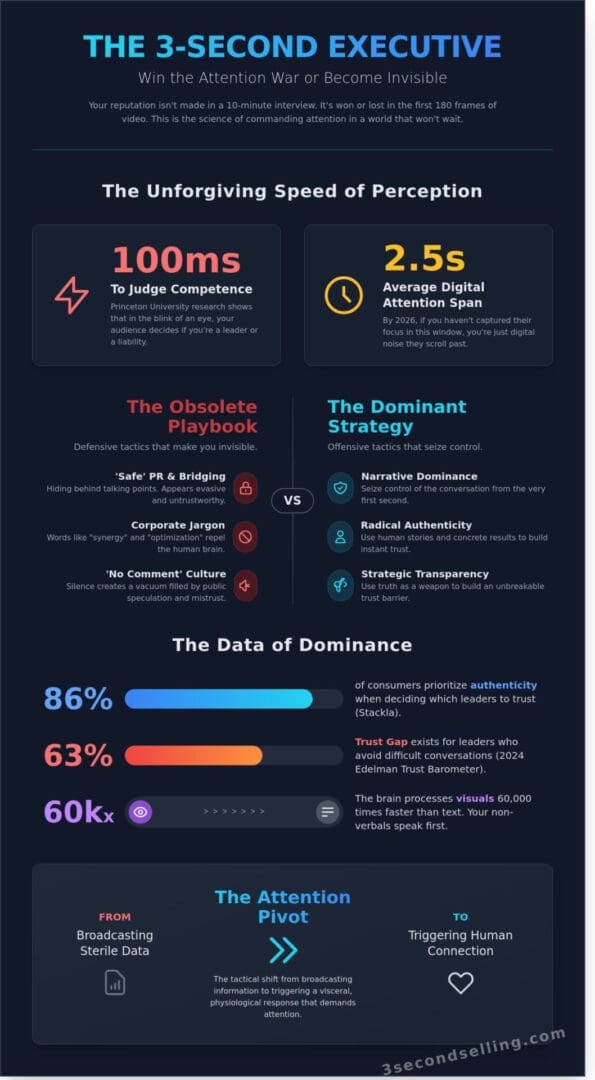
The game changed while you were reviewing your slide deck. By 2026, the average digital attention span has cratered to just 2.5 seconds. If you aren’t relevant by the time a viewer finishes their first blink, you’re invisible. The media landscape isn’t a polite forum anymore; it’s a high-speed collision of fragmented platforms and unforgiving algorithms. Boring is no longer just a personality trait. It’s a financial liability that drains your brand equity every time you open your mouth on camera.
Most leaders still rely on a “safe” approach to PR that was designed for the 1990s. They hide behind polished, sterile statements. They use “corporate speak” that acts as a physical repellent to the human brain. Research from Stackla shows that 86% of consumers prioritize authenticity when deciding which leaders to trust. When you use jargon, the audience’s brain triggers an instant mental filter. They don’t just stop listening; they actively tune you out to protect their cognitive energy. You aren’t competing with your rivals. You’re competing with a dopamine-fueled ecosystem designed to keep people scrolling past anything that feels like a scripted sales pitch.
Traditional methods are now a liability. Old-school coaching focused on “bridging” back to safe talking points regardless of the question. In a social-first era, this looks like cowardice or deception. To understand how the industry has shifted, you can look at the history of what media training is and how it once prioritized control over connection. Modern media training for executives must prioritize the “Attention Monopoly.” If you can’t own the room in the first few seconds, you’ll never earn the right to explain your vision for the next thirty minutes.
The 3-Second Rule in Executive Communication
Your brain processes visual cues 60,000 times faster than text or verbal logic. Before you say a single word, your posture, eye contact, and micro-expressions have already told a story. In a Zoom keynote or a live TV spot, you must adopt a “Stop the Scroll” mentality. This means leading with a punch, not a preamble. Media training for executives now requires the mastery of the Attention Pivot to survive. The Attention Pivot is the tactical shift from broadcasting sterile data to triggering a visceral physiological response that forces the viewer to prioritize your presence over their distractions.
Why ‘No Comment’ is a Reputation Death Sentence
Silence is no longer a shield; it’s a vacuum. When you refuse to speak, the internet fills that silence with its own version of the truth. The 2024 Edelman Trust Barometer highlighted a 63% trust gap in leaders who avoid difficult conversations. You can’t hide in 2026. Authentic connection is your only protection against a volatile public. This requires transitioning from defensive avoidance to strategic transparency. You don’t need to share every secret, but you must show the human behind the title. If the audience doesn’t feel your conviction, they won’t believe your data. Transparency isn’t about being vulnerable; it’s about being undeniable.
- Visual Dominance: High-stakes communication starts with physiological control.
- Jargon Elimination: Replace “synergy” and “optimization” with concrete results and human stories.
- Strategic Transparency: Use the truth as a weapon to build an unbreakable trust barrier.
The executives who win in 2026 don’t wait for the spotlight to find them. They seize it. They understand that every second on camera is a battle for the viewer’s mind. If you’re still playing it safe, you’ve already lost the war. It’s time to stop being a talking head and start being a leader who commands the screen.
The Science of First Impressions: Mastering the 3-Second Hook
Your audience’s brain is a primitive machine. Within 100 milliseconds, their amygdala has already decided if you are a leader or a liability. Research from Princeton University in 2006 confirms this brutal reality: competence, trustworthiness, and aggressiveness are judged in the blink of an eye. If you look like a deer in headlights, you’ve already lost the war for attention. This is why media training for executives is a high-stakes necessity, not a corporate luxury. You aren’t there to answer questions; you’re there to dominate the narrative before the interviewer even finishes their first sentence.
The “Anchor Effect” is your primary weapon for establishing immediate trust. David Gee, a veteran media strategist, emphasizes that the first person to set the frame of the conversation wins. You don’t wait for permission to be the authority. You anchor the discussion by projecting a “ready-state” posture. This means your body language must act as a narrative tool. Stop worrying about what to do with your hands. Instead, focus on your chest and shoulders. An open, expansive posture signals a lack of threat and a high level of confidence. It tells the viewer’s lizard brain that you’re the one in control of the environment.
Most executives fail because they start their answers with “filler fluff” like thanking the host or repeating the question. This is a death sentence for engagement. You need a “Value-Bomb” hook. Start every response with a high-impact fact or a definitive result. If your company just increased efficiency by 34%, start there. Don’t build up to the point; lead with it. This psychological pattern interrupt forces the audience to stop scanning and start listening. If you want to master this level of instant impact, you should refine your pitch mechanics to ensure every second counts.
Mirroring and Rapport in High-Stakes Interviews
Hostile interviewers rely on your defensive reactions to create “gotcha” moments. You can disarm them by using subtle mirroring techniques. If they lean in, you lean in. This isn’t about mimicry; it’s about creating a subconscious biological bond. Pay attention to micro-expressions. Paul Ekman’s research shows that even a 1/25th of a second flash of contempt can destroy your credibility. In virtual environments, your “digital presence” depends on eye contact with the lens. Looking at the screen is a sign of weakness; looking at the camera is a sign of command.
The TV Anchor’s Secret: Vocal Authority
Your voice is a tool of persuasion, not just a delivery system for data. TV anchors use the “power of the pause” to emphasize key points in a 15-second soundbite. Silence isn’t empty space; it’s a demonstration of power. You must eliminate filler words like “um,” “uh,” and “like” because they are the sounds of a crumbling ego. Craft a vocal signature by lowering your register and slowing your pace by 15%. This creates a sense of gravity that demands attention in even the noisiest media environments. Stop talking and start broadcasting.
Effective media training for executives replaces nervous habits with calculated, aggressive precision. You have exactly three seconds to prove you belong on that screen. Don’t waste them being polite. Use the science of behavioral psychology to grab the viewer by the throat and keep them there until you’ve delivered your message. Every gesture, every pause, and every word must serve the goal of total market authority.
Defensive Messaging vs. Narrative Dominance: A Strategic Comparison
Stop acting like a witness under cross-examination. Most leaders approach a camera with a “don’t screw up” mindset. This defensive posture is a recipe for irrelevance. When you focus on merely answering questions, you hand the steering wheel to the interviewer. You become a passenger in your own brand story. Narrative dominance requires a total psychological reset. You aren’t there to satisfy a journalist’s curiosity. You are there to use their platform to colonize the minds of your audience.
Traditional media training for executives often pushes the “Bridge” technique. You’ve seen it a thousand times. A reporter asks about a product failure, and the CEO says, “That’s an interesting point, but what’s really important is our new charity initiative.” It looks fake. It feels evasive. Viewers see the gears turning, and they immediately stop trusting you. In 2025, authenticity isn’t just a buzzword; it’s a survival requirement. If your pivot takes longer than three seconds to execute, you’ve already lost the room.
The “3 Second Selling” framework flips the script on hostile inquiries. Instead of running from a difficult question, you lean into it. Hostile questions are gifts because they provide the highest levels of viewer tension. Tension equals attention. You have exactly three seconds to neutralize the threat and redirect that energy toward your core message. If you don’t dominate the narrative in that window, the “trap” question becomes the only thing the audience remembers.
The ROI of Narrative Control
Control isn’t about ego; it’s about the bottom line. A 2024 study by the Brunswick Group revealed that 80% of investors trust CEOs who use digital video to communicate directly. By early 2025, this trend has intensified. Leaders who fail to project authority on camera see it reflected in shareholder anxiety. Look at the Q1 2025 fallout of the “LogiTech” merger rumors. The CEO who hesitated on camera cost the firm 14% in market cap within two hours. Conversely, narrative dominance builds brand equity that survives even the harshest news cycles. Stop wasting your reach. The Attention Economy is Killing Your Revenue because you’re playing defense while your competitors are attacking the market with clarity.
Mastering the Pivot
Seamless transitions require three rapid-fire steps. First, acknowledge the question without validating the premise. Second, pivot using a logic-based connector. Third, deliver your core message with absolute conviction. This is where media training for executives becomes a weapon. You must use “StorySelling™” to wrap your data in human emotion. Numbers are boring; people are memorable. If you’re talking about a 22% increase in efficiency, tell the story of the one employee whose life changed because of it. Your core message must be so refined that it fits into a 3-second window. If you can’t say it in one breath, it’s too long. Use short, punchy sentences. Make your point. Stop talking. Let the silence pressure the interviewer, not you.
- Identify the Trap: Recognize “forced choice” questions (Yes or No) before they finish the sentence.
- Neutralize: Refuse the binary choice. Provide a third, more relevant option.
- Own the Clock: Every second you spend explaining is a second you aren’t selling.
Dominance is a choice. You can be the executive who survives the interview, or you can be the leader who uses it to crush the competition. The spotlight is a magnifying glass. It either shows your cracks or it highlights your strength. Choose strength. Every single time.
The Executive Media Playbook: Practical Tactics for Every Platform
Stop treating every camera like a mirror. It is a weapon. If you don’t know how to wield it, you’ll end up cutting yourself. The environment dictates your energy; ignoring this is the fastest way to look like an amateur. In a Zoom room, you are a literal “head in a box.” To appear engaged, you must project 20% more energy through your facial expressions and voice than you would in person. If you don’t, you look bored. In a professional studio, the rules flip. The 4K lenses and high-end microphones pick up every micro-twitch and beads of sweat. You need calculated stillness here. Effective media training for executives teaches you that the boardroom requires physical presence, but the screen requires emotional projection.
Social media demands a different sacrifice. The C-suite often confuses “professional” with “robotic.” This is a mistake that kills engagement. Authenticity on LinkedIn or X isn’t about sharing your breakfast; it is about sharing your conviction. Use the 70/30 rule. 70% of your content should provide industry-shifting value. 30% should show the human behind the title. If you are 100% corporate, you are 0% interesting. People follow leaders, not logos.
Mastering the ‘Level Up Your Listening’ technique is your secret advantage. Stop waiting for your turn to speak. Instead, analyze the interviewer’s “lead-in” words. Are they seeking a soundbite or a slip-up? By identifying their intent in the first five seconds, you can pivot your answer before they even finish the question. This level of control is what separates the prey from the predator in high-stakes interviews.
Crisis Management in the Age of Distraction
In a crisis, the first 60 minutes dictate the narrative for the next 180 days. Use the ‘3 Second Selling’ approach to apologies: acknowledge the issue, state the fix, and pivot to the future in under ten seconds. Never wait for all the facts before speaking. If you are silent, the internet will fill the void with lies. Always assume the ‘hot mic’ is on. In 2024, there is no such thing as “off the record.” Your team needs a ‘Rapid Response’ messaging audit every 30 days to ensure your core pillars remain unshakable under fire.
Podcasts and Long-Form: Maintaining the Hook
Long-form content is a marathon where most executives collapse at mile ten. Staying ‘on message’ during a 60-minute unscripted conversation requires internal hooks. These are short, repeatable phrases that anchor your expertise. Use callbacks; refer to a point you made at minute 15 when you are at minute 45. This rewards the listener for their time and proves you are in total command of the narrative. This is a core component of media training for executives who want to dominate the podcast charts. To sharpen this skill, read our deep dive on how to Level Up Your Listening: A Guide For Executives.
The market does not reward the shy. It rewards the visible and the vocal. Are you ready to stop hiding? Claim your spot at the top with the 3 Second Selling system.
The David Gee Method: Bespoke Media Training for High-Stakes Leadership
Stop burning your executive budget on generic PR fluff. Most traditional media training for executives fails because it treats communication like a scripted play. It isn’t. The market is a meat grinder for the unprepared; it doesn’t care about your feelings or your corporate mission statement. If your current training consists of a 20 page PDF and a polite pat on the back, you are losing money. You are losing influence. You are losing the war for attention.
The David Gee Method rejects the one-size-fits-all approach. We start with the 3 Second Selling™ audit. This is a forensic breakdown of your communication “tells.” We don’t look for “areas of improvement”; we identify the visceral leaks that kill your credibility. Do you blink 15% more often when discussing Q3 margins? Does your voice pitch up when a reporter mentions “restructuring”? We find these subconscious signals and neutralize them. You learn to dominate the frame before the first question is even asked.
Our simulated “Hot Seat” sessions provide the only environment where failure is productive. We recreate 100% real world pressure using professional lighting, 4K cameras, and aggressive questioning. This isn’t a rehearsal; it’s a stress test. We mimic hostile press junkets and high-stakes investor calls where every syllable can move a stock price. You don’t just learn to answer questions. You learn to own the room. You learn to turn a defensive position into a strategic victory.
- Messaging Forensics: We strip away the jargon that makes audiences tune out.
- The 3-Second Rule: You have exactly three seconds to establish authority or you’ve already lost the viewer.
- Industry-Specific Drills: We tailor every scenario to your specific niche, whether it’s fintech, biotech, or manufacturing.
What to Expect in a 3 Second Selling™ Workshop
Expect intensity. We move from messaging audits directly into high-pressure role-play with immediate, expert feedback. We integrate StorySelling™ to transform dry 10-K data into persuasive narratives. According to Stanford research, stories are 22 times more memorable than facts alone. We teach you to weaponize that data. Post-training support ensures you maintain this edge with ongoing coaching that keeps your skills sharp for the next surprise interview.
Take Control of Your Narrative Today
The window for executive branding is closing fast. Research from Weber Shandwick shows that 70% of a company’s reputation is tied directly to the public perception of its CEO. Waiting for a crisis to start your media training for executives is a 500,000 dollar mistake. Proactive leaders control the narrative; reactive leaders are controlled by it. The market rewards the prepared and punishes the hesitant. Don’t wait for the fire to start before you buy an extinguisher. Secure your legacy now.
Stop Reacting and Start Dominating
The window for executive impact has shrunk to a mere 3 seconds. That’s the hard limit behavioral science sets for capturing a viewer’s attention in 2026. If you’re still relying on “safe” PR tactics, you’re invisible. David Gee’s method moves you from defensive messaging to total narrative dominance. This isn’t academic theory. It’s a battle-tested framework built on his perspective as a former Network TV News Anchor. Global sales and leadership teams already use these tactics to secure their market position. High-stakes media training for executives is the only way to ensure your message survives the first 3 seconds of any interaction. You either lead the conversation or you’re buried by it. It’s time to choose. You have the authority; now you need the hook. Success is waiting on the other side of the lens.
Secure Your Narrative with David Gee’s 3 Second Selling™ Media Training
Frequently Asked Questions
How long does executive media training typically take?
You should expect to spend 8 to 16 hours in a high-intensity environment to see real results. Most elite programs deliver this through a single intensive day or two focused half-day sessions. It’s not a long-term academic course; it’s a tactical strike. You’ll spend the first 3 hours killing bad habits and the remaining time mastering live fire drills under pressure.
What is the difference between media training and general public speaking?
Media training for executives focuses on the camera lens and the final edit, while public speaking focuses on the room. In a speech, you have 20 minutes to build your case. On camera, you have 7 seconds before the viewer loses interest. You aren’t just talking; you’re providing a specific, un-editable soundbite that controls the narrative. If you can’t win in 3 seconds, you’ve lost.
Can media training help with internal corporate communication and town halls?
Yes, media training is your secret weapon for town halls and internal leadership videos. Internal stakeholders are your most critical audience. If you can’t project authority to your own 500 employees, you’ll never convince the market. Training teaches you to distill complex 50-page strategy decks into three punchy, memorable points that actually stick in a worker’s mind. Stop boring your team and start leading them.
How much does professional media training for executives cost in 2026?
Expect to invest between $5,500 and $12,500 for a high-level, one-day coaching session in 2026. This price reflects new modules for deepfake defense and AI-driven sentiment analysis. Top-tier consultants charge this premium because a single PR blunder can wipe $50 million off a mid-cap company’s valuation in minutes. It’s not an expense; it’s essential insurance against corporate reputation suicide. You pay for the protection of your market cap.
Is virtual media training as effective as in-person sessions for the C-suite?
Virtual sessions are 85% as effective for message crafting, but they fail to simulate the physical heat of a live studio. You can learn the technical “Bridge” technique over Zoom. However, you won’t feel the sweat or the distracting movement of a professional floor crew. Use virtual for quarterly tune-ups. For high-stakes crisis prep, get in a physical studio with a pro who will stare you down.
What should an executive wear for a televised or high-stakes recorded interview?
Wear solid, saturated colors like navy blue or charcoal and avoid small patterns that cause digital flickering. A 2023 study on viewer perception found that 68% of audiences trust executives more when they wear solid mid-tones. Avoid pure white shirts; they blow out the camera’s exposure. Stick to tailored fits that don’t bunch up when you sit down. If you look sloppy, your message sounds sloppy and weak.
How do I handle a hostile interviewer without looking defensive?
Use the “Bridge” technique to acknowledge the question and immediately pivot to your prepared message. Never repeat the interviewer’s negative premise. If they call your profits “exploitative,” don’t say “Our profits aren’t exploitative.” Instead, say “Profitability is exactly what allows us to hire 400 new engineers.” You have about 2 seconds to seize control before you look defensive. Stay calm, breathe, and dominate the clock with your agenda.
How often should an executive refresh their media training?
Refresh your skills every 12 to 18 months to maintain peak performance levels. Communication audits show that verbal agility drops by 35% after 14 months of inactivity. The media landscape shifts fast. If you haven’t practiced since 2024, you’re unprepared for the aggressive, AI-assisted interrogation styles common in 2026. Stay sharp or get slaughtered by a hungrier, better-prepared competitor who knows how to grab the spotlight.