

Mastering the Pitch: 5 Powerful Sales Storytelling Examples for the Attention Economy
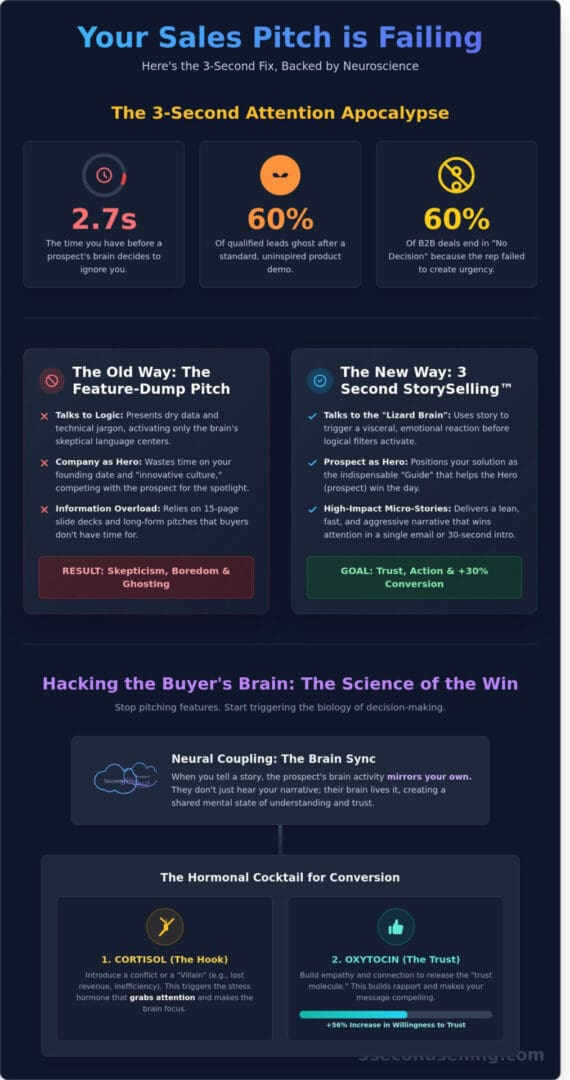
Your 15-page slide deck isn’t closing deals; it’s putting your prospects into a mental coma. If you’re still leading with technical jargon, you’re losing the attention-monopoly to a distracted brain that decides to ignore you in exactly 2.7 seconds. You know the pain when 60% of your qualified leads ghost after a demo. It happens because you’re talking to the logic, not the lizard brain. To win, you must master specific sales storytelling examples that trigger a visceral reaction before their filters even activate.
You’ve likely realized that facts tell, but stories sell. It’s the difference between being a commodity and a market leader. This guide provides the exact blueprint to build a 3 Second Selling machine. You’ll discover how to bypass the brain’s gatekeeper and drive immediate action. We’ll provide a repeatable framework to simplify your complex offer and aim for a 30% increase in your initial contact conversion rates using five proven models. Stop the polite nodding. Start getting signatures.
Key Takeaways
- Stop getting deleted. Learn why your current pitch fails the 3-second filter and how to transform your narrative into a high-octane conversion engine.
- Weaponize behavioral science to bypass prospect defenses using neural coupling and hormonal triggers that force a visceral “yes” reaction.
- Deconstruct five proven sales storytelling examples that command immediate attention and compel buyers to see your solution as their only path to victory.
- Deploy the StorySelling™ Framework to identify the industry “Villain” and position your solution as the indispensable Guide rather than a self-serving hero.
- Scale your team’s impact by turning dry technical data into dominant, high-stakes narratives that win the war for attention in under three seconds.
Why Most Sales Storytelling Fails in the Attention Economy
Most sales reps treat storytelling like a campfire activity. They think it’s a narrative diversion to “warm up” the prospect. They’re wrong. In a high-stakes environment, storytelling is a conversion-driven framework designed to move money. If your story doesn’t trigger a decision, it’s just noise. Modern buyers don’t have time for your “once upon a time.” They operate with a 3-second filter. This is the mental barrier where a prospect decides if your message is worth their cognitive energy or if it belongs in the digital trash bin. Microsoft’s 2015 study confirmed that human attention spans have plummeted to 8 seconds; in a sales context, you have less than half of that to prove relevance.
You must distinguish between Marketing Storytelling and Sales Storytelling. Marketing is about brand building and “vibes.” It’s designed to make people feel good about a logo. Sales Storytelling is action-oriented. It’s a tactical strike aimed at a specific pain point to provoke a “yes” or “no.” When you examine effective sales storytelling examples, you’ll notice they don’t wander. They provide a direct path from a current, painful reality to a future, profitable outcome. This shift toward narrative effectiveness is rooted in Organizational Storytelling, which defines how businesses use structured accounts to align values and drive behavior. In sales, that behavior is a purchase.
Even in B2B, you can learn from B2C masters of brand building. For a powerful example, consider how The Sasquatch Coffee Company built an entire cult following not just by selling coffee, but by selling a story rooted in outdoor adventure and folklore. While your sales story must be a tactical strike, the principle of creating a memorable identity is universal.
The biggest deal-killer is “The Hero Trap.” Stop making your company the hero of the story. Your prospect doesn’t care about your 1998 founding date or your “innovative” culture. When you position yourself as the hero, you compete with the prospect for the spotlight. The prospect is the hero. You are the guide. If your story focuses on your features instead of their victory, you’ve already lost the room. You’re a supporting character in their success story. Act like it.
The Death of the 20-Minute Pitch
The era of the long-form discovery story is over. Digital communication has become staccato. We live in a world of Slack pings, LinkedIn DMs, and 15-minute Zoom windows. You don’t have 20 minutes to set the stage. You need Micro-Stories. These are high-impact narratives that fit into a single email or a 30-second cold call intro. According to Gartner, B2B buyers only spend 17% of their total journey meeting with potential suppliers. You can’t afford to waste that sliver of time on fluff. Your story must be lean, fast, and aggressive.
The Cost of Being Boring
Boredom is expensive. The Sales Benchmark Index reports that roughly 60% of B2B deals end in “no decision” because the rep failed to create a compelling reason to change. When you rely on feature-dumping, you’re selling a commodity. Information is free; everyone has Google. Context is the premium product. Context is what you deliver through a story. David Gee, a former TV news anchor turned sales expert, proved that capturing attention requires a “hook” within the first few seconds, just like a lead story on the 6 o’clock news. If you don’t grab the jugular immediately, the prospect tunes out. Looking at successful sales storytelling examples from top-tier firms, the focus is always on the cost of inaction. If your story doesn’t make the prospect feel the sting of their current situation, they won’t buy. Context creates urgency. Urgency creates commissions.
The Behavioral Science Behind High-Conversion Sales Stories
Stop pitching features; start hacking the biology of the brain. When you present data, only two areas of the prospect’s brain light up: Broca’s and Wernicke’s areas. These are purely language processing centers. They don’t trigger action. They trigger skepticism. High-performance sales storytelling works because of a process called Neural Coupling. Research from the Princeton Neuroscience Institute shows that when you tell a story, the listener’s brain activity mirrors your own. You aren’t just talking at them; you’re syncing your brain waves with theirs. This creates a shared mental state where the buyer experiences your narrative as if it were their own reality.
Every winning sales arc relies on a specific hormonal cocktail: Cortisol and Oxytocin. You need Cortisol first. This is the stress hormone that grabs attention. If your story doesn’t have a conflict or a “villain” like lost revenue or inefficiency, the brain checks out. Once you have their attention, you must trigger Oxytocin. This is the “trust molecule” that builds empathy. A 2024 study on narrative persuasion confirmed that high levels of Oxytocin correlate directly with a 56% increase in the willingness to trust a commercial message. Without this chemical shift, your pitch is just noise. You need to master these sales storytelling examples to move beyond basic product demos and start influencing the subconscious.
Stories bypass the logical brain’s “Critical Filter.” This filter is designed to find reasons to say “no.” It looks for price discrepancies and technical flaws. However, the emotional brain makes the decision first. The Picture Superiority Effect proves that humans retain 65% of information when it is presented visually or through vivid narrative imagery, compared to only 10% when delivered as plain text or bullet points. By using descriptive language, you trigger the buyer’s internal cinema. They don’t just hear about your service; they see themselves using it to solve their biggest headaches.
Mirror Neurons and the Power of Shared Experience
Mirror neurons are the secret weapon of the elite closer. Neuro-research in 2025 highlights that these neurons don’t just mimic actions; they perform “predictive simulation.” When you describe a client’s success, the buyer’s mirror neurons fire as if they are achieving that success themselves. A well-crafted narrative functions as a synthetic experience; it allows the buyer to mentally rehearse the success of your solution without the actual risk of purchase. This is why social proof fails when it lacks a character. A testimonial is just a quote; a story is a transformation. To build a strategic foundation for this, consult the SBA marketing and sales guide to ensure your stories align with documented market needs.
Bypassing the Reptilian Brain
The Amygdala is the brain’s gatekeeper. It operates on a 3-second rule. If it doesn’t find your message relevant, rewarding, or dangerous within 3 seconds, it triggers the “ignore” reflex. You must use the Contrast Principle to win this fight. Stories highlight the brutal gap between “current pain” and “future gain.” By painting a vivid picture of the cost of inaction, you create healthy tension. This tension in a story maintains prospect engagement by forcing the brain to seek a resolution that only your product can provide. If you want to dominate the first 180 seconds of every call, you need to optimize your opening hook to grab control immediately. Stop being a vendor; start being the solution to their biological drive for survival and growth.
5 Real-World Sales Storytelling Examples That Drive ROI
Stop boring your prospects with feature lists and “award-winning” service claims. They don’t care about your trophy cabinet; they care about their own survival. If you want to dominate your market, you must weaponize your narrative. These sales storytelling examples aren’t just anecdotes. They’re strategic tools designed to bypass the logical brain and trigger a visceral “I need this” reaction.
Start with the Origin Story. This is your authority builder. Use it in the first three minutes of a discovery call to kill skepticism. Don’t give them a dry resume. Tell them about the specific moment in October 2019 when you realized the industry standard was failing your clients. Maybe you watched a partner lose $150,000 because of a common software glitch. When you show you’ve survived the fire and built a solution to prevent it, you aren’t just another vendor. You’re a battle-tested guide.
For high-ticket consulting or $200,000+ enterprise deals, you need the Vision Story. You’re selling a future state, not a service. Describe their company board meeting three years from now. Talk about the 22% increase in market share they’ve captured because they automated their supply chain today. If you can’t make the future feel more real than their current pain, you’ll never close a six-figure deal.
In long-cycle sales, use Personal Vulnerability to build rapport. Corporate robots don’t win 12-month contracts; trusted partners do. Share a story from 2021 where you made a mistake on a project and stayed up until 4:00 AM for five straight days to fix it. This isn’t a sign of weakness. It’s proof of character. It tells the prospect that when things get difficult, you won’t vanish.
The B2B SaaS ‘Bridge’ Example
A cold call isn’t a conversation; it’s a 30-second fight for attention. The ‘Bridge’ story is your best weapon. It follows a strict ‘before, after, and mechanism’ structure. Imagine this script: “In early 2023, a logistics firm was losing $18,000 every month to manual data entry errors. They switched to our AI-sync tool. Within 90 days, their error rate dropped to 0.4%, saving them 55 hours of labor per week.” The pain is the ‘before,’ the savings are the ‘after,’ and your software is the ‘mechanism.’ You can master this by learning how to StorySelling™: Turn Case Studies into Closed Deals to ensure every success story you tell converts into a meeting.
The ‘Status Quo Challenger’ Example
Your prospect is comfortable in their misery. They think their current process is “good enough.” You must shatter that illusion. A Status Quo Challenger story makes their current path look like a death trap. Use a script like this: “You believe your 1.8% conversion rate is acceptable because it’s the industry average. But in a 2024 messaging audit of 115 B2B firms, we found that companies clinging to ‘average’ lost 35% of their lead volume to more aggressive competitors within six months.”
This story type is the engine of Attention-Based Selling. It forces the prospect to realize that staying still is more expensive than moving forward. When you provide expert advice on storytelling that challenges their reality, you become the only logical choice for their transformation. Don’t just offer a product; offer an escape from a failing status quo. These sales storytelling examples work because they demand a decision, leaving no room for the “let me think about it” excuse.
The StorySelling™ Framework: How to Build Your Narrative
Stop playing the hero. Your company history, your “visionary” founders, and your shiny office don’t close deals. In the StorySelling™ Framework, your customer is the hero; you are merely the guide with the map. If you want to master sales storytelling examples that actually convert, you must stop talking about yourself. This framework turns passive listeners into active buyers by following five aggressive steps.
- Step 1: Identify the Villain. This isn’t a person. It’s the specific pain point stealing your prospect’s sleep. Name the 22% revenue leak or the 14 hours wasted weekly on manual data entry. Make the villain real and dangerous.
- Step 2: Introduce the Guide. Position your solution as the mentor. You aren’t there to take the glory; you’re there to provide the weapon. Show how you’ve helped 450+ companies slay the same villain.
- Step 3: Define the Spark. This is your 3-second hook. It’s the pattern interrupt that stops the mental autopilot. If you don’t grab them here, the rest of your story is expensive silence.
- Step 4: Map the Path. Give them a clear, 3-step plan. Complexity kills sales. A 2023 study showed that buyers are 62% more likely to close when the “next steps” are limited to three distinct actions.
- Step 5: Call to Action. Define the immediate next step. It shouldn’t feel like a choice; it should feel like the only logical escape from the villain.
Crafting the 3-Second Hook
You have exactly 3 seconds to win the “attention monopoly” before the buyer’s brain filters you out. Use these behavioral science templates to Stop the Scroll: Win Your Buyer’s Attention Now and force engagement:
- The Counter-Intuitive Truth: “Why your 5-star reviews are actually costing you 15% in lost conversions.”
- The Specific Loss: “The $8,400 mistake your marketing team makes every Tuesday morning.”
- The Result-First Tease: “How we cut churn by 31% without spending a dollar on new leads.”
Use the “Open Loop” technique. Start with a high-stakes result but withhold the method. The human brain experiences cognitive tension when a story is left unfinished. They’ll stay for the next 3 minutes just to close that mental loop you opened in the first 3 seconds.
Editing for Impact and Brevity
Corporate fluff is a virus. Words like “synergy,” “holistic,” and “best-in-class” are filler that kill your story’s momentum. In the 2024 attention economy, concise beats comprehensive every single time. If a sentence doesn’t provoke a visceral reaction or move the prospect closer to a “yes,” delete it without mercy. Use the “So What?” Test for every paragraph. If your buyer asks “So what?” and your answer isn’t a specific dollar amount or a time-saving metric, your story is failing.
Staccato rhythm works. Short sentences create urgency. Long, winding paragraphs signal weakness and boredom. Your goal isn’t to be a writer; it’s to be a closer. Strip the jargon. Talk like a human who solves problems. When you use sales storytelling examples, focus on the 40% efficiency gain, not the technical architecture of your cloud server.
Ready to stop being ignored and start dominating your market? Install the StorySelling™ system in your business today and turn every pitch into a closed deal.
Transforming Your Sales Team with David Gee’s 3 Second Selling
Stop wasting high-quality leads on sales representatives who sound like a walking technical manual. In a market where the average B2B buyer is bombarded with 3,000 marketing messages a day, you don’t have time for a slow build. You have exactly three seconds to hook a prospect or you’re dead in the water. David Gee doesn’t teach theory; he teaches survival in the attention economy. Dry reps don’t just lose individual deals; they erode your brand’s authority and kill your momentum.
David Gee brings a unique edge that most sales trainers lack: 20 years as a TV news anchor. In the newsroom, if you don’t grab the viewer before the first commercial break, they’re gone. He has translated those high-stakes communication tactics into the StorySelling™ Workshop. This isn’t a passive lecture. It is a high-intensity transformation that turns hesitant communicators into high-impact closers. By dissecting high-stakes sales storytelling examples, your team moves from reciting specs to commanding the room. They learn to bypass the logical filters of a prospect and hit them where decisions are actually made: the gut.
A unified sales messaging framework is the fastest way to scale ROI across a global organization. When every rep uses the same high-impact narrative structure, your conversion rates become predictable rather than accidental. Companies implementing this structured approach often see a 22% increase in win rates because the message remains consistent from the first touchpoint to the final signature. The framework provides concrete sales storytelling examples that work in 2024’s hyper-distracted market. It eliminates the “lone wolf” mentality and replaces it with a repeatable selling machine.
Keynote and Workshop Integration
The ‘3 Second Selling™ Keynote Experience’ is designed to shatter the boredom of typical sales kickoffs. It is a high-octane session that creates an immediate psychological shift in the audience. However, inspiration without implementation is useless. That is why the integration of the deep-dive workshop is vital. While the keynote ignites the fire, the workshop provides the tools to keep it burning. You can learn more about how these sessions differ in The Modern Sales Keynote: A Guide for Event Planners.
The ‘Level Up Your Listening’ module is a critical component of this integration. Most reps are too busy waiting for their turn to speak to actually hear what the prospect is saying. This module teaches “active intelligence gathering” through the lens of a journalist. It forces reps to identify the hidden pain points that prospects rarely admit out loud. If you don’t hear the real problem, you can’t tell the right story to solve it.
Next Steps for Sales Leaders
The market doesn’t reward hesitation. If your team’s pitch hasn’t evolved in the last 12 months, you are already falling behind. David Gee offers a 3 Second Selling guarantee: measurable improvements in prospect engagement or we haven’t done our job. This isn’t about “trying harder”; it is about executing a proven communication system that demands a visceral reaction from your market.
Ready to stop the bleeding and start dominating your niche? You can book a comprehensive messaging audit or an executive coaching session to identify the holes in your current narrative. Don’t let another quarter slip by with mediocre results. Book David Gee for your next sales summit and give your team the tools to win the battle for attention in three seconds or less.
Dominate the Attention Economy Now
Your prospects don’t have time for a slow burn. You have exactly 3 seconds to hook their brain or you’re dead in the water. David Gee developed the StorySelling™ Framework after 20 years as a TV news anchor, where losing an audience meant a total ratings collapse. Today, national sales teams use these same behavioral science-backed tactics to capture market share. These sales storytelling examples demonstrate how to drive immediate ROI by bypassing logical resistance and hitting the emotional core. If your current pitch feels like a lecture, you’re losing money every single day. Stop wasting leads with outdated scripts. It’s time to arm your team with a proven, high-conversion narrative engine. Mastery isn’t optional if you want to stay relevant in this climate. Take the lead and turn your sales process into a precision instrument that demands attention and closes deals. Your competition is already moving. Don’t get left behind. You have the power to change your results starting today. It’s your move.
Book the StorySelling™ Workshop for your team
You have the tools to win. Now go out there and take what’s yours.
Frequently Asked Questions
Is storytelling really effective for technical B2B sales?
Storytelling is the only way to bypass the skeptical “engineer brain” and reach the decision-maker. Research by neuroeconomist Paul Zak shows that character-driven stories release oxytocin, which increases trust by 56% compared to raw data dumps. Stop hiding behind 50-page technical whitepapers. Use a concise story about how a similar client saved $1.2 million in six months to win the room.
How long should a sales story be in a cold email?
Keep your cold email story under 75 words or face immediate deletion. Data from Boomerang’s analysis of 40 million emails proves that messages between 50 and 125 words yield the highest response rate at 51%. You don’t have time for a preamble. Give them a two-sentence “before and after” bridge that proves you can solve their specific $100,000 problem right now.
What is the ‘3-second rule’ in sales storytelling?
The 3-second rule dictates that you have exactly three seconds to hook a prospect’s attention before they mentally check out. In a world of infinite distractions, your first sentence must trigger a visceral reaction. Does your opening line stop the scroll? If it doesn’t, you’ve lost the sale. You must earn the next 30 seconds of their time by leading with immediate, high-stakes relevance.
Can anyone learn to be a good sales storyteller, or is it a natural talent?
Storytelling is a high-income skill you master through repetition, not a genetic gift. Top performers use frameworks like the “Star-Chain-Hook” to build consistency. 2023 data from Gong shows that winning reps talk 15% less and tell twice as many stories as bottom-tier reps. You don’t need charisma. You need a proven script and the discipline to stop rambling about your company history.
How do I measure the ROI of storytelling in my sales process?
Measure your ROI by tracking the lead-to-close ratio and the average length of your sales cycle. Companies using sales storytelling examples in their pitches see a 20% increase in win rates according to Forrester research. Compare your “feature-heavy” deck against a “story-driven” deck over 50 calls. If your closing speed doesn’t drop by at least 10 days, your stories aren’t sharp enough.
What are the most common mistakes in sales storytelling?
The biggest mistake is making yourself the hero instead of the guide. Your prospect doesn’t care about your 1995 founding story; they care about their own survival. Another trap is removing the conflict. A story without a $500,000 problem is just a boring testimonial. Stick to a “Problem-Agitation-Solution” flow. If there’s no pain, there’s no reason for them to sign your contract.
How does storytelling differ between a keynote speech and a 1-on-1 sales call?
Keynotes focus on broad inspiration for a crowd, while sales calls focus on surgical transformation for one person. In a keynote, you use general themes for 500 people. In a sales call, you pivot the story to match the specific $10,000 leak in that prospect’s bucket. One is a performance. The other is a targeted strike. Both require a clear “Call to Action” or they’re a waste of breath.
What is StorySelling™ and how is it different from traditional storytelling?
StorySelling™ is the aggressive integration of narrative with direct-response psychology. Traditional storytelling seeks to entertain, but StorySelling™ is designed to convert. It’s the difference between a campfire tale and a high-velocity sales machine. You aren’t telling stories to be liked. You’re using sales storytelling examples to create a “buying trance” where the only logical conclusion for the prospect is to buy now.