

Leadership Communication Skills Training: Winning the War for Attention in 2026
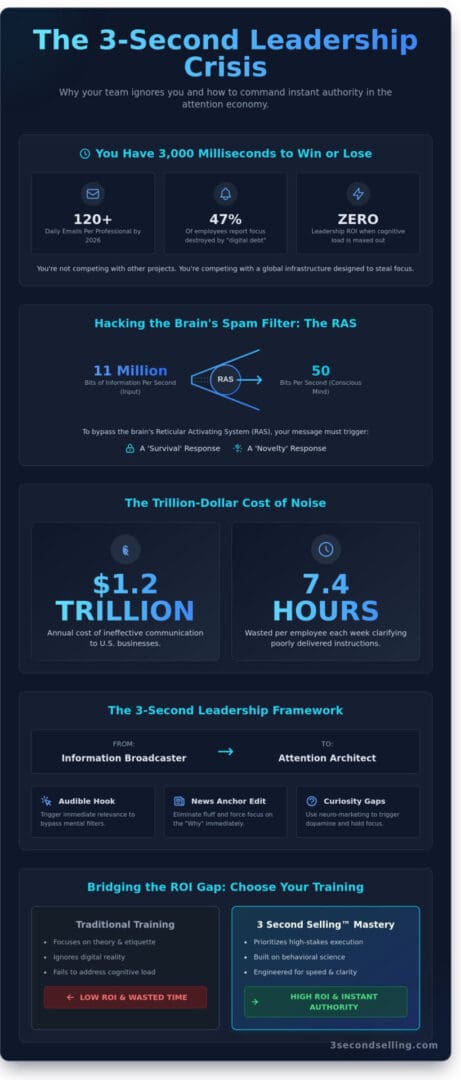
Your team isn’t ignoring your emails because they’re busy. They’re ignoring them because you failed to trigger a biological “must-read” response within 3,000 milliseconds. By 2026, the average professional will battle over 120 daily emails and dozens of instant notifications. This reality makes traditional leadership communication skills training a total waste of time. If you aren’t winning the war for dopamine, you’re losing your authority.
You’ve seen the glazed-over eyes in Zoom meetings. You’ve felt the frustration of “urgent” messages sitting unread for six hours. It’s a symptom of a broken system; 47% of employees report that digital debt is destroying their focus according to the 2023 Microsoft Work Trend Index. This article gives you the behavioral science needed to master high-stakes communication. I’ll show you how to capture and hold attention in the first three seconds to command instant authority. We are diving into the exact psychological triggers that drive action and ensure your message is never misunderstood or ignored again.
Key Takeaways
- Stop losing your audience before you finish your first sentence; master the “3-second rule” to dominate the attention economy.
- Hack the brain’s Reticular Activating System (RAS) to ensure your message bypasses mental filters and commands instant executive presence.
- Bridge the ROI gap by choosing leadership communication skills training that prioritizes high-stakes execution over theoretical “soft skills.”
- Implement the “Audible Hook” and “News Anchor” edit to eliminate fluff and force your team to focus on the “Why” immediately.
- Learn how to apply the 3 Second Selling™ framework to turn every boardroom interaction into a high-impact leadership moment.
The Attention Crisis: Why Your Leadership Communication is Failing
Your title doesn’t matter. Your corner office doesn’t matter. In the modern Attention Economy, attention is the only currency that buys results. If you can’t capture the focus of your team within the first three seconds, you’ve already lost the room. Most executives treat communication like a data dump. They are wrong. Leadership is a high-stakes competition against every notification, ping, and scroll-induced hit of dopamine that your employees crave. You are fighting for a finite resource that is being depleted by the second.
The “3-second rule” isn’t a suggestion; it’s a survival mechanism. Research from the 3 Second Selling methodology proves that if your opening doesn’t trigger a visceral reaction of relevance, the brain simply tunes out. You aren’t just competing with other projects. You’re competing with a global infrastructure designed to steal focus. If your message doesn’t promise immediate value, the listener’s mind will migrate to their inbox before you finish your first sentence.
Noise is expensive. A 2023 report by Grammarly and the Harris Poll revealed that ineffective communication costs U.S. businesses an estimated $1.2 trillion every single year. This isn’t just a minor friction point. It’s a systemic failure where employees waste an average of 7.4 hours per week clarifying poorly delivered instructions. If your team is guessing what you want, you are bleeding capital. Most leadership communication skills training programs focus on outdated etiquette. They ignore the reality of the 2026 digital-first workplace where speed and clarity are the only things that prevent project collapse. You need to dominate the foundational principles of interpersonal communication to cut through the static of a hundred open browser tabs. Stop being a source of noise and start being a signal of authority.
The Cognitive Load of the Modern Employee
The average office worker handles 121 emails daily and checks Slack every six minutes. This constant context switching creates a “distraction deficit” that erodes the capacity for deep work. Employees tune out corporate messaging because their brains are trained for “the scroll,” seeking instant gratification over dense executive updates. They aren’t lazy; they’re overloaded. Cognitive load is the total volume of mental effort being used in the working memory, and when it’s maxed out, your leadership ROI drops to zero.
From Manager to Attention Architect
Stop delivering information. Start managing attention. Your title grants you a seat at the table, but it no longer guarantees an audience. In a decentralized, remote-heavy environment, authority is a weak lever. You must become an Attention Architect. This requires a shift toward radical empathy, not as a “soft” trait, but as a strategic tool to identify what your team actually cares about. If you don’t solve their immediate problems in your first sentence, they won’t hear your second. Effective leadership communication skills training transforms you from a broadcaster into a precision-guided communicator who owns the room before the first slide even appears. Demand attention. Don’t beg for it.
The Behavioral Science of Influence and Executive Presence
Your team isn’t listening to you. It’s a biological reality. The human brain processes roughly 11 million bits of information every second, yet the conscious mind only manages about 50 bits. The Reticular Activating System (RAS) serves as the brain’s ultimate spam filter. It decides what’s worth a leader’s time and what’s background noise. If your message doesn’t trigger a “survival” or “novelty” response within 3 seconds, the RAS deletes it. This is exactly why generic leadership communication skills training fails. It teaches you what to say, but it ignores how the brain actually receives data.
David Gee, a veteran with 20 years of experience in high-stakes newsroom environments, applies the ‘TV News’ Framework to the boardroom. In a newsroom, if the lead doesn’t hook the viewer before the first commercial break, the ratings collapse. Your boardroom is no different. The “commercial break” is the smartphone in your manager’s pocket. You aren’t just competing with other projects; you’re competing with a global attention economy. To win, you must master neuro-marketing. By using curiosity gaps, you trigger a dopamine release in your listeners. This chemical reward keeps them focused on your words because their brain is literally craving the “payoff” of your conclusion.
Gee’s communication psychology is built on three uncompromising pillars. First is Authority. This isn’t about your job title; it’s about the non-verbal dominance you project in the first 0.5 seconds. Second is Authenticity. People have a visceral, negative reaction to “corporate-speak” and polished lies. If you sound like a brochure, you’ve already lost. Third is Action. Every communication must have a clear, urgent directive. Without an “ask,” your speech is just expensive, time-consuming noise that costs the company money.
The Newsroom Secret: Hook, Lead, and Story
David Gee’s anchor experience proves that 80% of your impact happens in the first 10 words. A “hook” is a pattern interrupt. It’s the difference between saying “Let’s review the budget” and “We are leaking $14,000 every day we ignore this supply chain gap.” The hook stops the corporate scroll. Once you have their attention, the “Lead” provides the vital context, and the “Story” provides the emotional glue. This structure builds instant credibility. You don’t sound arrogant because you aren’t talking about yourself; you’re talking about the mission with the authority of a front-line reporter.
Cognitive Triggers That Drive Team Action
To keep teams engaged in long-term projects, you must leverage the Zeigarnik Effect. This psychological principle shows that the brain remembers uncompleted tasks 90% better than finished ones. By starting a narrative “loop” in your Monday meeting and not closing it until Friday, you maintain mental tension and engagement. This is the foundation of the StorySelling™ Workshop, where leaders learn to pitch ideas internally. Facts tell, but stories sell the vision. If you want a 15% increase in productivity, don’t show a chart. Tell the story of the “enemy” your team is defeating. This advanced leadership communication skills training transforms you from a manager into a commander who owns the room.
Traditional Training vs. Attention-Based Mastery: The ROI Gap
Most corporate training is a graveyard of wasted capital. Research from 24×7 Learning reveals a staggering 90% of new skills learned in traditional workshops are never applied on the job. You are likely paying for “edutainment” rather than transformation. Companies in the United States spend over $160 billion annually on employee development, yet the performance gap remains wide. Why? Because most leadership communication skills training focuses on passive theory. It treats communication like a lecture rather than a high-stakes performance. Knowing the mechanics of a feedback loop is useless if a manager freezes during a confrontation. Execution under pressure is the only metric that matters.
In global business hubs, the demand for this high-stakes performance is even more acute. Executives in competitive international centers, for example, often seek out specialized programs. This is reflected in searches for services like coaching prise de parole en public genève, where the focus is on mastering influence for a global audience, not just learning theory.
The gap between knowing and doing is where your ROI disappears. Traditional models rely on passive listening. They expect leaders to absorb complex psychological frameworks while sitting in a dark room with a PowerPoint presentation. This approach ignores how the human brain functions during stress. When the stakes are high, leaders do not rise to the level of their goals; they fall to the level of their training. If that training was passive, their response will be non-existent. You need a system that builds visceral habits, not just intellectual libraries.
The Failure of ‘Check-the-Box’ Workshops
Generic workshops are designed for compliance, not for dominance. They treat high-stakes interaction as a “soft skill.” This label is a poison. It suggests that clear, persuasive communication is an optional accessory rather than a core engine of profit. When you categorize these skills as soft, you signal to your team that they are secondary to technical tasks. This is why the primary objection to training is always “we do not have time.” Leaders are busy fighting fires because they lack the communication tools to prevent them in the first place.
- The Generic Trap: One-size-fits-all templates fail to address the specific power dynamics of your boardroom.
- The Information Overload: Dumping 200 pages of theory on a manager creates paralysis, not action.
- The Lack of Accountability: Without immediate, measurable feedback, old habits reclaim the territory within 48 hours.
The 3 Second Selling™ Advantage
Stop treating internal communication like a memo and start treating it like a high-ticket sales pitch. Every interaction is a transaction. You are either selling your vision or you are buying someone else’s excuses. This is the core of the 3 Second Selling™ philosophy. You must win the attention-monopoly in the first three seconds, or you have already lost the room. This approach applies aggressive sales psychology to internal leadership to drive immediate buy-in. It turns every meeting into a conversion event.
To fix the ROI gap, your leadership communication skills training must include immediate feedback loops. You cannot wait for a quarterly review to see if a leader has improved. You measure the result by the visceral reaction of the team in real-time. Is there clarity? Is there urgency? Is there a commitment to action? When you transform communication from a corporate chore into a competitive edge, you stop managing and start dominating. This is how you move from a cost center to a profit center. Results are the only truth in business. Everything else is just noise.
The 3-Second Leadership Framework: Tactical Implementation
Stop wasting time with pleasantries. Your team is distracted, over-caffeinated, and tired of meetings that could have been emails. If you don’t grab their attention in the first 3 seconds, you’ve already lost the room. This tactical framework is the backbone of any effective leadership communication skills training program because it focuses on the only currency that matters: attention.
Forget the “how are you” fluff. Start with the “Why” immediately. A 2015 Microsoft study famously claimed the human attention span dropped to eight seconds, but in a corporate environment, that window is even tighter. Your first sentence must address a pain point or a goal. If the meeting is about budget cuts, don’t bury the lead. Start with the impact on their specific projects.
Step 2: Elimination of Fluff
Adopt the “News Anchor” edit. Journalists use the inverted pyramid for a reason; it works. Put the most critical information in the first paragraph of every email and the first 30 seconds of every presentation. A 2023 report by the Radicati Group shows the average professional receives 121 emails daily. If your message requires scrolling to find the point, it is destined for the trash folder. Cut every word that doesn’t drive the objective forward.
Step 3: Visual Authority
Presence is not about wearing a suit; it is about congruence. Albert Mehrabian’s research at UCLA established that 55% of communication is conveyed through body language. In the “Age of Distraction,” your physical energy must command the space. This means square shoulders, direct eye contact, and an absolute lack of fidgeting. If you look unsure, your message is discarded regardless of its quality.
Step 4: The Call to Connection
Stop broadcasting and start engaging. Leadership isn’t a monologue. After you deliver your hook and your data, pivot to a dialogue. Ask a specific, high-stakes question. Instead of “any questions,” try “which part of this plan presents the highest risk to our Q4 deadline?” This forces immediate mental participation.
Step 5: Level Up Your Listening
This is the executive’s secret weapon. Active listening isn’t just staying quiet while the other person talks. It’s about tactical empathy and reflecting back the core of their concern. Advanced leadership communication skills training focuses on these micro-moments because that is where authority is won or lost. Level Up Your Listening to ensure you aren’t just hearing words, but diagnosing problems before they explode.
Mastering the First 3 Seconds of Every Meeting
Command the room with a script that demands focus. Try this: “We have 15 minutes to solve the 14% drop in lead conversion we saw last Tuesday. Here is the data.” If you feel the energy drifting, use a pattern interrupt. Stand up, change the slide, or call a specific name. Use the Bottom Line Up Front (BLUF) technique. It’s a military standard for a reason. It saves lives in the field and saves millions in the boardroom by eliminating ambiguity.
Digital Presence: Stopping the Scroll in Slack and Email
Subject lines are your headlines. A subject line like “Quick question” is a failure. Use “Action Required: [Project X] Budget Approval by 4 PM” instead. This utilizes Attention-Based Selling internally. You are selling the importance of your request. Structure updates with bullet points and bold text for skimmability. If a C-suite executive can’t understand your request in 5 seconds of scanning, you haven’t communicated; you’ve just made noise. Master the art of 3-second influence and take control of your professional impact.
Transform Your Leadership with 3 Second Selling™ Training
Stop boring your audience to death with long-winded presentations that go nowhere. Most executive teams fail because they talk too much and say far too little. You have exactly three seconds to hook your listener’s brain before they check their email or drift off. Our 3 Second Selling™ methodology turns your executives into communication powerhouses who own every room they enter. This isn’t a “soft skill” program; it’s high-octane leadership communication skills training designed for the front lines of modern business.
David Gee brings 30 years of high-pressure media and corporate experience to your boardroom. He doesn’t teach from a dry textbook. He teaches from the trenches of live television and high-stakes negotiations where a single wrong word can end a career. This background matters because your leaders don’t operate in a vacuum. They operate in a world where every second is a brutal battle for attention. When you bring Leadership in the Age of Distraction to your organization, you aren’t just hiring a speaker. You’re installing a new operating system for your team’s influence and authority.
Why settle for mediocre results when the stakes are this high? Statistics from 2023 suggest that 86% of corporate failures are directly linked to a lack of effective communication. We fix that by stripping away the corporate jargon and replacing it with visceral, punchy messaging that drives immediate action. Our approach is provocative, aggressive, and effective because it respects the biological reality of how humans process information. We don’t want your team to be “better” speakers; we want them to be dominant communicators who command an attention-monopoly.
Keynote vs. Workshop: Which Does Your Team Need?
Choose the ‘Keynote Experience’ for your 2026 annual kickoff if you want to ignite a fire under 500 people at once. These sessions are high-energy, fast-paced, and designed to shift an entire culture’s mindset in 60 to 90 minutes. We use the 3 Second Selling™ framework to break through the noise of a crowded conference schedule and leave your team with a permanent mental shift.
Interactive workshops are the choice for deep behavioral change within smaller executive groups. These sessions involve intensive, hands-on practice where your leaders receive direct feedback on their delivery and messaging. We also provide customized media training for public-facing executives who need to handle 24/7 media scrutiny without breaking a sweat. Whether it’s a 10-person boardroom or a 1,000-seat auditorium, we tailor the intensity to your specific goals.
Take the Next Step Toward Communication Mastery
Evaluate your current impact before you spend another dollar on generic training. A Messaging Audit reveals exactly where your leaders are losing the room and how much revenue that’s costing your organization. Don’t wait until your competitors out-pitch you at your own game. We’re currently accepting bookings for the 2026 leadership summit season, and the calendar fills up fast for organizations prioritizing leadership communication skills training.
The market doesn’t reward “nice” communication; it rewards clarity and authority. Are you ready to stop being ignored? It’s time to transform your leadership from background noise into a market-shaping force. Your next move determines whether you lead the conversation or just follow it. Book your 3 Second Selling™ Discovery Call today and start winning the war for attention.
Dominate the 2026 Attention Economy Now
The 2026 business landscape doesn’t forgive boring leaders. You have exactly 3 seconds to seize control before your audience retreats into their devices. Traditional methods fail because they ignore the behavioral science of visceral reactions. Modern leadership communication skills training must evolve into a tactical weapon for immediate influence. You either master the 3 Second Selling™ Framework or you become background noise. David Gee, a former Network TV News Anchor, built this system to bridge the ROI gap that leaves standard executive presence programs in the dust. He has already transformed national sales and leadership summits by replacing theory with front-line dominance. Stop wasting your breath on listeners who aren’t there. It’s time to capture the attention monopoly you deserve. Your team is waiting for a leader who actually commands the room. Take the first step toward becoming that authority today.
Stop the distraction and win the room. Book David Gee for your next leadership summit.
You have the power to change the energy of any meeting in an instant. Go claim it.
Frequently Asked Questions
What are the most important leadership communication skills for 2026?
Radical transparency and cognitive empathy are the non-negotiable skills for 2026. Gartner predicts that 75% of top-tier organizations will pivot to human-centric models by then. You don’t have time for fluff. You must master the art of the difficult conversation and deliver feedback that sticks without bruising egos. If you can’t bridge the gap between digital efficiency and human connection, you’ll lose your best talent to competitors who can.
How long does it take to see results from leadership communication training?
You’ll see tactical improvements in 48 hours, but permanent habit rewiring takes 66 days. Effective leadership communication skills training isn’t a one-time event; it’s a neurological reset. Data from the European Journal of Social Psychology confirms that complex behaviors require at least two months to become automatic. Stop looking for overnight miracles. Start building a communication machine that produces consistent, measurable results every single day.
Can communication skills training really improve executive presence?
Yes, training builds executive presence by aligning your internal confidence with external perception. A study by the Center for Talent Innovation found that executive presence contributes to 26% of promotion decisions. If you can’t command a room in 3 seconds, you’re invisible. Training transforms your stammer into authority and your hesitation into a decisive call to action. You’ll learn to own the space, regardless of who else is in it.
What is the difference between leadership communication and public speaking?
Public speaking is a performance, while leadership communication is a strategic dialogue designed to drive specific business outcomes. Leaders spend 80% of their time in small-group interactions or one-on-one sessions, not behind a podium. Public speaking focuses on delivery. Leadership communication focuses on influence, psychological triggers, and moving the needle on KPIs. It’s about winning the war in the hallways, not just the battle on the stage.
How do you measure the ROI of leadership training?
You measure ROI through employee retention rates, engagement scores, and the speed of project execution. Towers Watson research shows that companies with highly effective communication practices generate 47% higher total returns for their shareholders. If your team isn’t hitting targets, your words are failing. Track the “misunderstanding tax” on every delayed project. This reveals the true cost of poor leadership communication skills training or the lack thereof.
Why is the first 3 seconds of a message so critical for leaders?
The first 3 seconds determine whether your audience listens or tunes out. Neuroscience shows the brain categorizes incoming data as threat, boring, or vital almost instantly. If you don’t hook their attention immediately, you’ve lost the attention monopoly. Microsoft’s data on the 8-second attention span is actually generous. In a high-stakes meeting, you have even less time to prove you’re worth listening to. Lead with the punchline.
Is your training suitable for virtual or hybrid leadership teams?
Our training is specifically engineered for the 74% of companies now operating in hybrid or virtual environments. Digital leadership requires a different set of cues because you lose 90% of non-verbal body language over Zoom. We teach you how to project dominance and clarity through a 1080p lens. If you can’t lead through a screen, you’re obsolete. We ensure your message carries weight even when you’re not in the room.
How does behavioral science improve leadership communication?
Behavioral science improves communication by leveraging cognitive biases like social proof and loss aversion to trigger immediate action. Research indicates that “nudging” techniques can increase team compliance by 30% without using formal authority. Don’t guess what works. Use proven psychological frameworks to bypass mental filters and speak directly to your team’s decision-making centers. It’s the difference between asking for cooperation and architecting an environment where success is the only logical choice.