

Sales Keynote Speaker 2026: Why Your Team Needs More Than Just Motivation
Your sales team has exactly 3 seconds to win or lose a deal before a prospect scrolls away. If your last kickoff left them “fired up” but still struggling with a 1.5% conversion rate, you threw your money away. Hiring a sales keynote speaker 2026 isn’t about finding a corporate cheerleader. It’s about finding a tactical expert who can dismantle the attention-starved barriers of the mid-2020s. Motivation is a temporary drug. Tactical dominance is a permanent asset.
You’ve watched your reps sit through high-priced speeches only to see them back on their phones ten minutes later. It’s a massive waste of resources. This guide shows you how to hire a speaker who replaces “fluff” with a 3 Second Selling framework that actually moves the needle. You’ll learn how to pick a partner who delivers a 25% boost in outreach engagement and turns your next event into a high-ROI revenue machine. Every second counts. Stop paying for entertainment and start investing in conversion.
Key Takeaways
- Stop burning budgets on temporary “rah-rah” hype that fails to survive the 2026 attention crisis.
- Master the “3-Second Rule” to seize a prospect’s interest before they scroll past your value proposition.
- Identify the specific traits of an “Alpha-Mentor” when selecting your sales keynote speaker 2026 to ensure measurable ROI.
- Transform your 2026 Sales Kickoff from a social event into a high-octane revenue engine with a singular, transformative objective.
- Discover how the “3 Second Selling™” methodology creates a total monopoly on attention in a high-stimulus market.
The 2026 Attention Crisis: Why Traditional Sales Keynotes Are Dead
Stop lighting your annual kickoff budget on fire. The era of the “rah-rah” motivational speaker is dead. By 2026, your sales team will be the most distracted group of humans in history. They don’t need another generic story about a mountain climber or a retired athlete. They need a reason to put their phones down. If your chosen sales keynote speaker 2026 cannot grab a room in three seconds, you’ve already lost the battle for their minds. Distraction is now the default state of the human brain.
Inspiration is a short-term drug; tactics are the long-term cure. Traditional keynotes fail because they rely on emotional spikes that evaporate before the first coffee break. In a high-stimulus environment, “feeling good” isn’t enough to change behavior. Your reps are fighting for survival in a market where AI-driven noise is constant. If your speaker isn’t providing a visceral, tactical framework for capturing focus, they are just expensive background noise. You aren’t buying a speech; you are buying a psychological intervention.
The Death of the 60-Minute Monologue
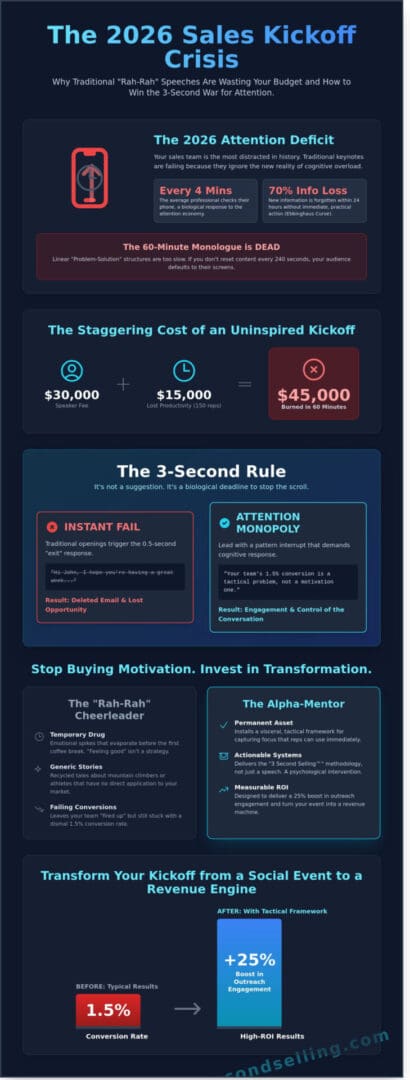
The traditional linear presentation is a relic of the past. Research into digital consumption habits indicates that by 2026, the average professional will check their phone every 4 minutes. This behavior isn’t a lack of discipline; it’s a biological response to the attention economy. When a speaker stands on stage and delivers a 60-minute monologue, they are asking for a level of cognitive commitment that no longer exists in the wild. The buyer’s brain has changed. It demands rapid-fire value, constant feedback loops, and high-intensity engagement. If your sales keynote speaker 2026 doesn’t break the fourth wall and shatter the traditional lecture format, your team will spend the hour responding to Slack messages instead of learning how to close deals.
- The 4-Minute Wall: If the content doesn’t reset every 240 seconds, the audience defaults to their screens.
- Linear Failure: Standard “Problem-Solution-Result” structures are too slow for an AI-accelerated workforce.
- Attention Monopolization: Successful speakers in 2026 don’t share attention with phones; they eliminate the desire to look at them.
The ROI of Engagement
Engagement isn’t a “nice-to-have” metric; it’s a financial imperative. Consider the math. When a team of 150 elite sales reps sits through an uninspired session, the cost is staggering. Between a $30,000 speaker fee and $15,000 in lost productivity, you’ve burned $45,000 in sixty minutes. Even worse is the “Keynote Retention” gap. The Ebbinghaus Forgetting Curve shows that humans lose 70% of new information within 24 hours if that information isn’t anchored to practical, immediate action. Your 2026 kickoff requires a strategy, not just a warm body behind a microphone. You need a speaker who installs a system, not one who just tells a story. If the team can’t use a technique the moment they walk out the door, the investment is a total loss.
Your sales force is tired of being told to “work harder” or “dream bigger.” They want to know how to win in a world that is trying to ignore them. The lights go down. The speaker walks out. The audience reaches for their pockets. This is the 2026 reality. You either hire someone who can hijack that instinct, or you accept that your kickoff is just a very expensive nap. Choose the alpha-mentor who brings front-line experience, not the theorist who hasn’t sold anything since 2015. Every second on that stage has a price tag. Make sure you’re getting what you paid for.
The 3-Second Rule: Using Behavioral Science to Stop the Scroll
The 3-Second Rule isn’t a suggestion; it’s a biological deadline. In the high-stakes environment of 2026, your prospect makes a subconscious “stay or go” decision before you finish your first sentence. This window represents the thin line between a closed deal and a deleted email. If you haven’t triggered a visceral reaction within 3 seconds, you’ve already lost. Behavioral science shows that the human brain processes images 60,000 times faster than text, and in a digital-first sales world, your “image” is the first line of your LinkedIn message or the first three words of your cold call.
David Gee brings a unique edge to this challenge. He adapted TV news anchor techniques to the corporate world because the stakes are identical. A news anchor has seconds to prevent a viewer from changing the channel; a salesperson has seconds to prevent a prospect from clicking “Archive.” Most sales teams fail because they lead with “polite” filler. They waste time with “I hope you’re having a great week.” That’s a 0.5-second exit trigger. To win in 2026, you must master the “Attention-First” approach, where every interaction begins with a pattern interrupt that demands a cognitive response.
When searching for a sales keynote speaker 2026, you need someone who understands that traditional “features and benefits” are dead. By the time your team reaches the “benefits,” the prospect’s brain has already filtered them out as noise. Success requires a shift toward neuro-linguistic triggers that bypass the logical mind and hit the survival brain. This is the foundation of 3-Second Selling. It’s about dominating the “attention monopoly” before your competitor even clears their throat.
The Neurology of Attention
Your prospect’s brain is a gatekeeper. The Reticular Activating System (RAS) filters out 99% of daily stimuli to prevent sensory overload. If your message looks, sounds, or feels like a “sales pitch,” the RAS classifies it as spam instantly. To become “signal” instead of “noise,” you must trigger dopamine through curiosity. A 2023 study on cognitive load suggests that curiosity loops are the most effective way to maintain engagement. If you don’t create a “knowledge gap” in the first 3 seconds, the brain shuts down. Your current pitch is likely being filtered because it’s predictable. Predictability is the death of sales. You need to be the unexpected variable that the brain cannot ignore.
Applying 3-Second Selling™ to Your Team
Moving your team from “polite” to “provocative” requires a total overhaul of your messaging architecture. Stop lead-ins. Start with the “Hook.” For example, instead of explaining your company’s history, start with a specific, painful data point that affects the prospect’s bottom line. This shift is critical when evaluating sales training effectiveness; if the training doesn’t result in immediate attention-capture, the ROI will be zero. High-stakes environments like 2026 demand practitioners, not theorists.
- LinkedIn: Use a “Scroll-Stopper” first sentence that challenges a common industry myth.
- Cold Calls: Use a 3-second “Permission-Hook” that acknowledges the interruption while offering immediate value.
- Emails: Subject lines must be 3 words or fewer to maximize mobile open rates.
The transition from capturing attention to building an authentic connection happens once the “threat” of a sales pitch is removed. You can see how this works in real-time by exploring the frameworks at 3secondselling.com. Once you own the first 3 seconds, you own the rest of the conversation. In 2026, the only sales keynote speaker 2026 worth booking is the one who can prove their method works before the audience even sits down. Stop being ignored. Start being the signal.
Motivation vs. Transformation: Choosing a Speaker for ROI
Stop wasting your budget on “feel-good” adrenaline shots. Most speakers deliver a 45 minute dopamine hit that evaporates before the Monday morning meeting. That’s the Inspiration Trap. If your team isn’t closing 15% more deals within 90 days, you bought a performance, not a transformation. You need an Alpha-Mentor. These are practitioners who still have skin in the game. They don’t just talk about the “Attention Economy”; they dominate it. To win in this climate, your team must master the psychological processes that consumers go through before they ever commit to a high-ticket purchase.
Choosing your sales keynote speaker 2026 requires a shift from entertainment to measurable ROI. If a speaker hasn’t sold a complex solution in the last 18 months, they’re teaching history, not strategy. Canned speeches are dead. Research from the Sales Enablement Society shows that customized training interventions result in 22% higher quota attainment compared to generic programs. Demand a curriculum that mirrors your specific market friction. If they can’t deconstruct your competitors’ weaknesses during the briefing, they won’t move the needle on stage.
While tactical dominance is one path, some leaders are pushing transformation further by rejecting purely extractive models. For those looking to build a sales culture based on sustainable, long-term relationships rather than just short-term capture, regenerative business strategists like Jannine Barron offer a different framework for growth.
The Speaker Vetting Checklist
Don’t get blinded by a flashy sizzle reel. Ask about their foundational training. For example, David Gee’s news anchor experience isn’t just a fun fact; it’s proof he can hold focus when the “Attention Economy” is fighting to distract your audience. Does the speaker offer post-keynote workshops? A one-off speech is a spark; a workshop is the engine. Ask for a 30 day follow-up plan. If they don’t have one, they aren’t interested in your results. They’re just interested in the check.
- Direct Experience: Did they lead a sales team through a recession?
- Customization: Will they interview your top 3 closers before writing the script?
- Engagement: Can they handle a room of cynical, high-performing Alphas without losing authority?
Transformation Metrics
Success isn’t measured by a standing ovation. It’s measured by the CRM. A successful sales keynote speaker 2026 should impact your cold outreach response rates by at least 10% within the first quarter. Look for an immediate shift in how your team handles executive presence. Are they talking like vendors or like partners? Transformation shows up in the language of your reps. If their emails still look like templates from 2019, the keynote failed.
Track the long-term impact on team communication. Effective speakers provide a shared vocabulary that reduces internal friction. You should see a 20% reduction in “deal stall” phases because your team finally understands the triggers that move a prospect from “maybe” to “yes.” Don’t settle for smiles. Demand a measurable surge in your conversion pipeline. If the speaker can’t guarantee a framework for these results, keep looking. Your 2026 revenue depends on a closer, not a cheerleader.
Planning Your 2026 Sales Kickoff for Maximum Impact
Most sales kickoffs are expensive naps disguised as corporate strategy. You spend six figures on a venue, fly in the regional teams, and feed them lukewarm catering while a suit drones on about “synergy.” It’s a waste of capital. In 2026, the market won’t forgive a lack of focus. If your sales keynote speaker 2026 doesn’t trigger a visceral shift in how your team handles the first three seconds of a call, you’ve failed. You need a surgical strike, not a pep talk. Stop being polite with your budget and start being profitable with your time.
Start with one objective. What is the single behavior that must change by Monday morning? A 2024 report from the Bridge Group indicates that sales cycles are lengthening by 15% across B2B sectors. Your kickoff must address this friction directly. If your objective is to shorten the cycle, every slide and every workshop must serve that god. Firms that align their kickoff goals with specific behavioral changes see a 19% higher quota attainment according to the Sales Management Association. Don’t aim for “better morale.” Aim for “30% faster objection handling” or “shorter discovery phases.” If you can’t measure it, don’t waste stage time on it.
Your agenda needs “Attention Anchors.” Human focus is a depleting resource. Research from the University of California suggests the average attention span in digital-heavy environments has dropped to 47 seconds. This isn’t about entertainment; it’s about cognitive engagement. Use high-intensity micro-challenges every 20 minutes. Force your team to role-play a pitch or rewrite a headline on the spot. If the audience isn’t leaning forward, you’re losing money. Passive listening is for podcasts; your conference should be an arena of active execution where your sales keynote speaker 2026 sets the pace for the entire year.
The Pre-Event Momentum
Stop surprising your team. Build anticipation 21 days out. Send teaser videos that challenge their current results and disrupt their comfort zones. Survey the floor to find the real bottlenecks; 68% of reps say leadership doesn’t understand their daily friction. Use these insights to customize the 3 Second Selling framework so it hits their specific pain points. When the speaker walks on stage, the team should already be hungry for the solution. Align your leadership team first so they can model the behavior before the first session begins.
The Post-Event Execution
The real work begins when the stage lights go dark. Forgetting curves are brutal; 70% of new information is lost within 24 hours if not applied immediately. You must bridge the gap with StorySelling workshops that turn theory into muscle memory. Conduct a “Messaging Audit” 14 days after the event to ensure no one is sliding back into old, lazy habits. Results don’t come from inspiration; they come from the relentless application of new habits. Evolution isn’t a suggestion; it’s a requirement for survival in the 2026 economy.
Ready to dominate the first three seconds of every deal? Audit your sales message at 3secondselling.com and stop losing leads to boredom.
David Gee: The 3 Second Selling™ Keynote Experience
Stop hiring speakers who tell stories about climbing mountains or surviving shipwrecks. Your sales team doesn’t need to learn how to hike; they need to learn how to close. David Gee is the definitive choice for a sales keynote speaker 2026 because he addresses the only currency that matters in a hyper-distracted economy: attention. He doesn’t offer generic tips. He offers a tactical blueprint for market dominance. Most speakers waste twenty minutes on an introduction. David Gee wins the room in three seconds. He expects your team to do the same.
His pedigree is unique. He moved from the high-pressure environment of the news anchor desk directly into the boardroom. In live television, you have exactly three seconds to stop a viewer from changing the channel. If you fail, you’re dead air. David translated this “broadcast-level” urgency into a sales system that works for Fortune 500 companies and agile startups alike. He brings that same intensity to the stage. Expect high energy, provocative insights, and zero fluff. He doesn’t use filler words, and he won’t let your team use them either. Every sentence is designed to trigger a visceral reaction and maintain a total attention-monopoly.
Customization isn’t just a buzzword here. For national sales meetings or leadership summits, David dismantles the specific “polite” habits that are killing your conversion rates. He researches your industry’s specific pain points to ensure the “3 Second” rule applies to your actual customers. Whether you’re selling enterprise software or medical devices, the biological reality of the human brain remains the same. People decide to listen or leave in a heartbeat. David shows your team how to stay in the room and control the narrative from the first second to the final signature.
The 3 Second Selling™ Methodology
The experience centers on three pillars: Capture, Connect, and Convert. This isn’t a linear theory; it’s a circular engine for growth. David models the rule during the presentation itself. He captures the audience instantly, connects through relentless logic, and converts skeptics into believers. Teams that abandon traditional, slow-burn selling for this methodology see immediate shifts in engagement. They stop pitching and start dominating. It’s about creating an eladási gépezet (selling machine) that functions at the speed of modern thought.
Booking for 2026
Demand for a high-impact sales keynote speaker 2026 is already surging as companies realize that 2025 strategies won’t survive the next shift in buyer psychology. David is available for both national and international engagements. The booking process includes a deep-dive discovery session to tailor the content to your specific market challenges. Don’t settle for a “motivational” speech that fades by the time the coffee gets cold. Secure a methodology that changes how your team speaks, thinks, and earns. Book David Gee for your 2026 event today and give your team the tools to win the battle for attention.
Own the Room or Lose the Year
Motivation is a commodity. Results are the only currency that matters in a hyper-distracted market. If your 2026 sales kickoff relies on 1990s-style rah-rah speeches, you’re burning your budget. Behavioral science confirms that prospects decide your fate in exactly three seconds. David Gee, a former Network TV News Anchor with global speaking experience, engineered the 3 Second Selling™ framework to weaponize this reality. He doesn’t just speak; he installs a high-speed conversion engine into your sales force. This isn’t about feeling good. It’s about winning the fight for the 3-second attention span.
Selecting your sales keynote speaker 2026 is the most critical decision you’ll make for your Q1 momentum. You can hire a storyteller, or you can hire a strategist who understands the 3-second rule from the front lines of broadcast news. Your competitors are already hunting for your clients’ attention. Will your team have the tools to seize it? Secure the expertise that turns fleeting attention into a permanent market monopoly today.
Check Availability for Your 2026 Sales Kickoff
Frequently Asked Questions
What makes a sales keynote speaker “modern” in 2026?
A modern sales keynote speaker 2026 focuses on AI-driven personalization and visceral human connection. They replace generic “hustle” talk with data-backed neuro-marketing. Since 80% of B2B sales interactions now occur in digital channels, your speaker must bridge the gap between algorithmic precision and the 3-second window of human attention. They don’t just talk; they provide a blueprint for immediate market dominance.
How much does a top-tier sales keynote speaker cost in 2026?
Top-tier speakers in 2026 command fees between $25,000 and $75,000 for a single appearance. Global authorities with proven frameworks like 3 Second Selling™ sit at the higher end of this bracket. Don’t look at the invoice; look at the ROI. If a $50,000 investment increases your $10 million pipeline conversion by just 2%, you’ve generated $200,000 in found money. It’s a simple calculation of value.
Can a 60-minute keynote really change my team’s sales performance?
Yes, if it provides a mental hard reset rather than a temporary pep talk. A 60-minute session succeeds when it delivers one punchy insight that sticks. Research shows that 70% of keynote content is forgotten within 24 hours unless it triggers a visceral reaction. David Gee focuses on one actionable shift that your team applies to their next 3-second interaction. Results follow action, not just listening.
What is the difference between a motivational speaker and a sales strategist?
Motivational speakers sell feelings; sales strategists sell systems. A motivational speaker leaves your team pumped until Tuesday morning. A strategist gives them a weapon. You need a sales keynote speaker 2026 who understands the if-then logic of a closing machine. If the speaker doesn’t talk about conversion rates, cognitive biases, or the 3-second attention rule, they’re just an expensive cheerleader you don’t need.
How do I ensure our sales kickoff doesn’t feel like a waste of time?
Eliminate the fluff and demand a no-mercy agenda. 90% of SKOs fail because they’re too long and too boring. Ensure your speaker provides a pre-event diagnostic to tailor the content to your specific market friction. If your team isn’t challenged or forced into immediate self-reflection within the first five minutes, you’ve already lost their attention. Demand a session that creates a “figuring out” moment for every rep.
Does David Gee provide virtual keynote options for 2026?
David Gee offers high-impact virtual keynotes delivered from a broadcast-quality studio. These aren’t standard Zoom calls; they’re immersive experiences designed to maintain an attention-monopoly through a screen. Virtual sessions in 2026 utilize real-time polling and 3D visual aids to ensure 100% engagement. It’s a surgical strike on your team’s bad habits, delivered anywhere in the world without the travel overhead. It’s efficient and deadly effective.
What industries benefit most from the 3 Second Selling™ framework?
High-competition sectors like SaaS, Fintech, and high-end manufacturing see the fastest results. Any industry where the attention phase of a sale lasts more than three seconds is losing money. In 2025, 65% of buyers reported feeling overwhelmed by options. The 3 Second Selling™ framework cuts through that noise. It’s essential for companies selling complex, high-ticket solutions where the first impression dictates the final contract.
How far in advance should I book a sales keynote speaker for a 2026 event?
Secure your date at least 9 to 12 months in advance. The 2026 calendar for elite speakers fills up by mid-2025, especially for Q1 sales kickoffs. Waiting until 6 months before your event means settling for whoever is left rather than who you actually need. Lock in your expert now to ensure your team starts the year with a dominant edge. Delaying this decision is a choice to accept mediocrity.