
The Virtual Keynote Speaker Crisis: How to Hijack Attention in 2026
Your last virtual event was a catastrophic waste of money. A digital ghost town. A sea of black screens and muted mics while your audience secretly cleared their inbox. You know it. You saw the pathetic engagement scores from your post-event survey and felt the dead-air silence that screamed “we’re bored.” It was a cheap knock-off of a real conference, and your budget burned for nothing.
Stop the bleeding. This article is your battle plan. We’re giving you the psychological framework to hire a virtual keynote speaker who doesn’t just present; they seize control of the screen. They create a high-energy, cinematic experience that makes multitasking impossible. You’ll learn the exact performance triggers that create visceral reactions, the non-negotiable tech that separates the pros from the PowerPoint prisoners, and the one question that guarantees your 2026 event becomes an unforgettable attention-monopoly.
Key Takeaways
- Stop hiring speakers who treat a virtual event like a recorded lecture and learn to identify a true high-stakes communication experience.
- Master the psychological trigger to bypass your audience’s ‘ignore’ filter in the first 3 seconds, a technique that dictates the success of the entire session.
- Discover the “Professionalism Threshold” for tech setups and see how simple production choices can double audience engagement and protect your brand.
- Get the checklist of 5 non-negotiable traits every high-impact virtual keynote speaker must have, and learn why broadcast experience is now more critical than a Ph.D.
Why Most Virtual Keynotes Are a Waste of Your Budget
You paid thousands for a virtual keynote and got what, exactly? A glorified webinar? A pre-recorded lecture your team watched on 2x speed? Let’s cut the crap. You’re burning money on digital events that create zero impact. By 2026, the term ‘virtual keynote’ has evolved. It’s not a passive video call. It’s a high-stakes, immersive communication experience engineered to monopolize attention and force action. Anything less is a catastrophic waste of your budget.
Most speakers fail because they fall into the ‘Passive Participation’ trap. They are accustomed to reading a room, making eye contact, and feeling the energy shift. Online, they are blind. They are broadcasting into a digital void, hoping someone on the other side is listening. The very definition of a keynote speech is to set the central theme of an event. How can a speaker set a theme when they have no idea if the audience is captivated or ordering lunch?
The cost of this failure is staggering. It’s not just the speaker’s fee you’re losing. It’s your team’s productivity. Do the math on the real cost of boredom:
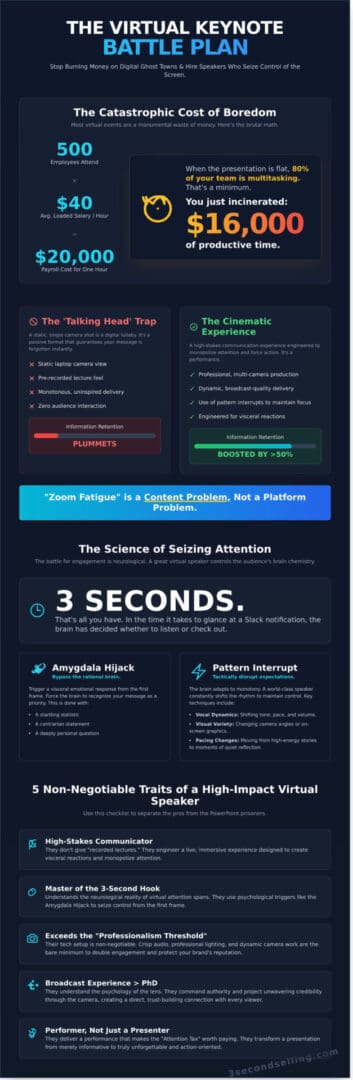
- 500 employees attend your 60-minute virtual event.
- The average loaded salary is a conservative $40 per hour.
- Your payroll cost for that single hour is $20,000.
When the presentation is a flat, uninspired monologue, a minimum of 80% of your team is multitasking. That’s a fact. So you just incinerated $16,000 of productive time for your team to check email and scroll through LinkedIn. Congratulations.
The Death of the ‘Talking Head’ Format
Your team is conditioned to click away. Research from user-experience experts at Nielsen Norman Group confirms that you have less than 20 seconds to capture attention online. A static, single-camera shot of someone talking is a digital lullaby. There’s a huge psychological gap between passively ‘watching’ a speaker and actively ‘experiencing’ a keynote. One is forgotten instantly. The other creates change. Non-interactive formats kill information retention; studies show interactive engagement can boost it by over 50%.
Zoom Fatigue is a Content Problem, Not a Platform Problem
Blaming the software is a coward’s excuse for weak content. The problem isn’t Zoom, Teams, or Webex. The problem is the message and the messenger. Every virtual attendee pays an ‘Attention Tax’-the immense cognitive load required to stay focused on a screen while battling a dozen real-world distractions. A world-class virtual keynote speaker doesn’t just present information; they deliver a performance that makes paying that tax worthwhile. They transform a presentation from merely informative to truly performative. Settling for ‘good enough’ tech and a recycled script guarantees you one thing: you’ll be just another forgotten tab in your team’s browser.
The Science of Virtual Engagement: Capturing Attention in 3 Seconds
You have three seconds. Not four. Not five. Three. In the time it takes your remote team member to glance at an incoming Slack notification, their brain has already decided whether to listen to you or to mentally check out for the next 45 minutes. This isn’t a theory; it’s a neurological reality. The battle for attention is won or lost in the opening moments. A great virtual keynote speaker doesn’t just present; they seize control of the audience’s brain chemistry from the very first frame.
This is achieved through a controlled “Amygdala Hijack.” Coined by psychologist Daniel Goleman, this describes bypassing the brain’s rational prefrontal cortex and triggering an immediate, visceral emotional response from the amygdala. Your audience’s brain is hardwired to filter out boring, predictable information. It’s a survival mechanism. To break through, you must use a provocative opening: a startling statistic, a contrarian statement, or a deeply personal question. This isn’t about cheap tricks; it’s about forcing the brain to recognize your message as a priority. Ignore this, and you’re just another talking head in a sea of browser tabs.
Look at how professional broadcasters like David Gee command authority. It’s the “Newsroom Method.” They aren’t just talking to a camera; they are projecting unwavering credibility through it. They understand the psychology of the lens. Their eyeline is locked on the camera, not the screen, creating a direct, trust-building connection with each viewer. They use a precise, controlled delivery that communicates expertise before a single data point is shown. They have mastered executive presence in a 16:9 box.
The secret weapon to maintain this control is the “Pattern Interrupt.” The human brain craves novelty but quickly adapts to a monotonous rhythm. A speaker who maintains the same tone, pace, and visual format for more than a few minutes is inviting their audience to disengage. You must tactically disrupt their expectations.
- Vocal Dynamics: Shift from a powerful, projecting voice to an intense whisper to share a “secret.”
- Visual Shock: Replace a text-heavy slide with a single, powerful, high-resolution image. Or hold up a physical object.
- Forced Interaction: Don’t just ask for questions at the end. Command an immediate response in the chat. “Type the one word that describes your biggest challenge right now. Go.”
The Behavioral Science of Remote Listening
Your team’s home office is a Colosseum of Distractions. A 2021 Statista report found 47% of remote workers struggle with it. To compete, you need to trigger dopamine, the brain’s reward chemical. Data-heavy slides don’t do this. Stories do. Research from Princeton’s Uri Hasson proved that compelling stories create “neural coupling,” making the listener’s brain activity mirror the storyteller’s. You’re not just transmitting information; you’re synchronizing minds.
Visual Cues and Executive Presence Through a Lens
Amateurs look at the faces on their screen. Pros look into the camera lens. This single change transforms your presence from a passive observer to an active leader. Frame yourself from the mid-chest up, allowing your hand gestures to add energy within the frame. Your background isn’t a decoration; it’s a credibility statement. A clean, professional setting signals authority, while a cluttered room or a glitchy virtual background erodes it instantly.
This isn’t about being “good on Zoom.” It’s about wielding the psychological tools of the digital medium to create an undeniable impact. A world-class virtual keynote speaker knows these rules are non-negotiable. If you’re ready to stop guessing and start commanding attention, it’s time to learn the science behind a 3-second opening.
Cinematic Production vs. Laptop Cameras: What Actually Drives ROI
You hired an expert. You paid the invoice. Then they appear on screen, looking like a grainy silhouette in a witness protection video. Think your team doesn’t notice? Think it doesn’t reflect on your brand’s standards? That blurry, buzzing feed is the ‘Professionalism Threshold’. The moment a speaker’s tech looks amateur, their message loses authority, and your investment starts circling the drain.
The human brain is a pattern-recognition machine built for efficiency. A static, single-camera shot from a laptop is a predictable pattern. After just a few minutes, the brain categorizes it as “low-priority input” and begins to autopilot. A multi-camera setup, switching angles every few minutes, shatters this pattern. It’s a simple neuro-hack that forces active viewing. A 2020 Microsoft study on remote work found video meeting fatigue begins setting in around the 30-minute mark due to sustained concentration. Dynamic visuals act as a reset button, keeping minds locked in.
Worse than bad video is bad audio. It’s the invisible killer of engagement. When audio is distorted or muffled, the brain works overtime just to decipher the words. This creates intense ‘cognitive load’, also known as listener fatigue. A 2018 study in the Journal of the Audio Engineering Society confirmed that audiences perceive speakers with poor audio quality as less competent, less intelligent, and less trustworthy. Your expert’s brilliant insights are dead on arrival, killed by a cheap microphone.
The Essential Tech Stack for a Pro Virtual Speaker
That $2,000 camera is a paperweight without professional lighting and sound treatment. A true professional’s budget for a virtual studio often exceeds $10,000, with less than a quarter of that spent on the camera itself. The real investment is in a multi-point lighting system and acoustic paneling. A true virtual keynote speaker has a producer managing the tech, switching cameras, and running interactive elements. Why? So the speaker can focus 100% on delivering a powerful message, not fumbling with Zoom settings. Ask about their backup plan. A pro has a bonded internet solution combining fiber and 5G. A dropped connection isn’t a technical issue; it’s a failure to prepare.
Production Value as a Credibility Multiplier
High-gloss production isn’t about vanity; it’s about authority. We are conditioned to trust what looks and sounds professional. It’s called the ‘BBC Effect’: broadcast-quality presentation subconsciously signals that the information is credible and important. This isn’t just a theory; it’s the Halo Effect in action, a cognitive bias first documented by psychologist Edward Thorndike in 1920. A speaker’s impeccable production (a positive trait) causes the audience to rate their message (another trait) more favorably. The perceived value of the advice skyrockets, driving post-event implementation and delivering actual ROI.
5 Non-Negotiable Traits of a High-Impact Virtual Speaker
Hiring the wrong speaker for a virtual event isn’t just a waste of money. It’s an act of corporate sabotage. You’re paying someone to actively drain your team’s energy and focus. The digital stage is a brutal, unforgiving arena where attention is the only currency. Most speakers are bankrupt.
Stop looking for a “speaker.” You need a digital engagement specialist. A broadcast professional. Someone built for the screen, not the stage. Here are the five traits that separate the true pros from the presenters who will get your team multitasking within three minutes.
- Broadcast Experience: Forget the stadium speakers. They play to the back row. You need someone who has spent hundreds of hours in front of a professional camera lens. They understand lighting, audio, and how to create intimacy through a piece of glass. Their energy is calibrated for the screen, not a 30,000-square-foot auditorium.
- Dynamic Messaging: A static, pre-planned speech is a death sentence online. A high-impact speaker reads the chat like a stock ticker, identifying confusion, excitement, or dissent in real-time. They can pivot their talk on a dime based on a single question, turning a monologue into a dynamic, live workshop. This skill is directly connected to mastering active listening in sales, where top performers listen for 57% of the conversation while bottom performers can’t stop talking for more than 40 seconds.
- Technical Self-Sufficiency: Your IT team has better things to do than troubleshoot a speaker’s grainy webcam. A pro arrives with a pro setup: a 4K camera, a broadcast-quality microphone, and multi-point lighting. They run their own tech. They have their own backups. They reduce your risk to zero.
- Pre-Event Strategy: Does their discovery call feel like a checklist? Run. A real virtual keynote speaker conducts a deep-dive audit of your team’s specific ‘Attention Economy’ challenges. They interview your people to understand if the enemy is Slack notifications, back-to-back Zoom fatigue, or project management chaos. The talk is then surgically customized to solve that problem.
- Action-Oriented Closures: The most dangerous moment of any virtual keynote is the end. A weak speaker finishes with a “Thank you” slide and a limp “Any questions?” An elite operator ends with a command. A “do this now” directive that forces the audience to immediately apply the lesson. No applause. Just action.
Finding a speaker who embodies these traits is key. While the technical delivery is critical, the core message must also be powerful. For example, some of the most impactful virtual presenters, like Michael Hingson, build their keynotes around timeless themes such as leadership, trust, and teamwork to create genuine connection and inspire action.
Vetting the ‘Demo Reel’ for Virtual Reality
Warning: A slick reel of a speaker commanding a live audience of 5,000 is completely irrelevant. It proves they can shout. It doesn’t prove they can connect through a screen. Demand a virtual demo reel. Look for crisp lighting, crystal-clear audio, and, most importantly, evidence of them interacting with the digital audience. Ask for a 5-minute unedited clip to see how they handle the brutal reality of a quiet chat room or a momentary tech glitch.
The Customization Litmus Test
Canned speeches die a painful, silent death in a virtual environment. Your team will tune out instantly. The test for a truly custom talk is simple: can the speaker reference specific internal projects, team members, or recent company wins in their pitch to you? If they can’t, they haven’t done the work. And here’s the ultimate audit: look at their own website. Does it grab your attention and sell you in three seconds? If their own marketing can’t hold you, they have no business teaching your team how to capture anyone else’s. Think your own marketing is sharp enough? Put it through our 3-Second Audit and see the brutal truth.
Transform Your Next Event with the 3 Second Selling™ Virtual Experience
Your last virtual event was a failure. People logged in, but they didn’t tune in. Your sales team checked their email, scrolled through social media, and treated your expensive speaker like background noise. Why? Because most speakers don’t understand they’re not just competing for attention; they’re in a bare-knuckle brawl against the entire internet. And they’re losing. Badly.
It’s time to stop gambling on presenters who treat a webcam like a confessional booth. You need a weapon. You need a system engineered to hijack focus in a world of infinite distraction. This is the 3 Second Selling™ Virtual Experience, a keynote designed from the ground up to conquer the screen and turn passive viewers into active participants.
Leading this charge is David Gee. Before “virtual” was a buzzword, David spent over a decade as a TV news anchor, mastering the art of ‘The Lens.’ He learned how to command attention through a piece of glass when the slightest dip in energy meant the viewer reached for the remote. That unforgiving environment was the perfect forge for the ultimate virtual keynote speaker. The result is a high-octane, cinematic production with zero fluff. Just pure, actionable strategy delivered with the urgency of a breaking news story.
The David Gee Difference: From Newsroom to Keynote
Broadcast journalism is the ultimate training ground for virtual engagement. It teaches you to be concise, impactful, and relentlessly focused on the audience. David leverages principles of behavioral science and his unique ‘StorySelling’ methodology to create pattern interrupts that make it neurologically impossible for your team to ‘tab away.’ He doesn’t just present information; he engineers an experience that makes your message un-ignorable and unforgettable.
Booking Your 2026 Virtual Experience
This isn’t a one-size-fits-all canned speech. Every engagement is a custom-built asset designed to solve your specific sales challenges. The process is rigorous: it starts with a deep-dive discovery call, moves to a full messaging audit of your current sales process, and culminates in a bespoke virtual production. We don’t do boring. We build sales machines.
- 60-Minute Virtual Keynotes: A concentrated blast of energy and strategy to ignite your sales conference or team meeting.
- Half-Day Virtual Workshops: An immersive, hands-on session where your team rebuilds their pitch using the 3 Second Selling™ framework.
- Executive Coaching: One-on-one training for leaders who need to command attention and drive action through the screen.
Stop wasting your budget on forgettable webinars. It’s time to arm your team with a competitive edge that actually works in the digital trenches. It’s time to own their attention. Secure David Gee for Your Next Virtual Event.
Your Next Virtual Event: Hijack Attention or Lose It Forever
The digital stage is a battlefield for attention, and your budget is the casualty of every boring presentation. Forget what you thought you knew. Success in 2026 isn’t about better slides; it’s about hijacking the human brain in the first three seconds. It’s about cinematic delivery that makes a laptop camera look like a relic. The choice of your next virtual keynote speaker is the single decision that separates a game-changing event from an expensive sedative.
Stop gambling with your audience’s time. It’s time to deploy a proven weapon. David Gee, a former Network TV News Anchor and the creator of the 3 Second Selling™ framework, doesn’t just present; he produces a broadcast-quality experience from his multi-cam studio. He engineers engagement. Are you ready to see the difference? Book David Gee: Hijack Your Team’s Attention Now
The power to captivate is now in your hands. Use it.
Frequently Asked Questions
What is a virtual keynote speaker?
A virtual keynote speaker is a professional who delivers a high-impact presentation to a remote audience through digital platforms like Zoom or Webex. Forget a simple webinar. This is a broadcast-quality performance designed to ignite action and change mindsets, not just share information. They are masters of the digital stage, tasked with one job: grabbing and holding your team’s attention to deliver a powerful, memorable message that gets results.
How much does a virtual keynote speaker cost in 2026?
Virtual keynote speaker fees in 2026 are projected to range from $10,000 to $75,000, with top-tier experts commanding six figures. The real question isn’t about cost; it’s about ROI. Are you paying for a 60-minute distraction or a catalyst for a 12-month sales surge? The fee buys you expertise, engagement, and measurable outcomes. Cheaping out here is the most expensive mistake you can make, guaranteeing a bored audience and zero impact.
How do you keep a virtual audience engaged for an hour?
You don’t. You re-capture their attention every 3-5 minutes. An hour-long monologue is a death sentence for engagement. The pros use a relentless barrage of pattern interrupts: live polls, targeted Q&A, breakout rooms, and high-impact visuals. It’s about creating a dynamic, two-way experience, not a passive lecture. The goal is a state of ‘can’t-look-away’ focus, turning passive viewers into active participants who are hungry for the next point.
What technology does a virtual speaker need?
The bare minimum for a pro is a broadcast-quality studio setup. This means a 4K DSLR camera, not a webcam. It means a condenser microphone like a Shure SM7B, not a headset. It demands professional three-point lighting and a hardwired ethernet connection with minimum 50 Mbps upload speeds. Anything less is an amateurish signal to your audience that your message, and their time, isn’t worth the investment. Technology isn’t an accessory; it’s the entire stage.
Can a virtual keynote be as effective as an in-person one?
It can be *more* effective. An in-person event relies on charisma; a virtual event relies on a system. With tools like real-time polling and chat analytics, a skilled virtual keynote speaker can generate more measurable engagement than someone on a physical stage. According to a 2021 Markletic report, 80% of virtual event organizers reach a wider audience. It eliminates travel costs, expands reach, and delivers a focused message directly to your team’s workspace. It’s not a substitute; it’s an upgrade.
How do I choose the right virtual speaker for a sales meeting?
Look for scars, not just a slick presentation. The right speaker for a sales team has a documented history of increasing revenue, not just collecting speaking fees. Scrutinize their demo reel: is it a high-energy virtual delivery or a boring webcam chat? Ask for specific, metric-backed case studies. You need a strategist who delivers a tactical sales playbook your team can execute the moment the call ends. Anything else is just expensive entertainment.
What is the ‘3-second rule’ in virtual speaking?
The ‘3-second rule’ is the unforgiving law of the digital world: you have three seconds to prove your message is more important than anything else competing for your audience’s attention. It’s the window to hook them with a powerful question, a shocking statistic, or a bold promise. If you fail to seize their focus in that initial moment, you’ve lost. They will mentally check out, open a new tab, and your entire message will evaporate into the digital ether.
Do virtual speakers provide recordings of their sessions?
Yes, but it’s a contractual point, not a given. A recording transforms a one-time event into a permanent training asset, so its value is negotiated upfront. Standard agreements often include a recording for internal use for a limited time, such as 90 days. Broader rights for marketing or long-term access typically come with an additional licensing fee. Never assume. Always get the usage rights specified clearly in the contract to maximize your investment.