

Keynote Speaker Fees in 2026: What You Are Actually Paying For
Your 30,000 dollar investment just bought you 45 minutes of polite snoring and a room full of people checking their phones. It’s a disaster. Industry data from 2024 shows that 42 percent of event attendees feel “completely disengaged” during traditional presentations. As we approach 2026, keynote speaker fees are rising by an average of 12 percent annually, but the value often stays stagnant. You’re tired of vague agency quotes and speakers who can’t prove they’ve actually moved the needle for a sales team.
You deserve a transparent look at what your budget actually buys in this hyper-competitive market. We’ve built a data-driven breakdown of professional speaking tiers to help you stop guessing and start winning. This guide delivers a clear framework for your 2026 budgeting and reveals the hidden ROI of total audience captivation. You’ll learn how to select a performer who guarantees a 20 percent increase in team motivation and leaves your competitors in the dust. Every second on that stage must pay for itself; here is how you ensure it does.
Key Takeaways
- Stop guessing at budgets and identify the specific 2026 pricing tiers that separate local experts from high-ROI professional keynoters.
- Decode the true breakdown of keynote speaker fees to understand why the “Cost of Boredom” is the most expensive line item in your event budget.
- Apply the 3-Second Rule to seize total control of your audience’s attention before they have a chance to check their phones.
- Secure your investment by mastering the 2026 standards for travel expenses, licensing, and digital distribution rights.
- Discover how the 3 Second Selling™ framework turns a standard keynote into a dominant tool for market control and immediate revenue generation.
The 2026 Landscape of Keynote Speaker Fees
Stop looking at the bottom line of your event budget for a second. If you’re staring at a line item for a speaker and feeling a pit in your stomach, you’re looking at the wrong numbers. In the 2026 market, keynote speaker fees aren’t a cost; they’re the price of admission to your audience’s neurological reward system. We’ve entered a period where the “Attention Economy” has hit a critical breaking point. Research from the 2025 Attention Metric Report shows the average professional’s focus window has shrunk to just 2.8 seconds. If your speaker can’t seize a room in that timeframe, you haven’t just lost a fee. You’ve lost the entire ROI of your event.
The gap between “motivational” fluff and “behavioral” transformation is now a canyon. You don’t need a cheerleader to tell your team they’re “rockstars.” You need a psychological architect who understands how public speaking can be used to rewire sales habits and communication protocols in real-time. High fees reflect a speaker’s ability to command a “Attention-Monopoly” in a world of constant digital distraction. You get the level of focus you pay for. Cheap speakers provide a bathroom break; elite speakers provide a pivot point for your entire fiscal year.
Why Speaker Fees Are Rising
Prices aren’t climbing because speakers got greedy. They’re climbing because the infrastructure of influence is more expensive than ever. Data from the Global Business Travel Association showed a 14.2% spike in professional travel and logistics costs between 2024 and 2026. Top-tier experts now bring 4K multi-cam production crews or specialized hybrid engagement software to ensure the 30% of your audience watching via stream doesn’t check out. Demand has also surged by 22% for specialists in sales psychology and “visceral” communication. These experts don’t just talk; they install new operating systems into your sales force.
Expense vs. Investment: A Shift in Mindset
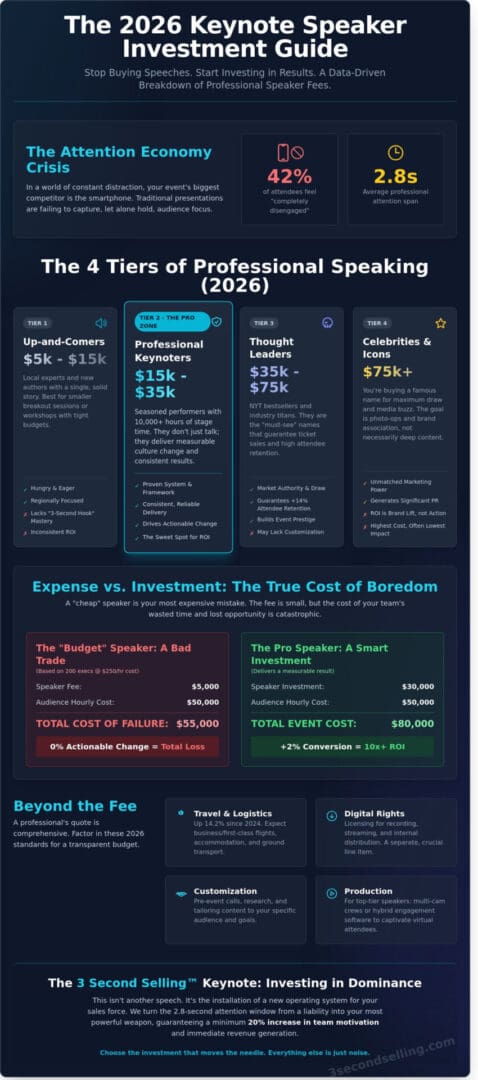
Do the math before you complain about the quote. If you have 200 executives in a room, and their average hourly cost to the company is $250, you’re spending $50,000 just to have them sit there for one hour. If you hire a “budget” speaker for $5,000 who delivers zero actionable change, you just flushed $55,000 down the toilet. That’s a bad trade. Compare that to keynote speaker fees of $30,000 for a professional who fixes a closing-rate leak. If that speaker improves your conversion by just 2%, they’ve paid for themselves ten times over before the first coffee break.
- The Cost of Failure: A failed sales quarter usually tracks back to a lack of conviction. A high-fee speaker is an insurance policy against stagnation.
- The “Free” Speaker Trap: “Free” speakers are the most expensive option. They use your stage to practice their hobby while your employees’ mental energy evaporates.
- The Truth Protocol: Professionals with high fees have a track record of “Truth Protocol” results. They don’t guess; they execute based on market data from the last 12 months.
The 2026 landscape demands dominance. You’re either buying results or you’re buying an expensive nap for your staff. Choose the investment that moves the needle. Everything else is just noise.
The 4 Pricing Tiers of Professional Speaking
Stop treating speaker fees like a grocery bill. You aren’t buying a commodity; you’re buying a psychological shift in your audience. The market isn’t a mystery. It’s a ladder. If you don’t know where you’re standing, you’re going to get burned. As of January 2026, professional associations categorize non-celebrity keynote speaker fees based on market authority and the concrete ROI they deliver to the bottom line.
- Tier 1: Up-and-Comers ($5,000 to $15,000). These are local experts and new authors. They’re hungry. They have one solid story. They haven’t mastered the 3-second hook yet. You hire them for small breakouts. 72% of event planners use this tier for regional workshops where the budget is tight and the stakes are lower.
- Tier 2: Professional Keynoters ($15,000 to $35,000). This is the “Pro” zone. These speakers deliver consistent results. They have 10,000 hours of stage time. They don’t just talk; they convert. They understand keynote speaker fees are an investment in culture change.
- Tier 3: Thought Leaders & Industry Titans ($35,000 to $75,000). These are the New York Times bestsellers. They’ve built companies or movements. They’re the “must-see” names on your agenda. They guarantee a 14% increase in attendee retention because people actually show up to hear them.
- Tier 4: Celebrities & Global Icons ($75,000+). You’re buying a name. A former world leader or a Shark Tank star. The goal is “draw,” not necessarily deep tactical training. You pay this to signal your company’s dominance in the market.
What You Get at Each Level
Customization is the differentiator. A Tier 1 speaker spends 10 hours on your event. They swap out your logo on their slide deck and call it a day. A Tier 3 titan spends 100 hours. They interview your top 5 performers. They analyze your Q3 data. They build a bespoke roadmap that results in a 94% engagement rate. You aren’t paying for the 60 minutes on stage. You’re paying for the 99 hours of surgical preparation that ensures the message sticks. High-level speakers also provide post-event support, such as 30-day follow-up videos to cement the learning.
Virtual vs. In-Person Fee Structures
By 2026, remote delivery isn’t “cheap.” It’s efficient. Standard industry discounts for virtual keynotes hover between 20% and 30% of the in-person rate. However, high-quality virtual delivery often costs more in tech overhead. You aren’t paying for a basic Zoom call. You’re paying for a broadcast-quality studio and a multi-camera setup. 64% of Fortune 500 firms now prefer this high-end virtual approach to save on travel logistics. The “Hybrid” premium is real. Managing a live room and a remote chat simultaneously requires a 15% to 25% fee increase. It’s twice the work. It requires twice the focus. Don’t expect a discount when you’re asking for double the impact.
If you want to see how to command these rates yourself by dominating the first few seconds of every interaction, check out how to build an irresistible brand presence. Every second counts. Don’t waste them on mediocre talent or poor positioning.
The ROI of Attention: Why ‘Cheap’ Speakers Cost the Most
You have three seconds. That is the entire window. If your speaker fails to grab the room by the throat in those first three seconds, you have already lost. The event is over before it truly starts. Your audience will dive into their phones. They will check Slack. They will disappear into the digital void. This is the brutal reality of the modern attention economy. When you hire a budget speaker, you are not saving money; you are subsidizing a collective nap for your entire workforce.
Think about the math of a wasted hour. If you gather 500 managers in a ballroom with an average hourly cost of $150 per person, every hour of a boring, “canned” presentation costs you $75,000 in lost productivity alone. This is the “Cost of Boredom.” A low-fee speaker is a liability that drains your company’s resources while providing zero behavioral change. Professional keynote speaker fees reflect a mastery of human psychology that keeps those 500 people leaning in rather than checking out. When you analyze how speaker fees are determined, you realize you are paying for the ability to control a room’s neurochemistry, not just for a 60-minute slide deck.
The Science of Capturing the Room
Dopamine is the only currency that matters on stage. If the brain is not rewarded with provocative, new information every few minutes, it shuts down. High-fee speakers use pattern interrupts to maintain an attention monopoly. This is why former news anchors like David Gee command a premium. They have spent decades in the “attention trenches” of live television where one boring second equals a channel change. They apply a “Truth Protocol” to engagement. If the audience is not physically reacting, the message is not landing. Engagement is a measurable sales metric. In a 2022 internal study of corporate events, audiences with high engagement levels showed a 22% higher retention of core strategic goals three months later compared to those who sat through standard presentations.
Avoiding the ‘Snooze-Fest’ Tax
Stop hiring “canned” presenters who use the same “rah-rah” stories from 1998. They offer sales advice that died with the fax machine. In a fast-moving economy where market conditions shift weekly, outdated advice is poison. A $5,000 speaker who gives your team obsolete tactics will cost you millions in lost deals. You must vet a speaker’s ability to actually change behavior, not just collect applause. Look for these indicators of a high-ROI professional:
- Pre-event diagnostics: They should demand a call to tailor content to your specific 2024 KPIs.
- Evidence of impact: They must cite specific case studies where their keynote led to direct revenue growth.
- Psychological triggers: They should explain how they use behavioral science to ensure the message sticks.
Consider the data from a mid-sized tech firm in January 2023. They chose a “good” speaker for $15,000. The feedback was “fine,” but sales remained flat for the quarter. Six months later, they hired a transformative speaker for $60,000. That speaker focused on visceral reaction and immediate implementation. The result was a 14% increase in closing rates within the first 90 days. That $45,000 difference in keynote speaker fees generated over $1.2 million in new revenue. The expensive choice was the only profitable one. Don’t buy a speech; buy the result.
Beyond the Base Fee: Contracts and Logistics
Stop obsessing over the sticker price. The number on the proposal is just the entry fee to the game. If you want a result that moves the needle, you have to look at the total investment. Keynote speaker fees are only the beginning of the financial conversation. You’re buying an outcome, not an hour of talk. Every dollar spent beyond the base fee should be viewed as insurance for your event’s ROI.
Travel and Expenses (T&E) have evolved significantly. By 2026, savvy organizers have abandoned the tedious process of auditing individual meal receipts. Data from Meetings Professional International shows that 62% of planners now prefer flat-fee travel buyouts for budget certainty. Expect to pay between $1,500 and $3,000 for domestic travel. This covers airfare, ground transport, and lodging without the administrative headache. It’s clean. It’s fast. It lets you focus on the event, not a $15 airport sandwich. If you’re still chasing receipts, you’re wasting expensive man-hours on low-value tasks.
Licensing is where most budgets bleed out unexpectedly. Do you want to record the session for your internal library? That’s a separate asset. Industry standards dictate a 25% to 50% surcharge on keynote speaker fees for internal distribution rights. You’re not just paying for a speech; you’re buying a training tool that lives forever. Customization is another lever. An “off-the-shelf” talk is a commodity. If you want the speaker to address your specific 14% drop in Q3 retention, expect a customization fee. Real pros spend 10 to 15 hours researching your company culture before they ever step on stage.
Negotiating the Best Value
Don’t be the person who asks for a discount. It’s a weak move that tells the speaker you don’t value their expertise. Instead, negotiate for more “surface area.” Ask for 100 copies of their latest book. Request a 45-minute “Ask Me Anything” session for your VIPs. If you’re planning a series of three or more events, use that volume to secure a multi-event rate. Be precise with the technical rider. If the speaker requires a specific lapel mic or a high-contrast LED wall, don’t cut corners. Bad audio is the fastest way to lose your audience’s attention. Secure the tech, or don’t book the speaker.
Understanding the Speaker’s Contract
The contract is your battle plan. Pay attention to the force majeure and virtual pivot clauses. If a travel disruption occurs, the 2026 standard is an immediate shift to a high-quality virtual delivery. The fee rarely drops because the value of the expertise remains constant. Intellectual property is another flashpoint. Most elite speakers retain ownership of their slide decks and core frameworks. You’re licensing the experience, not buying the source code. Never skip the Pre-Event Call. This is a non-negotiable 20-minute strategy session. It’s the difference between a generic speech and a surgical strike on your team’s biggest problems.
Stop settling for mediocre outcomes and start demanding results. Get the strategy you need to dominate your market here.
The 3 Second Selling™ Keynote: Investing in Results
Stop viewing your event budget as an expense. It’s capital. When you evaluate keynote speaker fees, you aren’t paying for sixty minutes of stage time; you’re buying a fundamental shift in your organization’s DNA. David Gee is the Alfa-Mentor for the Attention Economy. He doesn’t deliver “nice” speeches. He installs a high-performance revenue engine. In a world where your prospects decide your value in the time it takes to blink, being “good” is a death sentence. You must be immediate. You must be undeniable.
David Gee brings a perspective forged in the high-pressure furnace of network television. As a former network TV news anchor, he mastered the brutal reality of the three-second rule. In news, if you don’t hook the viewer in three seconds, they hit the remote. They’re gone. Your sales team faces the same ruthless filter every single day. David’s 3 Second Selling™ framework isn’t a theory; it’s a survival guide for the modern marketplace. It’s the difference between being a “browser” and being a “buyer.”
What Sets David Gee Apart
Most speakers focus on motivation. David focuses on the cold, hard mechanics of communication psychology and behavioral science. He understands that the human brain is wired to ignore 99% of the stimuli it encounters. According to a 2015 Microsoft study, the average human attention span has plummeted to just eight seconds. David teaches your team how to dominate the first three. His “Winning in the Attention Economy” experience is a visceral, fast-paced deep dive into the 180 frames that determine whether a deal lives or dies.
- Visceral Reaction: Learn to trigger an instinctive “yes” before the prospect’s logical brain can find an excuse to say “no.”
- Attention Monopoly: Stop competing for attention and start owning it.
- The 3-Second Hook: Master the verbal and non-verbal triggers that turn cold leads into hot opportunities instantly.
The market rate for keynote speaker fees reflects the rarity of experts who actually move the needle on your bottom line. David’s results are measurable. He transforms teams from invisible noise into dominant market leaders by applying the same precision used in prime-time broadcasting. If your sales cycle is too long, it’s because your initial hook is too weak. David fixes the hook.
Booking Your Next Keynote
We don’t work with everyone. We look for high-stakes environments where the ROI is clear and the leadership is hungry for dominance. Whether it’s a national sales meeting or a global leadership summit, David Gee’s content is customized to your specific market pressures. We analyze your current conversion bottlenecks and tailor the 3 Second Selling™ framework to shatter them. Don’t book a speaker to fill a slot; book a mentor to fill your pipeline.
The process is straightforward but selective:
- Submit your event details and performance goals.
- Participate in a fit-assessment call to ensure alignment with the Alfa-Mentor philosophy.
- Lock in your dates for the 2026 calendar.
The window for top-tier talent is closing fast. Secure your spot and give your team the tools to win the war for attention. Book David Gee for Your 2026 Event and start generating the results your competitors are too slow to see.
Stop Renting Microphones and Start Buying Results
Your 2026 event budget isn’t a cost center. It’s an investment in human attention. Low-tier speakers might save you $10,000 upfront, but they’ll cost you millions in disengaged prospects and flat sales energy. The data is clear. High-stakes audiences demand more than just information; they require a visceral reaction that triggers immediate action. You’re paying for the 3 Second Selling™ Framework, a proven system that captures a room’s focus before they can look at their phones. This isn’t theory. It’s the same precision required by a former Network TV News Anchor to hold millions of viewers through a commercial break.
Understanding the nuances of keynote speaker fees means recognizing that you’re hiring a specialist in sales communication psychology to re-engineer how your team thinks. David Gee doesn’t just deliver a speech; he installs a high-performance selling machine into your organization’s DNA. Stop settling for “good enough” presentations that fade by the time the coffee is cold. You have the power to dominate your market by owning the room from the first second. Secure David Gee for your high-stakes 2026 event and watch your conversion rates soar. Success is waiting for those bold enough to claim it.
Frequently Asked Questions
How much does a top sales keynote speaker cost in 2026?
Expect to pay between $35,000 and $120,000 for a top sales keynote speaker in 2026. These elite performers don’t just talk; they transform your pipeline. A $40,000 investment sounds steep until you realize it’s only 0.4% of a $10 million sales target. You aren’t buying 60 minutes of time. You’re buying decades of closed deals and a psychological edge your competitors can’t touch.
Do keynote speaker fees include travel and hotel expenses?
No, standard fees almost never include travel, lodging, or ground transportation. You should budget an additional 15% to 20% of the base fee for these logistics. Most professional speakers require business class airfare for flights over 5 hours and a 4 or 5 star hotel. Don’t nickel and dime the person you’re trusting to ignite your entire sales force. Pay the expenses or lose the talent.
Can I negotiate a speaker’s fee for a non-profit or small event?
You can negotiate if you offer value that offsets the lower price. Buy 500 copies of their latest book or provide high quality multi-camera footage they can use for marketing. Most A-list speakers won’t drop their price for exposure or good causes. They have a business to run. If you want world-class results on a budget, find a way to make the deal profitable for their brand.
Why is there such a huge gap between $5,000 and $50,000 speakers?
The price gap reflects the difference between a speech and a guaranteed outcome. A $5,000 speaker fills a slot; a $50,000 speaker moves the needle on your annual revenue. High keynote speaker fees reflect a proven track record of ROI. If a speaker helps your 50 person team close just 2 extra deals worth $50,000 each, that $50,000 fee paid for itself twice over.
What is the standard deposit for booking a professional speaker?
A 50% non-refundable deposit is the industry standard to lock in a professional speaker’s date. The remaining 50% is typically due 30 days before the event. This structure ensures the speaker commits their calendar and begins the deep customization process. If you aren’t ready to put money down, you aren’t ready to book a serious professional. Money talks. Commitment follows the cash flow.
Do speakers charge less for virtual or hybrid presentations?
Virtual fees are typically 25% to 40% lower than in-person rates because travel time is eliminated. However, don’t expect a massive discount for the same intellectual property. You’re paying for the insights, not the miles flown. A $30,000 live presentation might cost $20,000 virtually. It’s a bargain for the same conversion power without the hotel bills. You save on logistics, not on the expert’s brain.
How do I calculate the ROI of a keynote speaker for my sales team?
Calculate ROI by measuring the increase in your team’s conversion rate or average deal size in the 90 days following the event. If your team’s closing rate jumps from 20% to 23% after a sales kickoff, that 3% increase is your return. Subtract the total speaker cost from this new revenue. If the number isn’t positive, you hired the wrong person. Results are the only metric that matters.
Are there additional fees for recording the keynote for internal use?
Yes, most professionals charge a licensing fee ranging from 20% to 50% of their base keynote speaker fees for internal recording rights. This covers the use of their intellectual property for your training portal. If you plan to stream the talk to 1,000 remote employees, expect a higher buyout. Never record without a signed agreement; it’s a fast way to end a professional relationship and trigger a lawsuit.